

TL;DR
- DeepCura is best for practices that need EHR (electronic health record) integration and broader clinical AI, because it connects with major EHRs and includes AI scribing and billing.
- Allo is best for small teams that prioritize transparency around HIPAA. It's the only tool in our comparison with a BAA (Business Associate Agreement) that explicitly covers every feature, including AI.
- Freed is worth considering for practices looking for a healthcare-specific AI receptionist without changing their phone system, because it works with an existing line.
- Quo and Nextiva round out the list: Quo pairs a full phone system with a shared inbox and built-in team chat (but their BAA doesn't cover the AI features), and Nextiva fits practices already running their phone system.
Introduction
Your waiting room is full. Your receptionist is checking in patients, and the phone starts ringing again. Each one of those missed calls might be a patient who ends up calling the practice down the street.
An AI receptionist for medical offices can pick up calls for you 24/7. It handles the routine phone stuff (like booking and rescheduling appointments, taking messages, and answering basic questions) so your staff can focus on things that need a human.
But a medical office isn't a regular small business. The stakes are higher. There's patient information to protect and urgent calls that need to reach a person (not an AI) immediately. That means you can't just pick any AI receptionist on the market.
This article compares five AI receptionists used by medical offices so you can see which one actually fits your practice. I looked past the marketing pages to check what each company documents about HIPAA compliance, pricing, and EHR integrations.
Before we get into it, a quick disclosure: Allo is our own product. To keep this article fair, I tested where I could, stuck to published pricing and HIPAA/BAA documentation, and leaned on third-party reviews (G2, Trustpilot).
Best AI receptionists for medical practices at a glance
| Tool | Best for | Yearly Price | G2 rating | Trade-offs |
|---|---|---|---|---|
| Allo | HIPAA transparency and small teams: BAA covers every feature, including the AI receptionist | $32 per user/month (annual) + $32/month for the AI receptionist seat + $50 BAA flat fee = $114/month | 4.7/5 | No native EHR integration, and BAA costs extra |
| Quo | Team collaboration: built-in team chat and a shared inbox for the whole staff | $23 per user/month + $25/month for 40 Sona calls ($0.75/call after that) | 4.7/5 | Costs rise with call volume, and BAA doesn't fully cover AI |
| Freed | Keeping your existing phone system: healthcare-specific AI receptionist | $149/month for 250 calls | 5/5 (only 13 reviews) | AI receptionist is still in beta, and BAA scope is unclear |
| DeepCura | EHR integration: native connections to major EHRs, plus broader clinical AI | $129 per provider/month or $999/year | 4.6/5 | More expensive if you only need a receptionist, and BAA details are unclear |
| Nextiva | Existing Nextiva customers: AI receptionist is integrated with a broader communication system | $23 per user/month + $99 per 100 interactions = ~$122/month | 4.5/5 | Usage-based pricing makes monthly costs unpredictable, and BAA scope is unclear |
How I compared these five AI receptionists
To keep this fair, since our own tool is on the list, I ran every candidate through three filters before including it:
- The AI receptionist has to hold a real conversation and handle appointment requests, not just take a message or route the caller through a menu. Every tool below can do that.
- It has to be a good fit for a small medical practice. If the tool needs an IT department or a procurement process to get running, it's not on this list.
- The price has to be checkable. That can be a flat monthly rate, a per-interaction charge, or a per-outcome fee. What it can't be is "contact sales" with nothing published anywhere.
That leaves five tools: Allo, Quo, Freed, DeepCura, and Nextiva. Here's what each one actually costs and what you get for it.
Allo, best AI receptionist for small teams and HIPAA transparency
Allo launched in 2024, and more than 20,000 businesses use it today. On G2 it holds a 4.7/5 rating across 209 reviews, with 4.1/5 on Trustpilot.
What Allo does
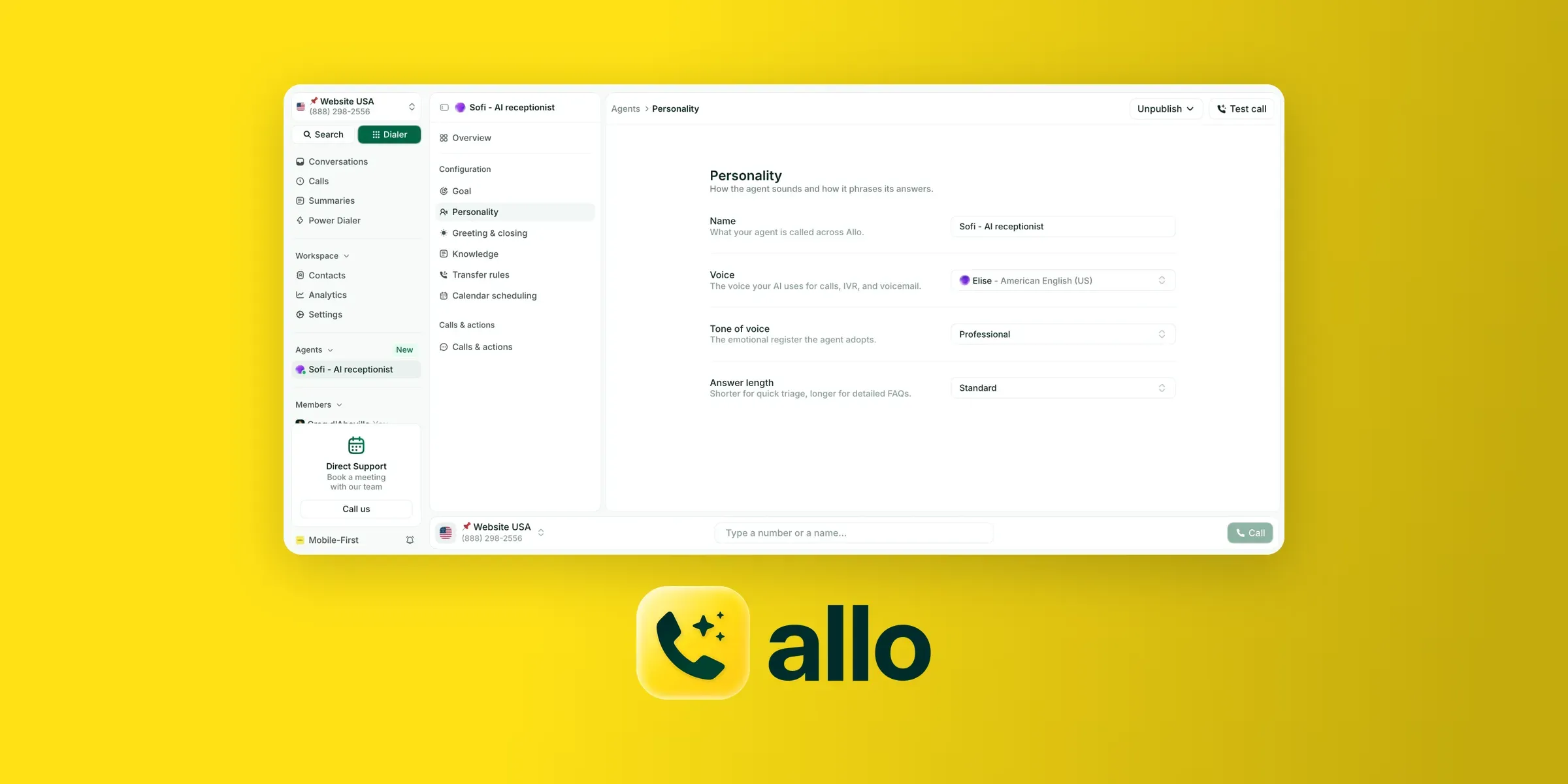
Allo is a full phone system with an AI receptionist built in. Here's what it can do:
- Answers calls 24/7, books and reschedules appointments, and texts back the calls it can't take live.
- Transcribes and summarizes calls, and transfers them to a human when needed.
- Speaks English, Spanish, and French, so a bilingual patient base doesn't need a second line.
- Holds call memory, referencing a patient's earlier calls and texts instead of starting cold every time.
- Can be trained on the practice's own documents, website, and FAQs.
- Lets you customize its voice, tone, and greeting, so a family practice and a specialty clinic don't have to sound the same.
Allo pricing
The $18/month Solo plan is Allo's entry price, but it doesn’t include HIPAA compliance.
You need the Business plan, which costs $32 per user/month when billed annually (or $45 monthly). The AI receptionist requires an extra seat: $32/month, paid yearly.
The HIPAA BAA adds $50/month per workspace. For one user, that brings the total to $114/month when billed annually.
Important note: Allo is the only tool here where the AI receptionist has no usage limit or per-call cost. A slow month and a busy month cost the same, which isn't true of any of the other four.
Healthcare features
Allo is the only tool in this comparison where the BAA explicitly covers every feature, including the AI receptionist.
Freed and DeepCura say "HIPAA-compliant, BAA provided," but none of them publish what's actually in it, so ask before you sign.
Beyond the BAA, here's what Allo looks like day to day:
- Books into the calendar your practice already uses: Google Calendar, Outlook, Calendly, or Cal.com.
- Reaches a CRM (customer relationship management system) or EHR only through Zapier, Make, webhooks, or the API (there's no native connection).
- Never gives medical advice.
- Lets you configure exactly when an urgent call gets routed to a human.
The catch
Allo has no native EHR integration, and the BAA is a separate $50/month line item on top of the Business plan.
This is a strong fit for a small practice whose real problem is missed and after-hours calls.
But it's the wrong tool for one that needs appointments written straight into an EHR.
Demo video of Allo
Quo, best for team collaboration on a full phone system
Quo is the rebranded OpenPhone. It launched in Canada in 2018, and Sona, its AI agent, arrived in 2025. On G2 the product holds a strong 4.7/5 across 3,374 reviews.
What Quo does
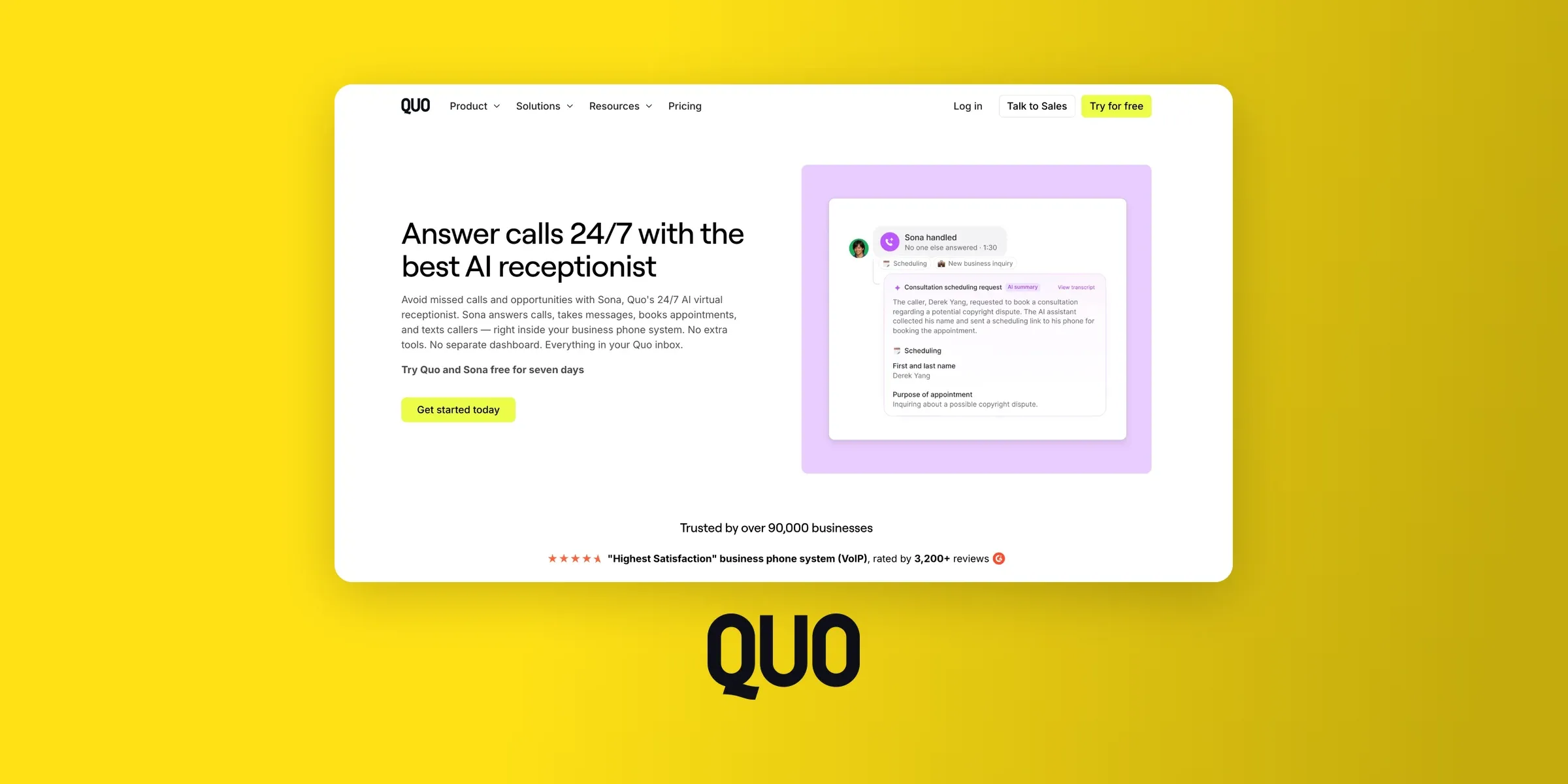
Quo is a full phone system built around team collaboration, with Sona handling answering and call summaries. Here's what it can do:
- Answers calls with Sona, and sends automatic SMS with links, forms, or directions during the call.
- Speaks English, Spanish, and French.
- Gives your team a shared inbox with built-in team chat, so more than one person can see and respond to a patient conversation.
- Lets you customize office hours, service descriptions, a detailed FAQ, and team member introductions.
- Generates call summaries and transcripts for every call Sona handles.
Quo pricing
The Business plan costs $33/month ($23 annually) per user.
Sona comes included on every plan with 10 free calls a month. Beyond that, you either buy a bigger credit tier or turn on per-call overages.
Credit tiers run from $25/month for 40 calls up to $199/month for 600. Overages run $0.45 to $1.00 a call, depending on your tier.
Healthcare features
A BAA is available on the Business and Scale plans, with no separate add-on fee. That's an advantage over Allo's $50/month BAA fee.
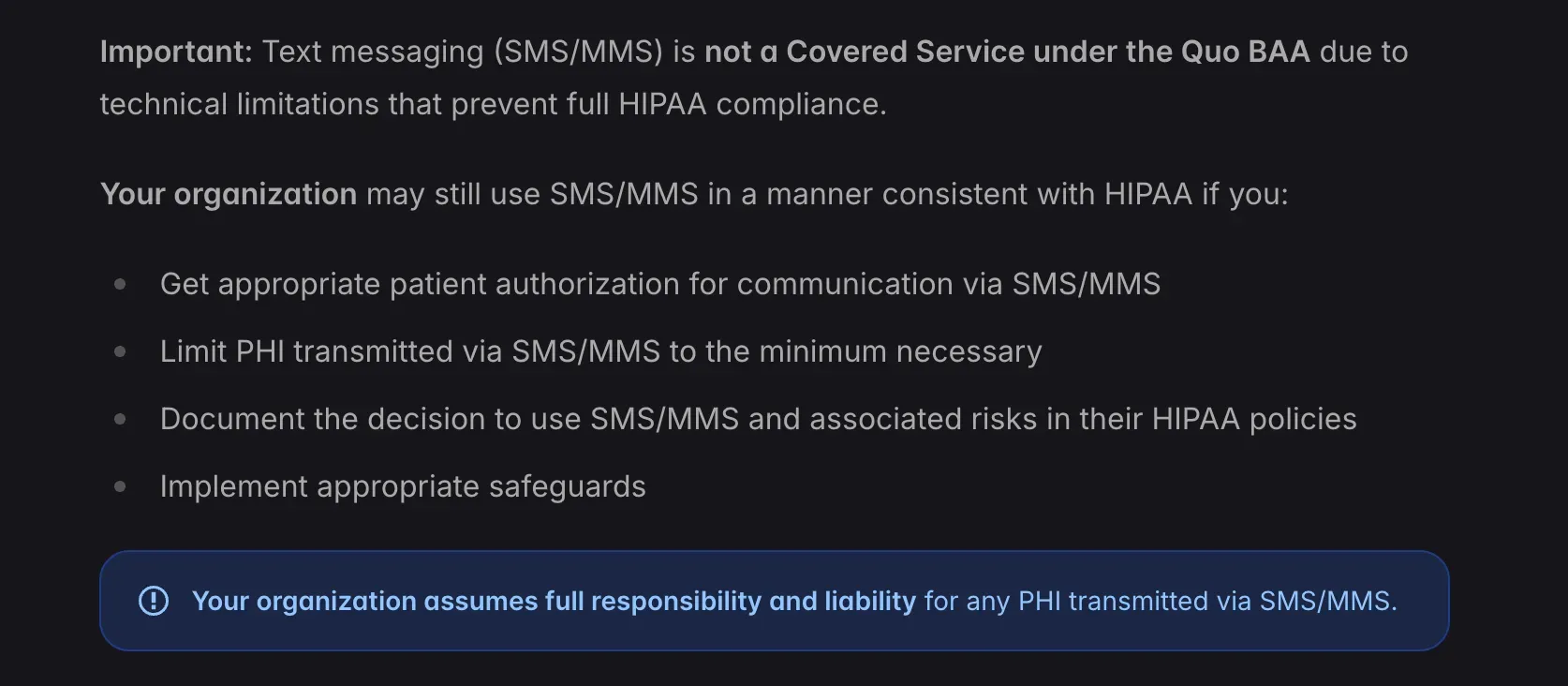
However, Quo's own HIPAA documentation draws a line worth paying attention to:
- SMS (text messages) and MMS (multimedia messages) aren't covered by the BAA.
- Third-party integrations aren't covered by the BAA.
- The practice, and not Quo, is responsible for patient notice, authorization, and documenting the decision to use AI features.
The catch
Sona only includes 10 free calls a month, and it pauses by default once those run out. When that happens, everything gets sent to voicemail instead of billing you automatically.
Keeping it running costs more. You either need a bigger credit tier, or you'll pay per-call overages.
For a busy front desk, 10 calls won't last a day, so this needs configuring before go-live, not after.
The BAA is also narrower than Allo's: AI features carry conditions rather than a flat guarantee.
It's worth reading Quo's actual HIPAA page before assuming "BAA available" means the same thing it does elsewhere.
Demo video of Quo
Freed, best for a healthcare-specific AI receptionist on your existing phone line
Freed launched in 2023 as an AI medical scribe for clinicians, founded by Erez Druk, before expanding into the front desk.
Its receptionist product, Front Desk, only launched in April 2026, and it's already used across more than 1,300 clinics. On G2 it holds a 5/5 rating, though from just 13 reviews so far.
What Freed does
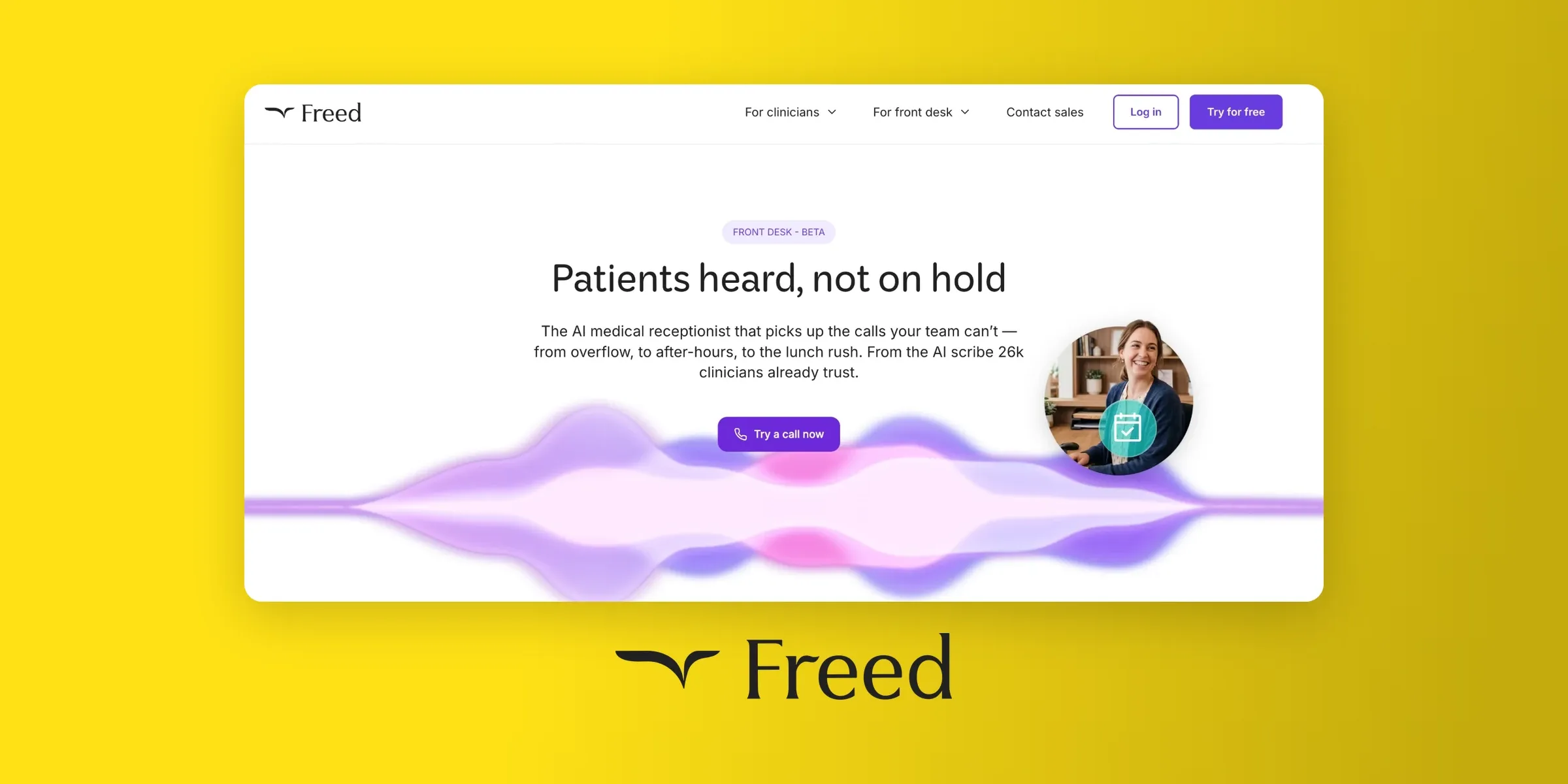
Freed is a standalone AI receptionist that sits on top of a practice's existing phone line. It's built specifically for healthcare. Here's what it can do:
- Answers calls 24/7 and handles intake and triage: new patient information, visit reasons, refill requests, and referral inquiries.
- Speaks more than 90 languages, the widest range of any tool in this comparison.
- Sends two-way SMS to patients and routes structured call summaries to a shared staff inbox.
- Does warm transfers to a live person during business hours, and doesn't send calls to voicemail.
- Cuts hold times by 90%, according to Freed's own figures.
Freed pricing
$149/month per 250-call block, for a single site with one or two numbers. Spam and dead-air calls aren't billed, and it does warm transfers during business hours.
Healthcare features
Freed offers HIPAA compliance and claims they don’t store patient recordings.
However, we weren’t able to check which plan tier the BAA requires, or whether it covers the AI features specifically versus just calling.
Its Advanced plan, built for practices on Athena, eClinicalWorks, or PracticeFusion, is still in development and waitlist-only.
The catch
Front Desk itself is only a few months old and still in beta, though Freed's scribe product has been around since 2023.
It's worth asking what their support actually looks like before putting a patient line on it.
It also has no EHR integration yet. Freed's press materials list that as a roadmap item, with no firm date attached.
And Freed doesn't publish which plan tier its BAA requires, or whether it covers the AI receptionist specifically versus just the scribe.
Demo video of Freed
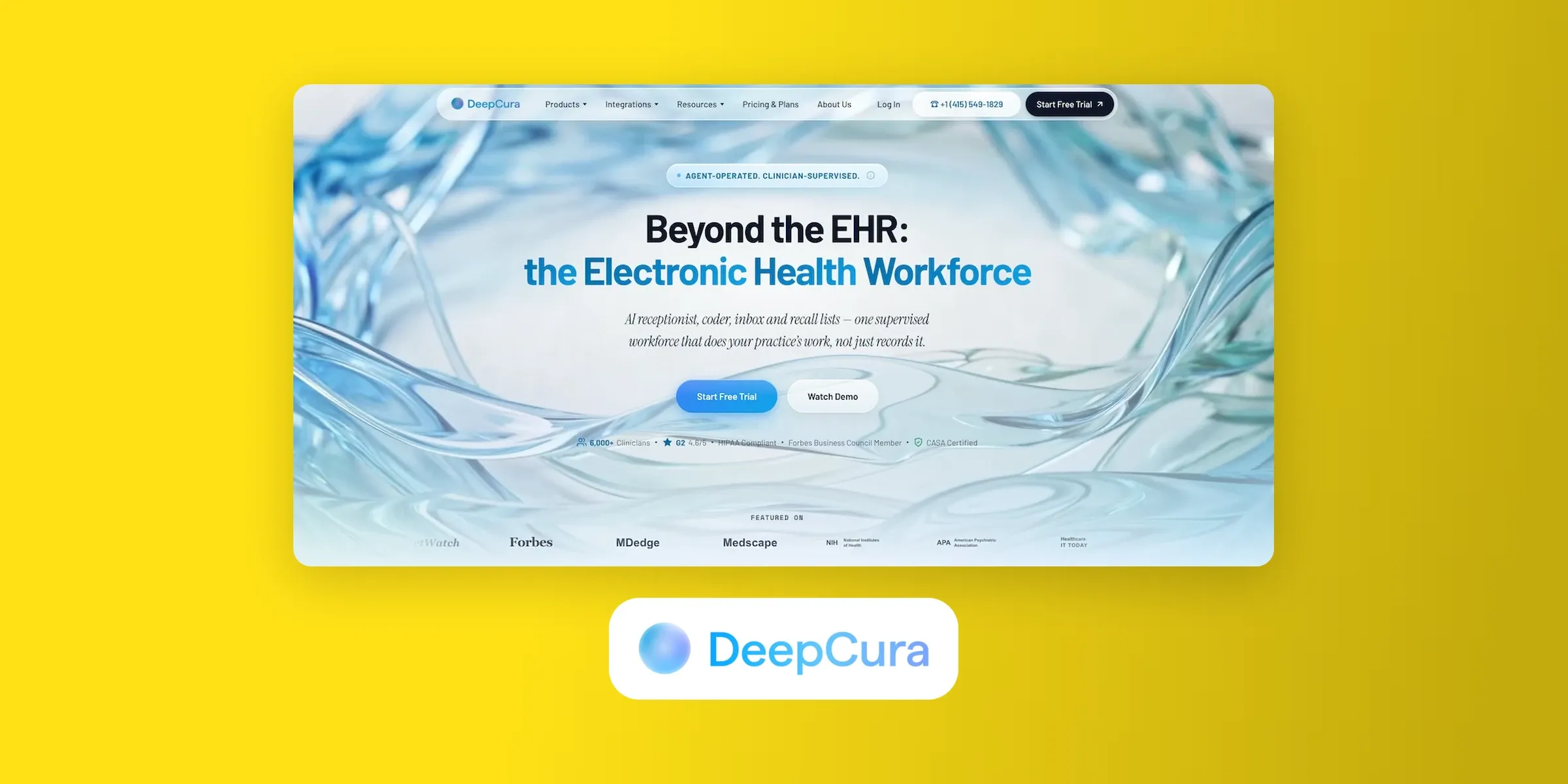
DeepCura, best for EHR integration and broader clinical AI
DeepCura was built by a single technical founder, Fernando Cowan.
The platform now serves more than 6,000 clinicians across over 50 specialties, with a 4.6/5 rating on G2 from 13 reviews.
What DeepCura does
DeepCura bundles six AI agents into one platform: scribing, the receptionist, billing, patient intake, fax management, and a clinical chat assistant that can answer questions using a patient's own uploaded records.
The receptionist is one part of the platform, not the whole product. Here's what it can do:
- Handles calls across a dozen pre-built categories, including scheduling, triage, prescription refills, referrals, insurance verification, and new patient intake.
- Warm-transfers calls to a live staffer with a contextual introduction, instead of a cold handoff.
- Generates an AI summary and email notification for every call it handles.
DeepCura pricing
$129/month per provider (a licensed clinician, like a doctor or nurse practitioner, not every staff member using the tool), or $999/year (about $83/month).
That covers every agent, but usage is credit-based: 1,000 credits a month shared across scribing, receptionist calls, billing, intake, and fax.
Volume discounts start at three seats.
Healthcare features
DeepCura is HIPAA-compliant with a BAA provided. But there's no published detail on what the BAA covers, or which plan tier it requires.
DeepCura connects directly to EHRs such as Epic, eClinicalWorks, Athena, AdvancedMD, and Veradigm.
It can add and update appointments directly in the practice's system.
Beyond scheduling, it also handles prior authorization requests and runs E&M (Evaluation and Management) billing integrity checks, administrative work that's specific to a medical practice.
The catch
At $129/month, DeepCura costs more than a receptionist-only competitor if all you actually need is call answering.
The price buys the whole platform, scribe and billing included, whether you use those parts or not.
DeepCura also doesn't publish what its BAA covers or which plan tier requires it.
And because the receptionist shares its credit pool with the scribe and every other agent, a heavy documentation month can eat into the calls it can answer.
Nextiva (XBert), best AI receptionist for practices already on Nextiva
Nextiva has sold business phone systems since 2008.
The company says more than 100,000 businesses use its platform, though that figure covers Nextiva's phone system broadly, not their AI receptionist specifically.
Nextiva scores 4.6/5 on both G2 (3,600+ reviews) and Trustpilot.
What XBert does
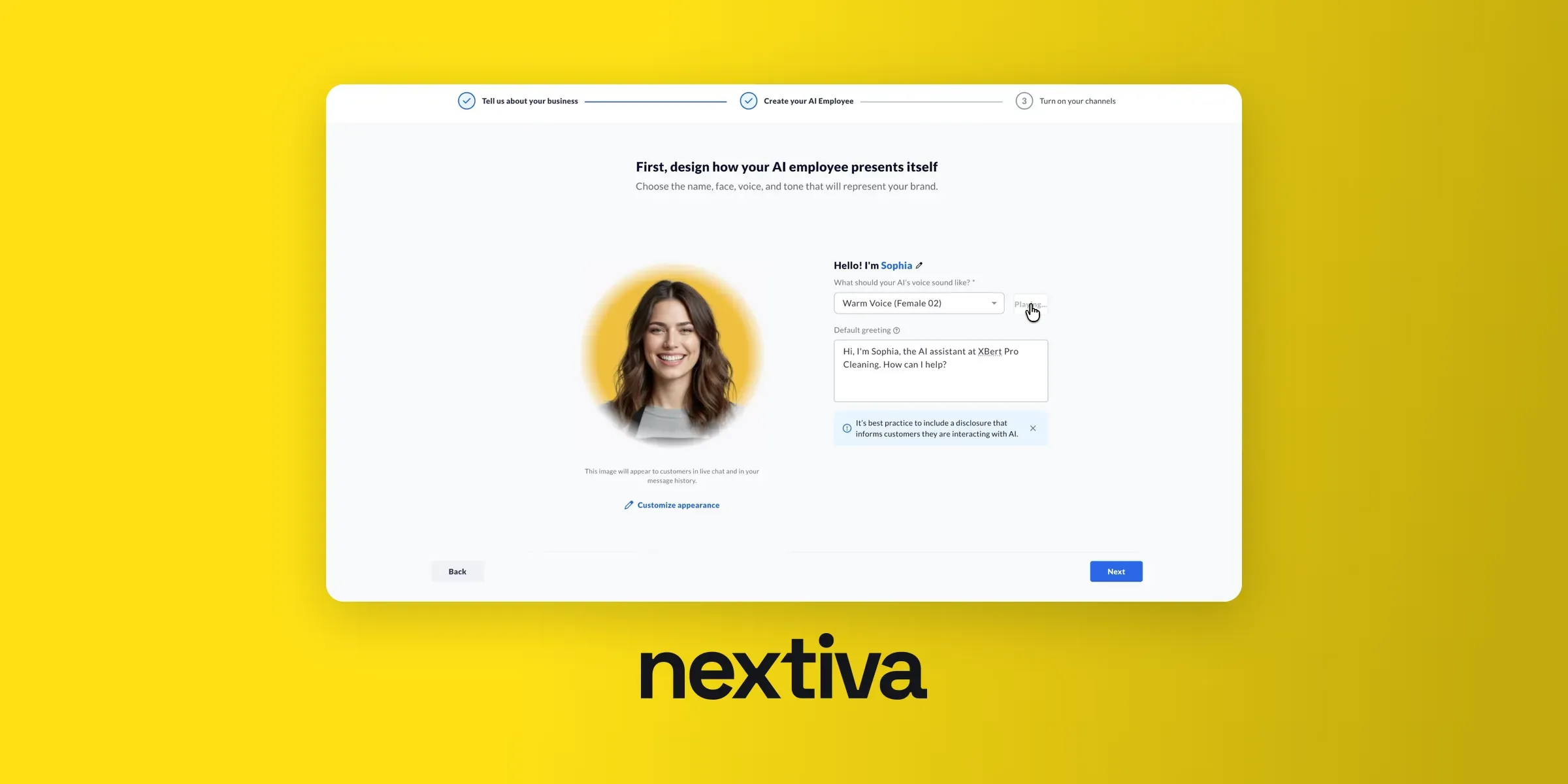
XBert is Nextiva's AI receptionist, sold as an add-on to its phone and contact-center platform. Here's what it can do:
- Answers calls, texts, and web chat from one system, with conversation context carried across all three.
- Keeps a running record of each caller, called the Customer Journal, so someone who calls one day and texts the next doesn't have to repeat themselves.
- Books appointments through real-time calendar integration, sends confirmation texts, and follows up automatically to cut down on no-shows.
- Captures lead and patient information and can trigger workflows in a connected CRM.
Nextiva pricing
XBert costs $99/month per 100 interactions, then $0.99 per interaction after, on top of a Nextiva phone plan.
The cheapest base plan, Core, costs $23 per user/month, billed annually. Combined, that puts a realistic starting cost around $122/month.
Healthcare features
Nextiva says it will sign a BAA "for covered services," per its own healthcare FAQ. What's unclear is which services that covers.
Nextiva doesn't publish a plan tier, and its richer healthcare features (like patient verification and direct Epic integration) appear tied to its enterprise Contact Center product, showcased with hospital-system customers rather than small practices.
It's worth confirming directly whether the standalone XBert add-on this section prices even qualifies for a BAA on its own.
The catch
XBert's pricing is usage-based, so a busier month will cost you more with no ceiling, unlike Allo's or DeepCura's flat monthly rate.
Nextiva doesn't publish which plan tier its BAA applies to.
It also doesn't confirm whether the EHR integration on its healthcare page is included in the standalone XBert add-on or requires a different product.
My recommendation: ask for the BAA in writing and confirm exactly what it covers before signing.
Demo video of Nextiva
What to consider when choosing an AI receptionist for a medical practice
You've seen what each of these five tools costs and claims to do. Price and a feature list only tell part of the story, though.
How well any of them works for your practice will come down to two structural choices: standalone versus full phone system, and healthcare-specific versus general-purpose tool.
Before you sign anything, you should also ask the vendor what "HIPAA compliant" covers, and what "scheduling" means for that vendor.
Standalone vs. full phone system
That's the first decision you'll need to make when choosing an AI receptionist for a medical office.
A standalone AI receptionist sits on top of the phone line you already have.
Freed and DeepCura both work this way. You forward your calls to them, and they answer the ones your front desk can't take.
The upside is that you can keep your existing setup. There's no need to port a number or switch carriers.
The tradeoff is that you'll be paying for your phone service and the AI separately. That's two vendors, two bills, and the AI will only answer the calls you send its way.
A full phone system, on the other hand, bundles your business number and the AI receptionist into one product.
Allo, Quo, and Nextiva are examples of that all-in-one system.
It's a simpler setup where you get one vendor, one bill, and one number. Routing, texting, and voicemail all connect to the same AI, since it's native to the system instead of bolted on.
The tradeoff is that you're switching phone providers and porting your number.
But remember to consider the total cost when you're doing the math. A full phone system can seem more expensive, but it often beats paying for two separate tools.
Healthcare-specific vs. general-purpose tools
The second decision: does the tool specialize in healthcare, or is it built for any small business?
Healthcare-specific tools, like Freed and DeepCura, are built around how a medical office runs. That can bring advantages depending on what your practice needs, like an EHR integration.
General-purpose tools, like Allo, Quo, and Nextiva, aren't built for medicine specifically. They tend to be more flexible and often cheaper.
They can still do the job well, though, if your main problem is calls going unanswered.
Neither category is automatically the right answer. A practice that needs deep EHR write-back should weigh that against a tool that's flexible but healthcare-agnostic.
Meanwhile, a practice whose real problem is missed and after-hours calls may not need a healthcare-specific tool at all.
What does "HIPAA compliant" actually mean?
Every vendor on this list makes some form of HIPAA compliance claim. But that phrase alone doesn't explain much.
There's no HIPAA certification body, so any company can put it on a website without a third party ever checking.
What actually matters is what's in writing. Before you sign up with any AI receptionist, ask the vendor:
- Will you sign a BAA, and at what plan tier?
- Does the BAA cover the AI features specifically, or just core calling?
- Are recordings and transcripts stored, and for how long?
- Is patient data (PHI, or Protected Health Information) used to train models?
- Which subprocessors touch the audio?
A vendor that answers all five questions clearly is telling you something real. A vendor that just repeats they are "HIPAA compliant" isn't.
And the answers vary more than you'd expect. Even tools that look similar on the surface differ on important aspects.
For example, whether the BAA covers AI features or just phone calls, and how much compliance work falls on your practice.
Don't assume "appointment scheduling" always means the same thing
Every tool on this list claims to handle appointment scheduling. That claim covers two very different things.
The basic version: the AI checks a calendar and tells the caller what's open. It's useful, but pretty limited.
The advanced version: the AI books the appointment correctly, which means knowing the provider, the visit type, and how long it runs.
It needs to be able to tell a new patient from a returning one, since they tend to follow different rules. It should be able to handle a reschedule or a cancellation without double-booking someone else.
For some practices, it also means writing the appointment straight into the EHR, not just a calendar.
Most vendors don't spell out which version they mean. A feature list that says "scheduling" could be either one.
Will a medical receptionist be replaced by AI?
The honest answer is no, it won't.
An AI receptionist is good at repetitive tasks. That includes answering calls after hours or when the line is busy, routing calls, answering simple questions, and handling routine scheduling.
It's not good at the rest of the job. Complex patient situations need a person who knows the practice. Urgent calls need a judgment call. And some patients will always want a human on the line, no matter how good the AI sounds.
Think of the AI system as backup that catches what your receptionist can't.
Which AI receptionist should you choose for your practice?
The choice comes down to what your practice actually needs.
If EHR integration matters, like writing appointments straight into Athena or eClinicalWorks, DeepCura is the clearest fit on this list.
If you want to keep your current phone line and just add AI on top, a standalone tool like Freed is the simpler path.
But if your problem is mainly calls going unanswered rather than a workflow tied to an EHR, a full phone system with AI built in, like Allo, Quo, or Nextiva, is worth a look.
None of these is the right answer for every medical office. The tool that fits depends on where your calls are actually falling through: after hours, during check-in, or somewhere in your EHR workflow that a phone system was never going to solve.
Frequently asked questions about AI receptionists for medical offices
Are AI receptionists HIPAA compliant?
It depends on the vendor and what's actually in the contract. There's no HIPAA certification body, so a vendor calling their product "HIPAA compliant" isn't backed by anyone checking. What matters is whether they'll sign a BAA, and at what plan tier (some vendors gate it behind a pricier plan). It's also worth asking if the BAA covers the AI features specifically or just core calling, what happens to recordings and transcripts, and whether patient data is ever used to train models. A vendor with a clear compliance process should be able to answer those questions.
How much does an AI receptionist for a medical office cost?
Prices vary because these tools use different pricing models. Quo's plan starts at $23 a month, but that only covers 10 AI calls, and even its $25 add-on tier only adds 40 more, so a busy practice may need to go higher. If you want a flat rate with no usage cap, Allo is the lowest at $114, followed by DeepCura at $129 and Freed at $149. Before signing, pull your typical monthly call count and run it against each vendor's tiers or per-interaction rate. The number on the pricing page is rarely what you'll actually pay.
Is an AI receptionist a good idea?
For most small practices, yes, especially for after-hours and overflow calls that would otherwise go to voicemail. It won't replace your front desk, and it shouldn't handle complex patient situations or urgent calls on its own. But for catching the calls your staff can't get to, it's a solid fit, as long as the vendor is upfront about HIPAA and what the BAA actually covers.
Can an AI receptionist schedule medical appointments?
Some can, but "scheduling" means different things across vendors. A basic version checks a calendar and reports what's open. A more advanced version can book the right provider and visit type, tell new patients from returning ones, and handle reschedules without double-booking.
Can an AI receptionist integrate with an EHR?
A few do, with direct write-back into systems like Athena or eClinicalWorks. Others can connect only to a calendar or CRM, and reach an EHR through something like Zapier or an API, if at all. It's worth confirming this information before you buy, especially if your practice depends on EHR sync.
Can an AI receptionist handle emergency calls?
The AI shouldn't be making that call on its own. A well-configured setup routes anything urgent straight to a person, with clear rules for what counts as urgent. The AI's job is to recognize when it's out of its depth, never to make a clinical judgment.
Can I create my own AI medical receptionist?
You can, but it's not that easy. An AI receptionist needs to handle calls reliably, follow your practice's rules, and connect to your scheduling system, all while protecting patient information. HIPAA adds another layer. Any provider touching patient data, including the ones powering your AI, needs to sign a BAA, which means chasing down agreements yourself. For most small practices, using an existing AI receptionist built for healthcare is much easier than building one from scratch.
Do patients know they're talking to AI?
This varies by practice and by state. Some states have started requiring disclosure when a caller is speaking with AI. But beyond the legal question, being upfront about AI use tends to build more trust with patients than hiding it.