At Allo, we build an AI-first phone system, so we spend our days thinking about how AI talks to customers. A good share of our own customers sell online, and they keep asking the same question: which AI should we put on our store?
So we went and looked.
Important note: in this article, we only look at AI shopping assistants that help shoppers choose on your own store. We compare five of them on what they actually do before purchase, what they cost for a realistic store, and what their users say about them.
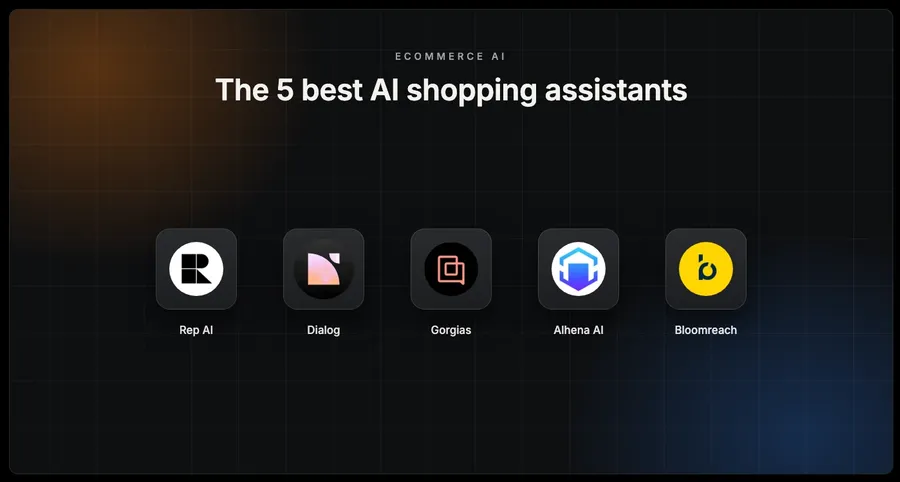
The best AI shopping assistants at a glance
Prices below are what a Shopify store with 50,000 monthly visitors and 1,000 AI conversations a month pays, on annual billing where it's offered. They are not entry prices; each tool's pricing section lists those.
| Tool | Recommended to | Monthly cost for a 50K-visitor store | G2 rating |
|---|---|---|---|
| Rep AI | Shopify brands fighting cart abandonment | $294/mo. 50K sessions tier, yearly billing (treating sessions as visitors) | 4.9/5 (62 reviews) |
| Dialog | Brands with complex, technical or premium products | $399/mo. Standard plan, up to 50K unique visitors, no conversation cap | 5/5 (10 reviews) |
| Gorgias | Brands already running Gorgias for support | ~$990/mo. Basic plan ($90) + 1,000 AI interactions × $0.90 | 4.6/5 (562 reviews) |
| Alhena AI | Beauty and fashion brands wanting try-on and fit tools | $999/mo. Scale plan, 1,200 conversations included, yearly billing | 4.9/5 (36 reviews) |
| Bloomreach | Enterprise retailers already buying the Bloomreach suite | Custom. No public pricing; Clarity is sold inside the suite | 4.6/5 (769 reviews, whole suite) |
How we chose the tools
- Where the candidates came from. We started with G2 and completed our list with the Shopify marketplace.
- The must-have. Each tool had to run an AI assistant on the merchant's own store that answers product questions and recommends from the live catalog before purchase. A support bot that can also upsell didn't qualify on its own.
- What we compared. Ratings on G2 and the Shopify App Store, number of reviews, the most recent reviews themselves, public pricing, and named customers using the tool today.
- Live references, above everything else. This category changes every quarter. So for each tool, we checked that the customers it names are actually running it on their site right now. We also picked the solutions that had the most prominent references.
- What we left out, and why. Shop.app, Perplexity Shopping, ChatGPT shopping and Amazon Rufus are useful for consumers, but they don't run on your store. Intercom Fin, eesel AI, Tidio, Zendesk and Ada are capable AI agents, but they're built for support first.
1. Rep AI
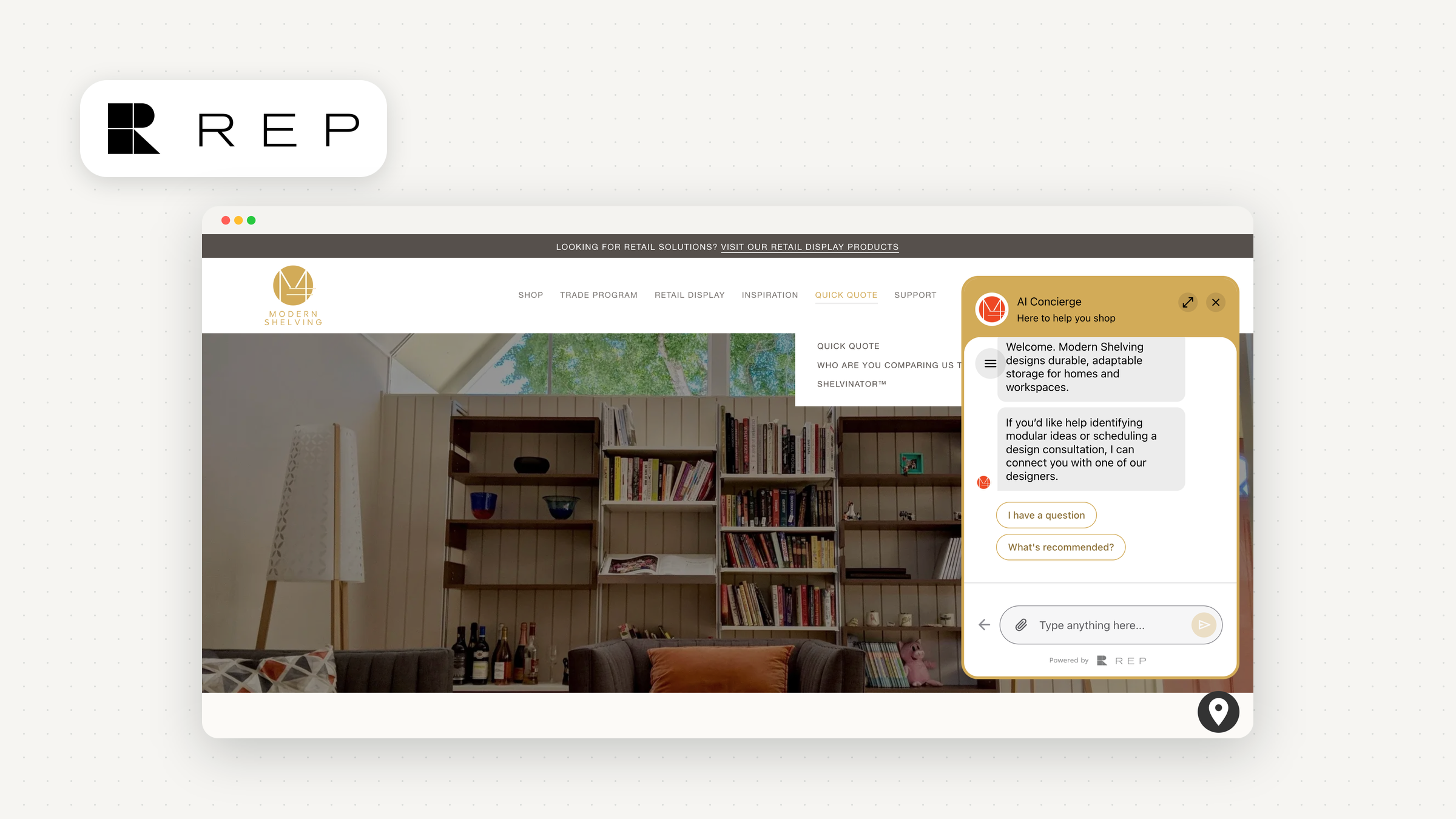
Rep AI is the best value if your problem is shoppers leaving rather than shoppers asking hard questions. It watches what visitors do on the site and starts the conversation itself when it spots hesitation, which makes it a strong cart-abandonment tool. It's also the cheapest tool here at our reference volume.
Who it works best for
Mid-market Shopify brands in the US with enough traffic to make behavioral triggers worthwhile. Its customers include AMIRI, 7 For All Mankind, OLLY and Goal Zero, across fashion, health and outdoor gear. If your shoppers mostly know what they want and just need a nudge, Rep AI fits. If they need an expert to explain the product, the tools further down go deeper.
Top features
- Proactive AI sales concierge. It reads behavioral signals (product comparisons, repeat browsing, exit intent) and opens a conversation at that moment.
- Recommendations, upsells and cross-sells inside the chat, based on what the shopper said.
- An optional AI support agent that resolves routine questions and hands off to a human.
- Multi-channel: on-site chat, email, Instagram and Facebook DMs, and WhatsApp.
- Customizable design and tone, in several languages.
Integrations
Rep AI runs on Shopify, Salesforce Commerce Cloud and WooCommerce. For human handoff, it connects to Gorgias, Zendesk and Help Scout.
Pricing
Rep AI prices the AI sales agent on monthly sessions, with a 30-day free trial:
- 3,000 sessions: $12/mo ($10/mo yearly)
- 10,000 sessions: $104/mo ($83/mo yearly)
- 25,000 sessions: $209/mo ($167/mo yearly)
- 50,000 sessions: $368/mo ($294/mo yearly)
- 80,000 sessions: $578/mo ($462/mo yearly)
The AI support agent costs extra ($149/mo at 50,000 sessions, or $462/mo for both agents). One thing to watch: sessions run higher than unique visitors, so a 50,000-visitor store can land in the 80,000-session tier. Pricing on traffic also means a flash sale or a viral week raises the bill.
Pros and cons
Pros
- Proactive engagement on behavioral signals.
- The cheapest tool in this comparison at our reference volume.
- Hands-on customer success: "Having a personal CSM manage our account has really made us feel important and like our success is their top priority."
- Reviewers report measurable lifts, such as "7-10%+ increase in sales from their chat service."
- Large review base: 4.7/5 from 111 reviews on the Shopify App Store and 4.9/5 from 62 on G2.
Cons
- Answers need supervision: "You also need to review the AI's answers to customer queries as sometimes it will answer incorrectly."
- The back end is technical: "the backend UX is very technical and difficult to navigate."
- Slow to reach full speed: "It takes a good month to get everything up and running."
- Recommendations come from the conversation rather than a deep reading of the catalog, so it's less suited to technical products.
Video
2. Dialog
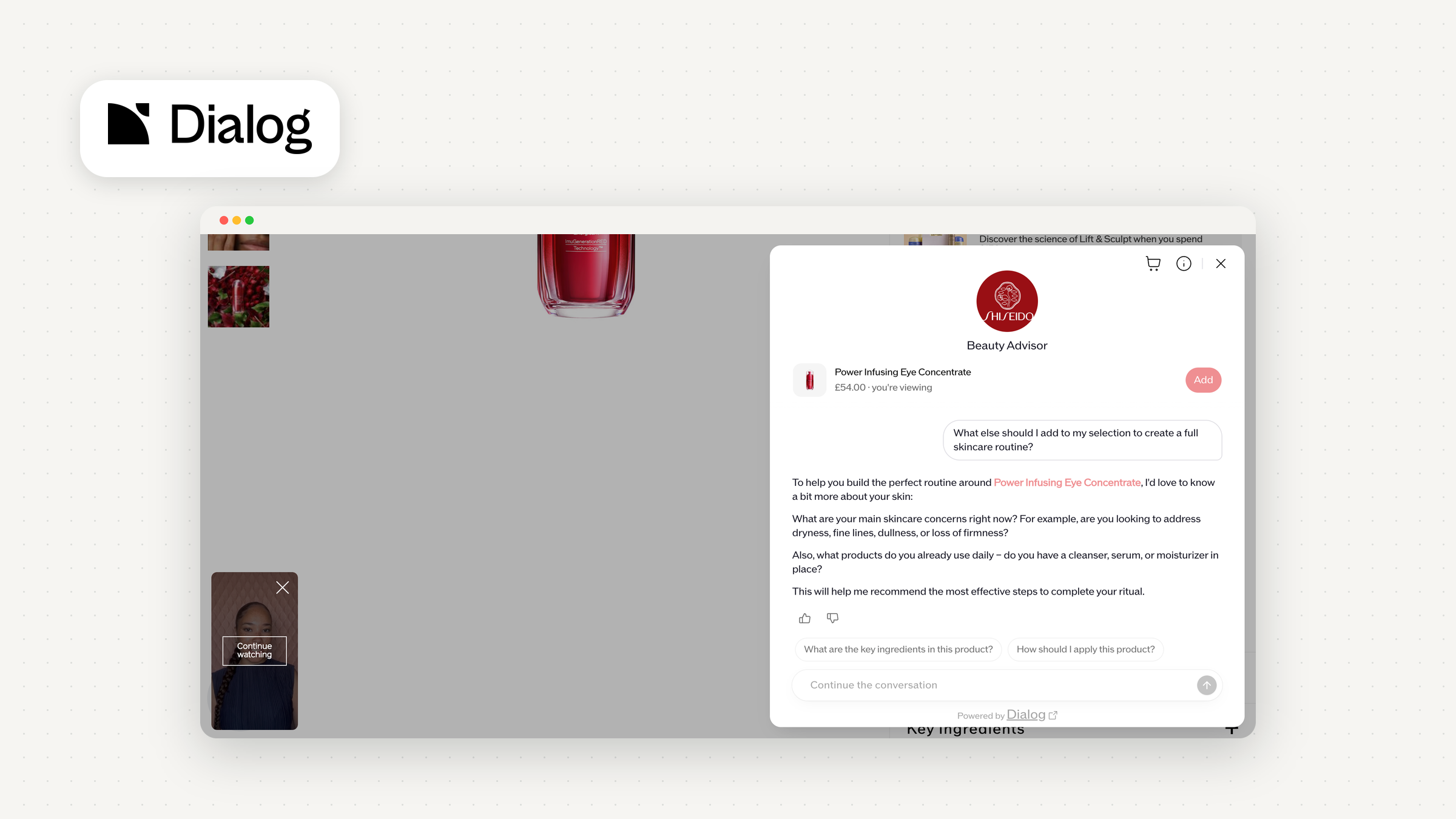
Dialog is our top pick for brands whose products need explaining before anyone buys them. It doesn't wait in a chat bubble in the corner, you can embed it anywhere on your website, including product pages. And because it's priced on traffic rather than conversations, you don't pay more when shoppers ask more.
Who it works best for
Mid-market and enterprise brands with complex, technical or high-consideration products: skincare with ingredient questions, luggage with size constraints, anything premium enough that a shopper wants an expert before paying.
Dialog is already set up on Shiseido, Oh My Cream, MG Motor, Delsey Paris and Manucurist among its 300+ brands. Its sweet spot starts around 25,000 monthly visitors on Shopify and 100,000 on other platforms. Below that, the free plan is the place to start.
Top features
- AI PDP assistant. Embedded in the product page, it answers technical questions, handles objections and guides the decision, like a sales associate standing next to the product.
- Personal shopper. A full conversational experience that recommends across the catalog.
- Smart reengagement for hesitant shoppers, based on what they asked and didn't buy.
- Analytics with native A/B testing, with the conversion difference visible in GA4.
Integrations
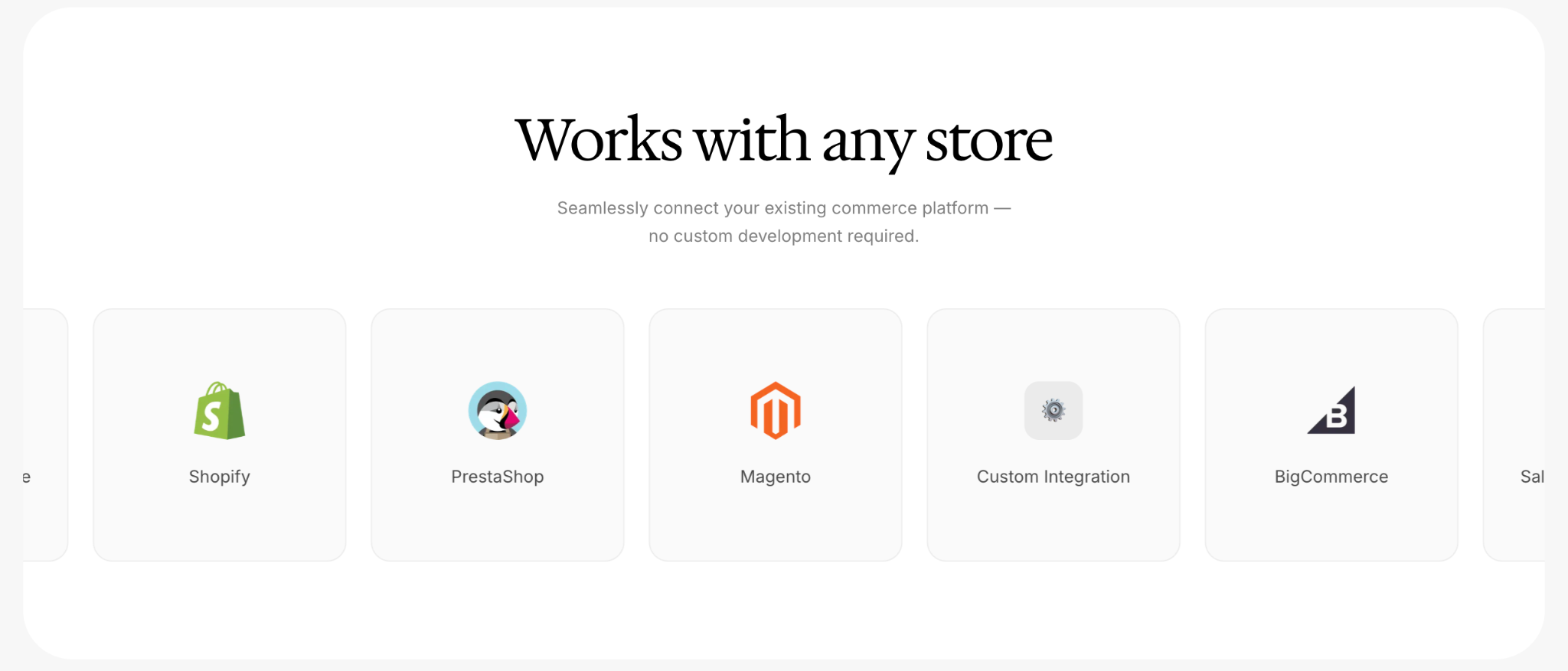
Dialog runs on Shopify, Salesforce Commerce Cloud, BigCommerce and Prestashop. It learns from your catalog, your internal documents and your blog articles, and it reports into Google Analytics 4.
Source: Dialog’s homepage
Pricing
Dialog prices on unique monthly visitors, billed every 30 days, with no cap on conversations:
- Free: $0/mo, 200 conversations, basic AI model, 2 training documents
- Starter: $249/mo, up to 25,000 unique visitors, advanced AI, custom logo, unlimited documents
- Standard: $399/mo, up to 50,000 unique visitors
- Scale: $799/mo, up to 100,000 unique visitors
There's a free trial, and it's self-serve on Shopify.
Pros and cons
Pros
- Flat pricing per traffic tier: more conversations don't cost more.
- Learns from more than the catalog (internal docs, blog articles), which helps on technical products.
- Native A/B testing, so you can measure the lift.
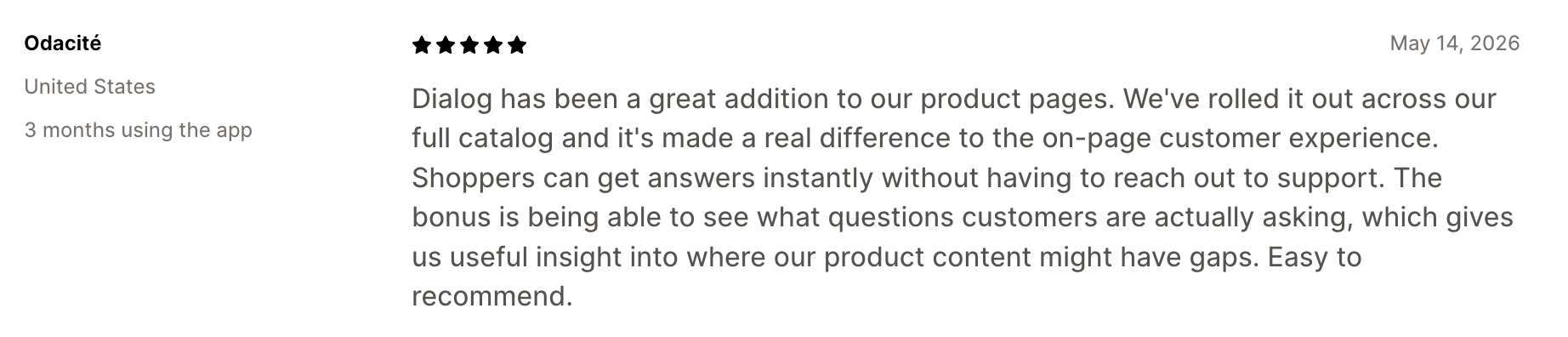
- 5.0/5 from 32 reviews on the Shopify App Store.
Cons
- A smaller review base than Rep AI or Gorgias (32 on Shopify, 10 on G2).
- It's a stand-alone pre-sale tool: you still need a helpdesk for post-purchase support.
- Visitor-based pricing means you pay for traffic even in a month when few shoppers open the assistant.
Source: Shopify App Store
Video
3. Gorgias
Gorgias is the logical choice if you already run your support on it, and a hard one to justify if you don't. Its Shopping Assistant (upsells, conditional discounts, product cards in the chat) is a layer on top of the leading Shopify helpdesk. You can't buy the AI without the helpdesk, and once you add both, it costs about as much as Alhena at our reference volume.
Who it works best for
Shopify brands, from small to mid-market, that already handle support in Gorgias and want the same AI to start selling. Gorgias is installed on more than 25,000 Shopify stores, including Steve Madden, Princess Polly, Reebok and Timex. The DNA is support first: most of its reviews praise ticket deflection, not product discovery.
Top features
- AI Agent included on every plan, which resolves support tickets autonomously.
- Shopping Assistant with upsells, conditional discounts and product cards in the conversation.
- One inbox for email, chat, SMS, social and voice, with full order context.
- Order actions from the ticket: refunds, edits and cancellations without opening Shopify.
- Revenue tracking that ties support conversations back to sales.
Integrations
Gorgias runs on Shopify, WooCommerce, BigCommerce, Magento and PrestaShop, and it's the helpdesk most other Shopify apps integrate with first.
Pricing
Gorgias bills on two meters: a helpdesk plan priced on monthly tickets, plus a fee for each automated AI interaction.
| Plan | Tickets included | Overage | Per automated AI interaction |
|---|---|---|---|
| Starter | 50/mo | $0.40/ticket | $1.00 |
| Basic | 300/mo | $40 per 100 | $0.90 |
| Pro | 2,000/mo | $36 per 100 | $0.90 |
| Advanced | 5,000/mo | $36 per 100 | $0.85 |
For our reference store, 1,000 AI conversations on Basic come to $90 + 1,000 × $0.90 = $990/mo. A store whose ticket volume needs Pro pays $550 + $900 = $1,450/mo.
Pros and cons
Pros
- Some teams use it for pre-sale too: "The AI Agent has been especially valuable in handling product inquiries and shopping assistance."
- The biggest review base in this comparison: 4.6/5 from 562 reviews on G2 and 4.2/5 from 651 on the Shopify App Store.
Cons
- Two meters make the bill hard to predict: "The billing structure is unfortunately a bit of a trap."
- The AI can invent answers: "When there isn’t enough information, it fabricates random answers that only frustrate our customers."
- Its own support draws complaints: "It’s ironic that the so-called best support app has some of the worst support I've experienced."
- Product discovery is a feature of a support tool, not the core of the product.
Video
4. Alhena AI
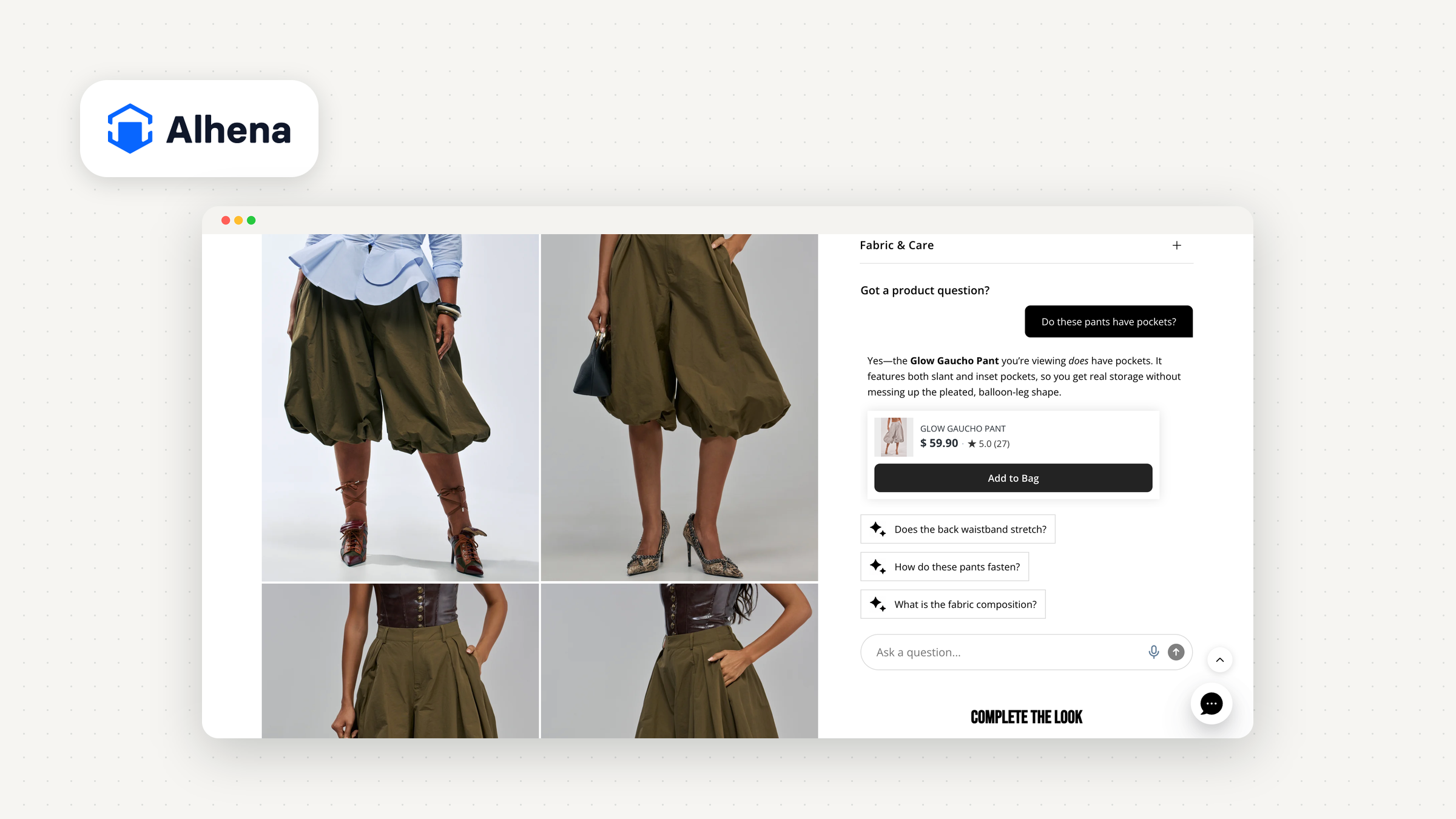
Alhena AI is the most complete pre-sale toolkit here, and the one whose bill grows fastest with success. Beyond a shopping assistant, it puts virtual try-on, an outfit builder and a fit analyzer directly on the product page. It bills per conversation, though, so the more your shoppers use it, the more you pay.
Who it works best for
Beauty and fashion brands that want visual tools as well as chat, and that would rather buy one platform than several. Alhena names Victoria Beckham, Tatcha, Murad, Paula's Choice and Living Proof among its customers, and its 91 Shopify stores skew toward beauty and apparel. It also covers support (returns, cancellations, order tracking), so it can replace two tools.
Top features
- AI shopping assistant: guided discovery, recommendations, upsells, cart-abandonment nudges and FAQs on product pages.
- Embeddable product-page agents: virtual try-on, outfit builder, room visualizer and fit analyzer. Dryrobe reports cutting size-related returns by 36% with the fit tools (Alhena's case study video).
- Support concierge: order tracking, returns, cancellations and appointment booking, with escalation to a human.
- One agent across channels: web chat, email, Instagram, Facebook and WhatsApp DMs, review platforms, and the phone.
- AI visibility tracking: how your products show up in ChatGPT, Gemini and Perplexity, included in every plan.
- 90+ languages.
Integrations
Alhena runs on Shopify, WooCommerce and Salesforce Commerce Cloud. It connects to Zendesk, Gorgias, Salesforce, Intercom and Klaviyo, and to review platforms such as Yotpo, Bazaarvoice and Trustpilot.
Pricing
Alhena bills per conversation, on annual plans:
- Free: 25 conversations/mo
- Essentials: $199/mo, 200 conversations
- Growth: $499/mo, 550 conversations
- Scale: $999/mo, 1,200 conversations
- Enterprise: custom, unlimited conversations
A conversation counts each time the AI resolves or assists a shopper, and serving an FAQ or a nudge counts too. Overage is $1.20 per conversation. For our reference store, Scale ($999) beats Growth plus overage ($499 + 450 × $1.20 = $1,039). At 2,000 conversations, the same store pays $999 + 800 × $1.20 = $1,959/mo.
Pros and cons
Pros
- The broadest set of pre-sale tools in this comparison, with try-on and fit tools on the product page.
- Accurate answers: "The app learns all about our site, products and documentation and provides thorough advice and answers without hallucinations."
- Brand voice can be tuned: "Alhena was the 1st AI that came very close to the tone and branding via Conversations we was looking for."
- Founder-level support: "The founders are involved in onboarding and constant improvements, they actually act on feedback."
- Self-serve, with a free plan.
Cons
- Per-conversation billing means engagement drives the bill, not traffic.
- A thin track record in ecommerce. Alhena was Gleen AI until February 2025, and 34 of its 35 G2 reviews predate the rename, many from crypto and developer communities rather than stores. On Shopify, it has 6 reviews.
- Analytics are basic: "I'd love to see more of an interactive dashboard and a longer lookback period on AI metrics."
- Spread across many product lines (sales, support, voice, social, AI visibility), which can be more than a store needs.
Video
5. Bloomreach
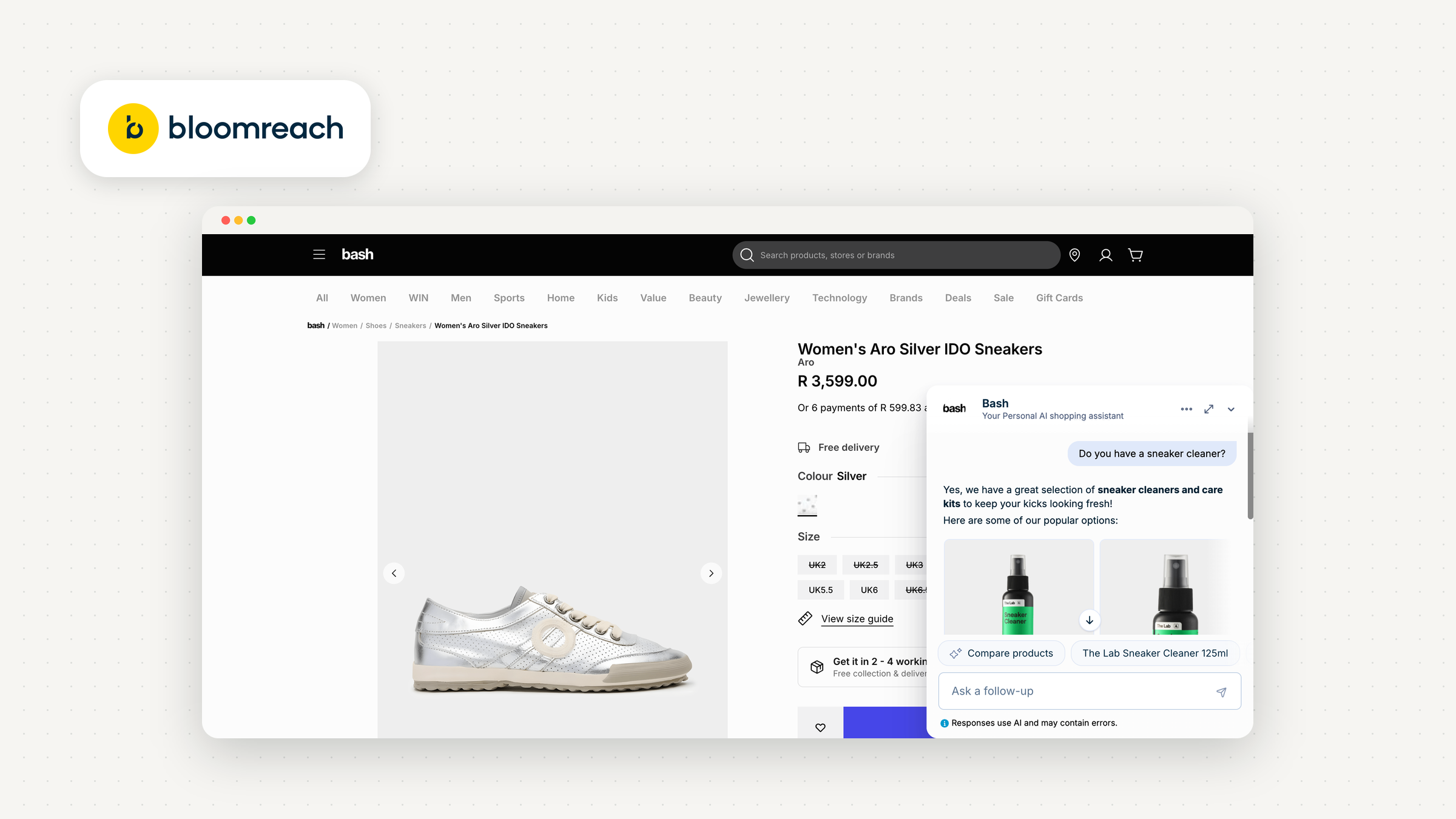
Bloomreach is only worth it if you already buy its suite. Its conversational shopping assistant, Clarity, launched in 2023 and is sold as part of a much larger personalization platform covering marketing automation, site search and a headless CMS. There's no way to buy Clarity on its own, and no public price.
Who it works best for
Enterprise retailers that already use Bloomreach for search, email or personalization, and want the shopping assistant to run on the same customer data. Its customers include The North Face, Patagonia, Pandora and Desigual. For a mid-market Shopify brand, it's more platform than the job requires.
Top features
- Clarity, a conversational shopping assistant for product discovery.
- Discovery: AI site search, merchandising and product recommendations.
- Engagement: a customer data platform with email, SMS, push and web campaigns.
- Content: a headless CMS with commerce components.
- Loomi, the AI layer across the suite.
Integrations
Bloomreach runs on Salesforce Commerce Cloud, Shopify, and BigCommerce.
Pricing
No public pricing. Clarity is bundled into the Bloomreach suite on a custom enterprise contract, with no free trial and no self-serve option.
Pros and cons
Pros
- One data model for everything: "Segments, journeys, email, web personalisation and predictions all run on the same data."
- Deep personalization and search, which a shopping assistant benefits from.
- Strong support and training: "The customer support is also excellent, with a knowledgeable team and useful training courses."
- 4.6/5 from 769 reviews on G2, though for the whole suite rather than Clarity.
Cons
- Not sold separately, and no public price.
- Complex to run: "Steep learning curve - quite a few quirks and platform jargon to learn."
- Reporting draws criticism: "Reporting options are quite shallow, we would appreciate more of it."
- Its Shopify app (email and SMS) has 2.7/5 from 6 reviews, a sign Shopify isn't its home turf.
Video
Conclusion
- For complex, technical or premium products, pick Dialog. It works on the product page, at the moment of doubt, and its traffic-based pricing doesn't punish a chatty audience.
- For beauty and fashion brands that want try-on and fit tools, pick Alhena AI, and budget for the per-conversation meter as usage grows.
- For cart abandonment on a budget, pick Rep AI. It's the cheapest here and the most reviewed pure sales assistant on Shopify, but plan a month of training before it's at full speed.
- Already on Gorgias? Turn on the Shopping Assistant before buying another tool. If you're not on Gorgias, don't adopt a helpdesk to get one.
- Already on Bloomreach? Ask your account team about Clarity. If you're not, it isn't a reason to buy the suite.
- Compare billing units, not list prices. Visitors, sessions, conversations and tickets scale differently. Run your own traffic and chat volume through each pricing page.
- Ask for a live reference before you sign. Not a logo, not a case study: a store running the tool today where you can ask it your hardest product question yourself.
FAQ
Can AI shopping assistants really be trusted?
They can when they answer from your live catalog and your own documents, and they can't when they're left to improvise. The complaints we found in reviews are about AI that guesses, like the Gorgias user who wrote: "When there isn’t enough information, it fabricates random answers." Alhena and Dialog both claim answers grounded in your own content, and Alhena's reviewers back that up. Before buying, ask your five hardest product questions on a live customer's site and check every answer. Then ask the vendor how the assistant behaves when it doesn't know: a good one says so and hands off to a human.
Can AI shopping assistants use our own brand voice?
Yes, all five tools let you shape the tone, though how much varies. Alhena's reviewers single out its brand voice: one says it was "the 1st AI that came very close to the tone and branding" they wanted. Rep AI offers customizable design and tone, and Gorgias teams use approved macros to keep answers on-brand. Whichever tool you pick, feed it your real copy (product pages, FAQs, past answers from your team) rather than a one-line tone instruction. Dialog is built around encoding the brand's identity and sales logic into the agent, and it deploys that same agent inside ChatGPT.
How much does an AI shopping assistant cost?
It ranges from free to a custom enterprise contract, and the billing unit matters more than the entry price. Dialog, Alhena and Rep AI all have a free plan or trial. For a store with 50,000 monthly visitors and 1,000 AI conversations a month, we found $294/mo for Rep AI, $399 for Dialog, about $990 to $1,450 for Gorgias, and $999 for Alhena. Bloomreach doesn't publish a price. Tools billed per conversation or per AI interaction cost more as shoppers engage more, while tools billed on traffic stay flat. That difference is small at launch and large after a successful campaign.