Summary
We analyzed 72,339 cold calls placed through Allo's power dialer to US and Canadian numbers between July and September 2026.
Here is what the data says:
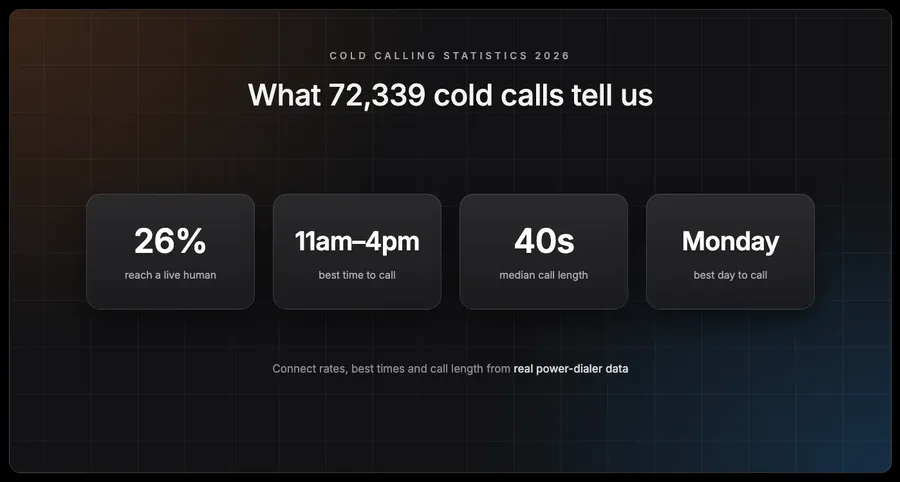
- Average connect rate: 26.0% of cold calls reach a live human. That is roughly 1 in 4 dials.
- Conversation rate: 7.4% of cold calls turn into a conversation of one minute or more. That is roughly 1 in 13 dials.
- Average call duration: a connected cold call lasts 60 seconds on average. The median is 40 seconds.
- Best time to cold call: between 11 a.m. and 4 p.m. in the prospect's local time. Every hour in that window connects 27% to 28% of the time.
- Worst time to cold call: 7 a.m. local time, with a 19.7% connect rate. A 2 p.m. call is 41% more likely to reach a human.
- Best day to cold call: Monday, with a 27.5% connect rate and the highest conversation rate of the week (8.7%).
- Worst weekday to cold call: Wednesday, with a 24.8% connect rate.
Introduction
At Allo, we eat our own dog food. That means we cold call…
A lot.
You can even follow our team on Instagram to see how they do it.
It made us wonder: how do we compare with the rest of cold callers?
Fortunately, we have access to a wealth of data on the topic through our users.
In this article, we share our findings on how many cold calls connect, the best time to cold call businesses, how long cold calls last, and more.
Our methodology
All the cold call statistics in this article come from our own unfiltered call data.
They are not survey answers or industry estimates!
Here's what you need to know about our approach (by the way, if you have remarks about our methodology, feel free to contact us).
The calls sample:
- To make sure we were only counting cold calls, we looked at outbound calls placed through the Allo power dialer between July 1 and September 30, 2026.
- To keep the sample consistent, we kept only calls to US and Canadian numbers. Toll-free numbers and Caribbean +1 area codes were excluded.
- We only kept calls where answering-machine detection ran, so we could tell a live human from a voicemail. Calls without a detection result were left out.
Other rules:
- Every figure in this article uses this same set of calls, so all the numbers can be compared directly.
- One call, one row. When a call was transferred and produced several call records, we counted it once and kept its longest leg for duration.
- Prospect local time. Using the caller's timezone would introduce a bias (a salesperson can cold call at 4 a.m. if she wants!). So instead, we inferred each prospect's timezone from the area code. "9 a.m." means 9 a.m. where the prospect is, not where the sales rep sits. Area codes that span two timezones were assigned to the zone most of their numbers fall in.
Our definitions:
- Connect: the call was answered by a live human. Voicemails and answering machines do not count.
- Connect rate: connects divided by all calls in the sample.
- Conversation: a connect that lasted one minute or more.
- Conversation rate: conversations divided by all calls in the sample.
- Call duration: the length of connected calls only.
Filtering:
To make sure our data was significant, we dropped any hour with fewer than 300 calls. When we cross the day and the hour, we only highlight time slots with at least 300 calls.
Checking significance:
To make sure the results are significant, we applied the following rules:
- Every rate comes with a 95% confidence interval. For the overall connect rate, that's ±0.3 points.
- We tested whether the differences between hours and between days are real with a chi-square test across all hours and all weekdays, then a two-proportion z-test when comparing two hours or two days.
- When two numbers are too close to tell apart, we say so in the article.
Limitations:
- We cannot report a reliable meeting-booked rate, because too few teams tag the outcome of their calls in Allo (this should improve in our next iterations!).
- This is observational data: our numbers show when cold calls connect, not that the hour alone is the cause.
When is the best time to cold call?
What is the best hour of the day to cold call?
Short answer: between 11 a.m. and 4 p.m., in your prospect's local time. Every hour in that window reaches a live human at least 27.1% of the time.
Within that window, the exact hour doesn't matter much. 11 a.m., 2 p.m. and 3 p.m. all land between 27.5% and 27.8%, and the gaps between them are too small to be meaningful. What matters is staying inside the window.
Here's how the day plays out:
- Early morning is a waste of dials. At 7 a.m., only 19.7% of cold calls reach a human. At 8 a.m. and 9 a.m., it's still only about 22%.
- Things pick up around 11 a.m. The connect rate jumps to 27.5% and stays above 27% until 4 p.m.
- After 5 p.m., it drops fast. 23.4% at 5 p.m., then about 22% at 6 p.m. and 7 p.m.
Put another way: a cold call at 2 p.m. is 41% more likely to reach a human than one at 7 a.m. Same rep, same list, same pitch!
| Local hour | Connect rate | Calls analyzed |
|---|---|---|
| 7 a.m. | 19.7% | 1,414 |
| 8 a.m. | 22.7% | 2,671 |
| 9 a.m. | 22.1% | 4,563 |
| 10 a.m. | 24.4% | 6,180 |
| 11 a.m. | 27.5% | 7,210 |
| 12 p.m. | 27.2% | 6,934 |
| 1 p.m. | 27.6% | 8,406 |
| 2 p.m. | 27.8% | 9,126 |
| 3 p.m. | 27.8% | 8,619 |
| 4 p.m. | 27.1% | 7,562 |
| 5 p.m. | 23.4% | 4,883 |
| 6 p.m. | 21.6% | 2,538 |
| 7 p.m. | 21.8% | 1,136 |
What is the best day to cold call?
Monday. It has the best connect rate of the week, at 27.5%.
That one surprised us (Monday is supposed to be the day everyone is buried in meetings).
Here's the full ranking:
- Monday: 27.5%
- Thursday: 26.3%
- Friday: 26.3%
- Tuesday: 25.9%
- Wednesday: 24.8%, the weakest weekday
- Saturday: 23.1%
Monday clearly beats Tuesday and Wednesday. Its lead over Thursday and Friday is smaller, and too close to call on connect rate alone.
Where Monday really pulls ahead is conversations: 8.7% of Monday cold calls turn into a conversation of a minute or more, against 7.4% or less on every other day.
But the day of the week matters a lot less than the hour. The spread between the best and worst weekday is only 2.7 points.
Fun fact: teams dial the most on Tuesdays and Wednesdays. Yet Monday, the quietest weekday, connects best.
| Day | Connect rate | Conversation rate | Calls analyzed |
|---|---|---|---|
| Monday | 27.5% | 8.7% | 11,111 |
| Tuesday | 25.9% | 7.2% | 18,243 |
| Wednesday | 24.8% | 6.9% | 16,662 |
| Thursday | 26.3% | 7.4% | 12,209 |
| Friday | 26.3% | 7.3% | 12,017 |
| Saturday | 23.1% | 6.8% | 2,056 |
(Sunday didn't have enough calls to make the cut. Your prospects can rest easy!)
What are the best time slots of the week?
When we cross the day and the hour, a few slots stand out:
- Monday at 11 a.m.: 32.5% connect rate, the best slot in our data.
- Friday at 3 p.m.: 30.1%.
- Monday at 4 p.m.: 29.6%.
- Thursday at 1 p.m.: 29.6%.
And the slots to avoid?
- Tuesday at 7 a.m. connects only 18.8% of the time
- Friday at 6 p.m. 18.9%
- Wednesday at 7 a.m. 19.3%.
What is the best time to have a real conversation?
Reaching a human is one thing. Keeping them on the line is another.
The conversation rate follows the same curve as the connect rate, only steeper. It doubles between 7 a.m. and the 11 a.m.–4 p.m. window:
| Local hour | Conversation rate | Calls analyzed |
|---|---|---|
| 7 a.m. | 4.2% | 1,414 |
| 8 a.m. | 5.4% | 2,671 |
| 9 a.m. | 5.5% | 4,563 |
| 10 a.m. | 7.6% | 6,180 |
| 11 a.m. | 8.4% | 7,210 |
| 12 p.m. | 7.8% | 6,934 |
| 1 p.m. | 8.0% | 8,406 |
| 2 p.m. | 7.8% | 9,126 |
| 3 p.m. | 8.4% | 8,619 |
| 4 p.m. | 8.3% | 7,562 |
| 5 p.m. | 6.4% | 4,883 |
| 6 p.m. | 4.9% | 2,538 |
| 7 p.m. | 4.9% | 1,136 |
The best slots of the week for a real conversation are Monday mornings: 10.8% of cold calls at 11 a.m. and 10.7% at 10 a.m. turn into a conversation of a minute or more.
At 7 a.m., the conversation rate sits around 5% or below on every weekday. In other words, even the prospects who pick up that early don't want to talk.
Does the time slot really matter?
Yes. A lot more than you'd think!
Let's take a sales rep who makes 70 cold calls a day. Same rep, same list, same pitch. The only thing that changes is when they dial:
| If the rep dials at… | Conversations per day | Conversations per month |
|---|---|---|
| 7 a.m. | 3.0 | 62 |
| 8 a.m. to 9 a.m. | 3.8 | 80 |
| 11 a.m. to 4 p.m. | 5.7 | 120 |
| 6 p.m. | 3.4 | 72 |
Moving those 70 dials from 8–9 a.m. to the 11 a.m.–4 p.m. window gets the rep about 2 more conversations a day, or 40 more a month. That's about 50% more conversations, without a single extra dial.
Compared with 7 a.m., a 3 p.m. calling block gets about twice as many conversations.
The day of the week moves the needle much less. 70 dials on a Monday get about 6 conversations, against about 5 on a Wednesday. Roughly one conversation apart.
So if you protect one thing in your calendar, make it your 11 a.m. to 4 p.m. calling block.
What is the average cold call connect rate?
Short answer: 26.0%. About 1 in 4 cold calls is picked up by a live human.
The other 3 end on voicemail, an answering machine, or no answer at all.
(With 72,339 calls behind it, that number is statistically significant. The margin of error is about ±0.3 points.)
What 100 cold calls look like
Here's what happens, on average, when a rep makes 100 cold calls:
| Out of 100 cold calls… | Calls |
|---|---|
| Don't reach a human (voicemail, machine, no answer) | 74 |
| Reach a live human | 26 |
| Turn into a conversation of 1 minute or more | 7 |
In other words:
- It takes about 4 dials to reach a human.
- It takes about 13 dials to get a real conversation.
For a rep making 70 cold calls a day, that's about 18 humans on the line and about 5 real conversations.
A word on how connect rates are counted
Be careful when you compare connect rates from different sources:
- We only count a call as connected when a live human answers. A voicemail is not a connect in our data.
- Some tools report "answered" calls instead, which can include voicemails and answering machines. Same calls, much higher number!
So if you see a connect rate far above 26%, check what's being counted before you panic about your own.
Does the connect rate change much?
Less than you'd think from day to day. More than you'd think from hour to hour.
- By day: it only moves between 24.8% (Wednesday) and 27.5% (Monday).
- By hour: it moves between 19.7% (7 a.m.) and 27.8% (2 p.m. and 3 p.m.).
That 8-point gap between the worst and best hours is the biggest lever we found in the data. If your connect rate is low, check when your team dials before you change anything else.
What is the average cold call duration?
Short answer: 60 seconds. That's the average length of a cold call once a live human picks up.
But the average flatters reality. The median is only 40 seconds. A handful of long calls pull the average up, while most cold calls are over in well under a minute.
(Voicemails and unanswered calls aren't included here. These figures only cover calls where a human actually answered.)
How long do most cold calls last?
Not long!
- A third of connected cold calls (34%) end within 30 seconds.
- Half end within 40 seconds.
- 71% end before the one-minute mark.
- Only 9% last more than 2 minutes, and 1.5% more than 5 minutes.
| Call length | Share of connected calls | Connected calls |
|---|---|---|
| Under 15 seconds | 9.5% | 1,788 |
| 15 to 30 seconds | 24.9% | 4,673 |
| 30 to 60 seconds | 37.0% | 6,954 |
| 1 to 2 minutes | 19.5% | 3,668 |
| 2 to 5 minutes | 7.5% | 1,412 |
| Over 5 minutes | 1.5% | 282 |
The most common outcome? A call that ends somewhere between 30 seconds and a minute. Long enough to say who you are, too short to have a real conversation.
That first minute is where most cold calls are won or lost. If your opener takes 30 seconds, a third of your prospects will already have hung up before you get to the point.
How much time does a rep actually spend talking?
Less than you'd think.
Take a rep who makes 70 cold calls a day. About 18 of them reach a human. At 60 seconds each, that's about 18 minutes of live conversation a day.
The rest of the calling block goes to dialing, ringing, voicemails and notes. (That's exactly the dead time a power dialer is built to cut.)
Cold call duration by day
| Day | Average duration | Median duration | Connected calls analyzed |
|---|---|---|---|
| Monday | 64 s | 41 s | 3,051 |
| Tuesday | 60 s | 40 s | 4,731 |
| Wednesday | 60 s | 39 s | 4,135 |
| Thursday | 58 s | 40 s | 3,215 |
| Friday | 57 s | 39 s | 3,161 |
| Saturday | 62 s | 42 s | 474 |
The typical cold call lasts about 40 seconds whatever the day. Look at the median column: it barely moves.
The averages move a little more (Monday calls run about 7 seconds longer than Friday ones). That gap comes from the long calls, not from the typical one. It matches what we saw earlier: Monday is the day prospects are most willing to talk.
Cold call duration by hour
Same story by hour: the typical call lasts about 40 seconds at any time of day. The median stays between 34 and 41 seconds from 7 a.m. to 7 p.m.
What changes is the long calls:
- Early mornings have fewer of them. At 7 a.m. and 8 a.m., the average connected call lasts 51 to 52 seconds, and only a quarter of calls go past 56 to 59 seconds.
- From 10 a.m. to 4 p.m., the long calls get longer. The average sits between 58 and 63 seconds, and a quarter of calls go past 64 to 71 seconds.
| Local hour | Average duration | Median duration | Connected calls analyzed |
|---|---|---|---|
| 7 a.m. | 52 s | 40 s | 278 |
| 8 a.m. | 51 s | 39 s | 606 |
| 9 a.m. | 57 s | 38 s | 1,010 |
| 10 a.m. | 61 s | 41 s | 1,508 |
| 11 a.m. | 61 s | 41 s | 1,981 |
| 12 p.m. | 60 s | 39 s | 1,883 |
| 1 p.m. | 60 s | 40 s | 2,320 |
| 2 p.m. | 58 s | 40 s | 2,531 |
| 3 p.m. | 61 s | 41 s | 2,394 |
| 4 p.m. | 63 s | 40 s | 2,047 |
| 5 p.m. | 66 s | 37 s | 1,143 |
| 6 p.m. | 62 s | 34 s | 547 |
| 7 p.m. | 65 s | 40 s | 248 |
What does it mean for your team?
Two takeaways:
- Don't judge your reps on call length alone. A 40-second cold call is exactly the median. A short call isn't a failed call.
- Work on the first 30 seconds. A third of connected calls are over by then, so it's the only part of the pitch nearly every prospect actually hears.
What is the average cold call conversion rate?
Short answer: 7.4% of cold calls turn into a real conversation (a call of a minute or more). That's the closest thing to a conversion rate our data can back up.
Why we don't publish a meeting-booked rate
A true conversion rate needs every call to be tagged with its outcome: meeting booked, call back later, not interested…
In Allo, that tagging is optional. We don’t have enough teams using the option to publish reliable figures at the moment.
What 1,000 cold calls look like
Here's the cold calling funnel our data can measure. Out of 1,000 cold calls:
| Out of 1,000 cold calls… | Calls |
|---|---|
| Reach a live human | 260 |
| Last 1 minute or more | 74 |
| Last 2 minutes or more | 23 |
| Last 5 minutes or more | 4 |
How to get more conversations out of the same dials
The levers we found in the data:
- Dial between 11 a.m. and 4 p.m., prospect local time. The conversation rate sits around 8% there, against 4% to 5.5% before 10 a.m.
- Don't skip Mondays. At 8.7%, Monday has the best conversation rate of the week.
- Protect your Monday mornings. Monday at 10 a.m. and 11 a.m. are the best slots of the week for a real conversation (10.7% and 10.8%).
How to measure your own conversion rate
The best benchmark is your own history.
To build it:
- Tag the outcome of every call, not just the good ones (meeting booked, call back, not interested, wrong person…).
- Track meetings booked per conversation, not just per dial. It tells you whether the problem is reaching people or what you say once you do.
- Compare month over month, with the same definitions every time.
FAQ
When is the best time to cold call a business?
Between 11 a.m. and 4 p.m. in the prospect's local time. In our data, every hour in that window reaches a live human 27% to 28% of the time, against 19.7% at 7 a.m. The best day is Monday (27.5% connect rate, 8.7% conversation rate). The single best slot of the week is Monday at 11 a.m., with a 32.5% connect rate. Avoid early mornings: before 10 a.m., fewer prospects pick up, and the ones who do rarely stay on the line.
Is it illegal to cold call?
No. Cold calling is legal in the US and Canada, but it's regulated. The main rules are: US consumers: you can't make sales calls to numbers on the National Do Not Call Registry, unless you have an existing business relationship or the person's permission. Autodialers and prerecorded messages: under the Telephone Consumer Protection Act (TCPA), calling a cell phone with an autodialer or a prerecorded voice generally requires the person's prior consent. Business-to-business calls: most B2B calls are exempt from the Telemarketing Sales Rule and the Do Not Call Registry. But some state laws still apply, and a business owner's personal cell phone may be treated like a consumer number. Canada: the CRTC's Unsolicited Telecommunications Rules and the National Do Not Call List apply. Calls to businesses are exempt from the list. Rules differ from one state to the next, and they change. This isn't legal advice: check with a lawyer before you launch a campaign.
What time are cold callers allowed to call?
In the US, federal rules allow telemarketing calls between 8 a.m. and 9 p.m., in the recipient's local time. Some states are stricter. Florida, Oklahoma and Maryland, for example, limit sales calls to 8 a.m. to 8 p.m., and cap them at 3 calls per person per 24 hours on the same subject. In Canada, telemarketing calls are allowed from 9 a.m. to 9:30 p.m. on weekdays, and 10 a.m. to 6 p.m. on weekends. Good news: the best window in our data (11 a.m. to 4 p.m.) sits comfortably inside all of these. And always go by the prospect's timezone, not yours! Source: FTC
What is a good cold call conversion rate?
It depends on what you count as a conversion. If you measure conversations (calls of a minute or more), here's how to read your numbers against our data: Average: 7.4% of cold calls. Good: 8% or more, which is what our users get in the 11 a.m. to 4 p.m. window. Great: 10% or more, which only the best slots reach (Monday at 10 a.m. and 11 a.m.). For booked meetings, we don't have a reliable benchmark at the moment. Your best benchmark is your own history: tag the outcome of every call and track meetings booked per conversation, month over month.