Main takeaways:
- Your mindset matters more than your words. Smiling, mirroring the prospect’s tone, and bringing positive energy shape your first impression before any script does.
- The best cold call opening lines follow a “two yeses” structure. Confirm the prospect’s name, then validate their role. Two small agreements build instant momentum.
- Never apologize for calling. Permission-based openers and “Am I bothering you?” kill your credibility before you’ve said anything of value.
Most salespeople dread the opening of a cold call.
Those first seconds where you either earn the right to keep talking or hear the click of a hang-up.
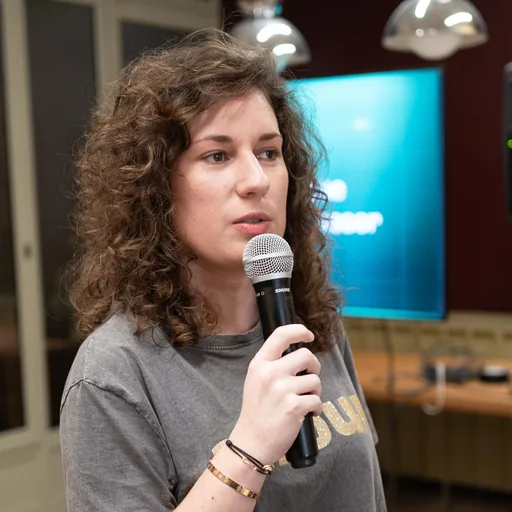
The good news? Pauline Perez, a cold call expert and Allo user, has a repeatable structure that works to share. And it takes less than 10 seconds.
In this guide, we’ll break down her approach so you can craft the best cold call opening lines for your next session.
The opening line mindset
Most advice about cold call openers focuses on the words. What to say, what not to say, which exact sentence to use.
Pauline starts somewhere else entirely. For her, the mindset you bring to the call matters more than any script.
It’s 10 seconds, not 30
You’ve probably heard that the first 30 seconds of a cold call are critical. Pauline disagrees. She thinks it’s even shorter than that.
“I’d even say it’s the first ten seconds that are important because it’s a lot when you pick up your phone and you have to go on talking for thirty seconds.”
Thirty seconds of uninterrupted talking feels like an eternity for the person on the other end. Your opener needs to land fast. Every word counts.
Smile before you dial
It sounds like a cliché. Pauline knows that.
“Smiling on the phone, you see, I say it every time, well I find it very common to say, but unfortunately it’s true.”
Her point is simple: your mood bleeds through the phone. If you’re frustrated, tired, or annoyed, your prospect hears it. If you’re smiling, they hear that too.
“If you do prospecting while looking angry, you attract what you give off.”
Mirror the prospect’s energy
Pauline uses a technique called mirroring. She matches the energy of whoever picks up.
If someone answers in a whisper, she whispers back. She shared a memorable example from her own calls:
“Once, I call someone, they pick up, they’re whispering to me. So I started whispering too and then they tell me: ‘why are you whispering?’ I said ‘I don’t know why’.”
The prospect laughed and walked out of the room to continue the conversation. That’s the power of matching tone instead of bulldozing through a script.
Pauline’s training students are often surprised by how differently she sounds on calls versus in the classroom:
“When people who are in the room that I’m training hear my audios, they’re always very surprised. They always tell me, actually, you speak really slowly.”
She speaks slowly on calls because the prospect isn’t sitting in a training room ready to absorb energy. They’re interrupted, distracted, maybe even annoyed. Matching their rhythm builds instant rapport.
Find your physical posture
Pauline calls standing up. Not because it’s a rule. Because she can’t sit still.
“I talk a lot on the phone while standing, but because I have trouble sitting still for too long. And that way, I’m dynamic, I walk, I talk with the guys.”
But she’s seen great cold callers who work lying down. The point isn’t the position itself.
“There’s no good or bad way to do it, I mean you have to do it the way you want.”
What matters is being comfortable enough to focus entirely on the prospect.
Think of it as a sport
Prospecting sessions are hard. Pauline compares them to going to the gym.
“It always sucks, but when you see the results at the end, you’re happy.”
Her trick? Schedule sessions in advance like workout appointments. Once they’re blocked in the calendar, they’re non-negotiable.
“When you’re in prospecting time, when you’ve scheduled prospecting in your calendar, you’re prospecting. So whatever happens next, we forget about it.”
No checking emails between calls. No cigarette breaks after one dial. Focused, uninterrupted blocks. (That’s also why having a phone system that auto-logs your calls to your CRM helps; you stay in the zone instead of switching to admin).
Believe in what you’re selling
This one is non-negotiable for Pauline.
“Personally, I only take clients where I believe in their solutions. I think that’s critical.”
If you don’t believe in your product, the prospect will feel it. Conviction isn’t something you can fake over the phone.
The openers that really work
Now for the mechanics. Pauline uses the same structure on every single call. It’s short, direct, and built around getting two quick “yeses” from the prospect.
Pauline’s “two yeses” cold call opener
The idea is simple. Before you pitch anything, get the prospect to confirm two things: their name and their role.
First yes: confirm their name.
When the person picks up, Pauline says their first name with a questioning intonation. Not a statement. A soft question.
“So the person said ‘hello’, and there I’m going to say ‘yes hello Julie’. So I’m going to question without really asking.”
This does two things. It confirms you’ve reached the right person. And it gives the prospect a reason to respond with “yes.”
Second yes: validate their role.
Right after, Pauline introduces herself and confirms the prospect’s job function. Again, with an induced question.
“Yes hello Pauline on the line with Boucan Factory. I’m calling you very quickly, I saw on LinkedIn that you were a sales director.”
If the person isn’t actually in that role, they’ll correct you. That’s a good thing. You’ve just learned who the right contact is.
“If Julie Dupont isn’t a sales director, because it’s a namesake and that happens a lot, she’s going to tell me “no, not at all. I’m a vet”.”
Then: propose a short exchange.
Once name and role are confirmed, Pauline makes her ask. It’s not a pitch. It’s a request for a conversation.
“And I wanted to see with you when you’d be available so we could quickly discuss your prospecting topics.”
That’s it. The whole opener takes under 10 seconds.
“So you see, it’s super short, and it’s always the same thing.”
Why this opener works
The structure is built on one insight: people naturally correct you when you’re wrong, and they naturally agree when you’re right. Either way, they’re engaging with you.
Pauline isn’t asking for permission. She’s not pitching features. She’s having a quick, human exchange.
And she keeps it consistent:
“You validate that you’re talking to another person, you validate that they’re actually responsible for what you’re calling about.”
Cold call openers you should never use
Not all openers are equal. Pauline is vocal about what doesn’t work.
Don’t use permission-based openers.
You’ve probably seen the advice: “This is a prospecting call, would you prefer to hang up or give me 30 seconds?”
Pauline hates this.
She shares what happened when someone tried it on her:
“The person said ‘hello, well, so if you’re prospecting, will you give me five minutes?’ I said no. And the problem is the guy ended up looking like an idiot.”
The problem with permission-based openers is that they give the prospect an easy exit before you’ve offered any value. And if they say no, the caller has nowhere to go.
Don’t apologize for calling.
“Am I bothering you?” is a reflex many salespeople have. Pauline never uses it.
“Me, I never ask people if I’m bothering them.”
There’s one exception. When she can actually hear that the person is busy, she’ll acknowledge it.
“When someone is in the metro, you can see it, we recognize the words, et cetera, I say ‘ah, are you in the metro’.”
That’s different from guessing. You’re reacting to real information, not making assumptions.
“You don’t start, you don’t say assumptions without having had information.”
Don’t kill your own energy.
Starting with low energy or an apologetic tone creates a self-fulfilling prophecy.
“If you have little energy and you’re looking angry, feel it.”
The prospect mirrors your energy. If you sound like you’d rather be anywhere else, they’ll want you to be anywhere else too.
What to do when the opener goes sideways
Not every call starts smoothly. Pauline has been snapped at, questioned, and interrupted. She doesn’t panic.
She shared an example where a prospect reacted aggressively from the start:
“I have calls where I have someone who says to me: ‘No, wait, who are you? You’re calling me by my first name, I don’t know you’.”
A less experienced rep might have apologized and hung up. Pauline stayed calm and explained why she was calling. The prospect ended up giving her a referral to the right person in the department.
“And yet the caller, when you listen to them at the beginning, it was very badly started, I think a lot of salesmen would have said ‘ah, sorry, I won’t bother you anymore and would hang up’.”
Her rule: when someone picks up, try to get as much out of the conversation as possible.
Even a “no” can turn into useful information. Who’s the right contact? When is a better time? Is there interest in the future? A good phone system records these calls so you can review what worked and what didn’t.
The real secret: it’s the same opener every time
Pauline doesn’t reinvent the wheel for each call. Her structure stays identical. What changes is her tone, pace, and the specific role or pain point she references.
“It’s always the same thing. That is, you validate that you’re talking to another person, you validate that they’re actually responsible for what you’re calling about.”
Consistency is what makes it work. You don’t need 15 different best cold call opening lines. You need one solid structure that you execute well, every time.
And that consistency only comes with practice. Not role-play. Real calls.
“Pick up your phone and call the prospect. That’s it. Simply. And then listen back to the calls.”