Best business SMS service in 2026: Our 6 top picks
Six business SMS services priced for the same team, plus why one emoji can double your bill.


A business SMS service lets your company send and receive text messages (SMS, or short message service) from a business number instead of someone's personal cell phone.
The trouble is that the phrase covers several kinds of products.
Some are phone systems that also text, and some are marketing tools built to send one message to thousands of people.
Others are developer APIs (application programming interfaces) that send texts from your own software.
If your goal is answering customers' texts, a marketing tool is the wrong comparison. This guide splits the options by job, with two picks for each.
Business SMS services do three different jobs
Before you compare prices, figure out which job you're hiring the service for. The wrong type can cost more and still not do what you need.
Conversations with customers
A customer texts the number on your van or your website, and someone on your team replies. This is one-to-one texting, usually on the same number you use for calls.
Phone systems with texting handle this best. You usually pay per user, and typed texts are included up to a fair-use limit.
Marketing campaigns
You send one message to hundreds or thousands of contacts who opted in. Think a weekend promo or a restock alert.
Bulk texting tools handle this, with keywords, sign-up forms and scheduling. You pay in credits, and every segment to every recipient uses one.
Automated messages from your own software
Your booking system sends a reminder, or your app sends a login code. Nobody on your team types these.
SMS APIs handle this. You pay per segment, often less than a cent before carrier fees.
You or a developer builds the logic that decides when a text goes out.
The 6 best business SMS services in 2026
The table prices one scenario for every tool: a five-person team sending 1,000 one-segment texts a month in the U.S. It uses yearly billing where the tool offers it and adds the carrier fees each tool passes on.
| Tool | Best for | Monthly cost for 5 users and 1,000 texts | G2 rating |
|---|---|---|---|
| Quo | Texting on a low-cost phone line | $76.50: 5 × $15 (Starter plan, texting included) + $1.50 carrier campaign fee. Plus $19.50 one-time registration | 4.7/5 (3,423 reviews) |
| Allo | Calls and texts in one shared inbox | $160: 5 × $32 (Business plan with calling, shared inbox, AI call summaries and CRM sync, plus 500 typed segments per user). Plus $24 one-time registration | 4.7/5 (209 reviews) |
| SimpleTexting | Text marketing for a small team | $91.70: $39.20 (1,000 credits) + $10 local number + 2 extra users × $20 + about $2.50 carrier fees. Plus $4 one-time registration | 4.7/5 (650 reviews) |
| SlickText | Text marketing on a tight budget | $45.03: $40.83 (1,000 credits, yearly) + $4.20 carrier fees. Number included; extra teammate pricing not listed | 4.8/5 (1,940 reviews) |
| Twilio | Automated texts from your own software | About $14.50 to $16: $8.30 (1,000 segments) + $3.50 to $5 carrier fees + $1.15 number + $1.50 campaign fee. Plus $19.50 one-time registration and developer time | 4/5 (537 reviews) |
| ClickSend | Pay-as-you-go texting without code | $36.09: 1,000 × ($0.0285 + $0.0041 carrier fee) + $3.49 toll-free number. Unlimited users | 4.1/5 (49 reviews) |
The phone systems look pricier because the seat price also covers calling and a shared inbox. If texting is all you need, the per-text tools win on price.
If your team also answers calls, the per-text tools don't replace a phone system.
How we chose the tools
- Two-way texting from a business number. Every tool here can send texts and receive replies.
- Published U.S. prices. We only included tools whose pricing page lets you work out a monthly cost without a sales call.
- A clear job. We picked two tools for each of the three jobs above, based on our own testing, G2 ratings, end review counts.
- How they handle carrier registration. Every U.S. business texting from a local number has to register. We noted what each tool charges and how long approval takes.
We left out several well-known services:
- Google Voice starts at $10 per user/month with U.S. texting included. Its team plans run as add-ons to a paid Google Workspace subscription, which makes it a fit mainly for teams already on Google's tools.
- RingCentral and Dialpad both text, but texting is one feature of a larger phone system. Quo and Allo cover that job here.
- Textmagic, Salesmsg and Podium cover the same jobs as our picks. We kept the list to two tools per job.
A quick note: Allo is our product, and it's included in this article.
To keep this comparison fair, we used the same scenario for every tool and linked the key claims to each company's own pages. Allo's limits are listed the same way as everyone else's.
Quo: best for texting on a low-cost phone line
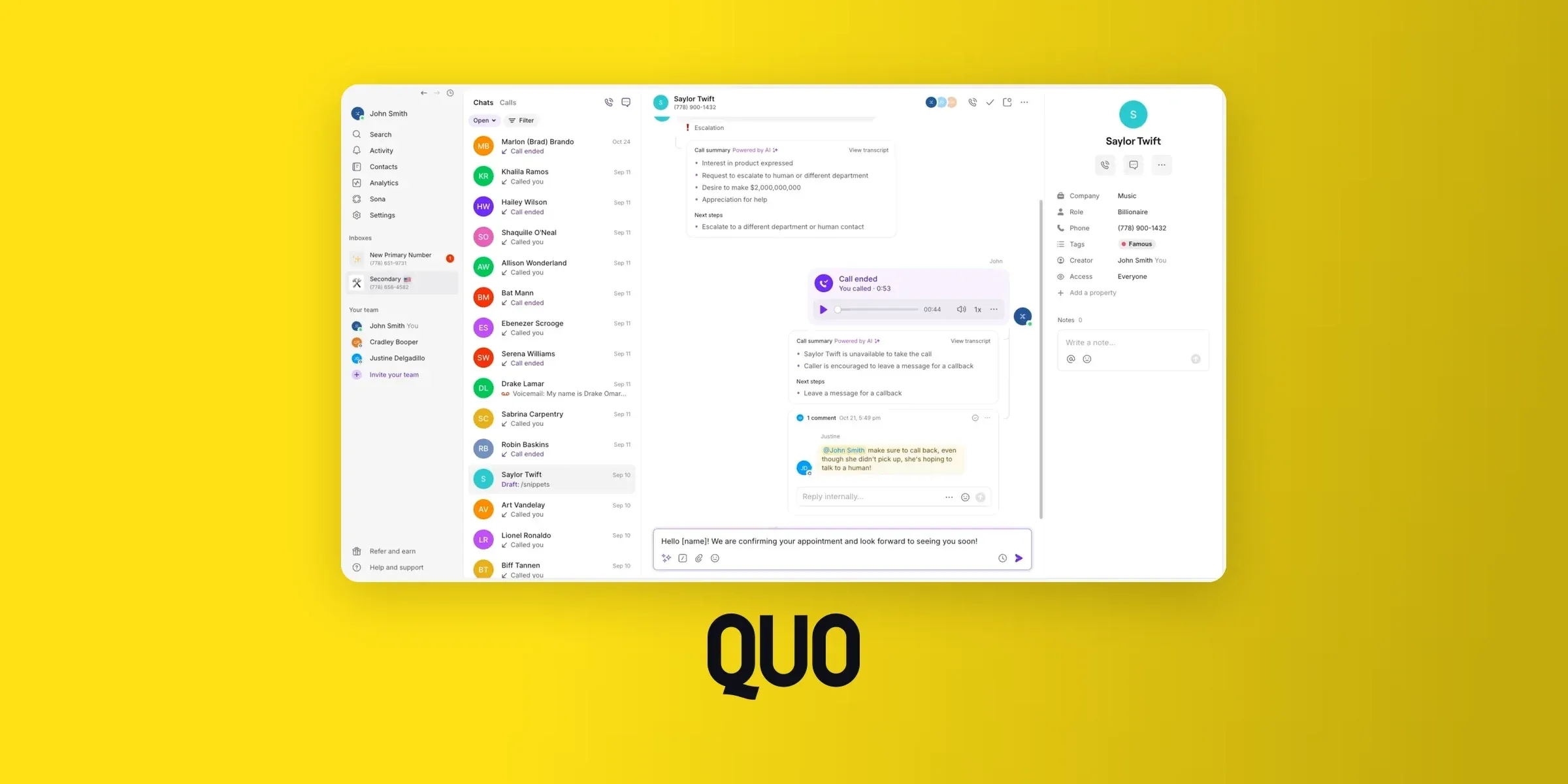
Quo (formerly OpenPhone) is the cheapest way here to get a shared business number with calling and texting. Texting to U.S. and Canadian numbers is included on every plan, subject to a fair-use policy.
For five people, the Starter plan comes to $76.50 a month, or $15.30 per person.
The fairer match is Quo's Business plan, at $116.50 for five people. Quo still costs $43.50 a month less.
Who Quo works best for
Quo fits a small team that mostly texts one customer at a time and wants the lowest price per seat. A solo owner pays $15 a month billed yearly, with no seat minimum.
It doesn't fit marketing blasts. Quo's bulk messaging sends separate one-to-one texts, and each send requires explicit recipient consent and opt-out instructions.
Quo texting features
Every plan includes group messaging, scheduled messages, snippets (saved replies) and auto-replies. Snippets save typing for questions you answer every day, like opening hours or directions.
A group text holds up to 10 people, including you, and only works from a local number.
Automated texts sent through the API or tools like Zapier cost $0.01 per segment. International texts are billed in credits by destination.
Quo pricing
| Plan | Billed yearly | Billed monthly |
|---|---|---|
| Starter | $15 per user/month | $19 per user/month |
| Business | $23 per user/month | $33 per user/month |
| Scale | $35 per user/month | $47 per user/month |
Carrier registration costs $19.50 once, plus $1.50 a month for most businesses. If carriers reject the application, resubmitting costs $15.
If you need AI summaries on every call and CRM sync, compare Quo's Business plan instead. For five people, that's $115 a month plus the $1.50 fee, or $116.50.
Quo pros and cons
Pros
- Texting included on every plan, with no credits to track for typed messages
- Lowest per-user price in this guide, with no seat minimum
- Registration can be quick: "My SMS application and business caller ID were approved within days, and two-way texting has worked reliably since." (Sheri K., Oct. 2026, G2 review)
Cons
- Group texts cap at 10 people, and bulk messages go out as separate one-to-one texts
- AI call summaries only cover Sona-handled calls on the Starter plan
- No phone support: "there is no customer service number we can call, and no account rep we can call if there are any issues or questions." (Owen C., Sept. 2026, G2 review)
Quo demo
Allo: best for calls and texts in one shared inbox
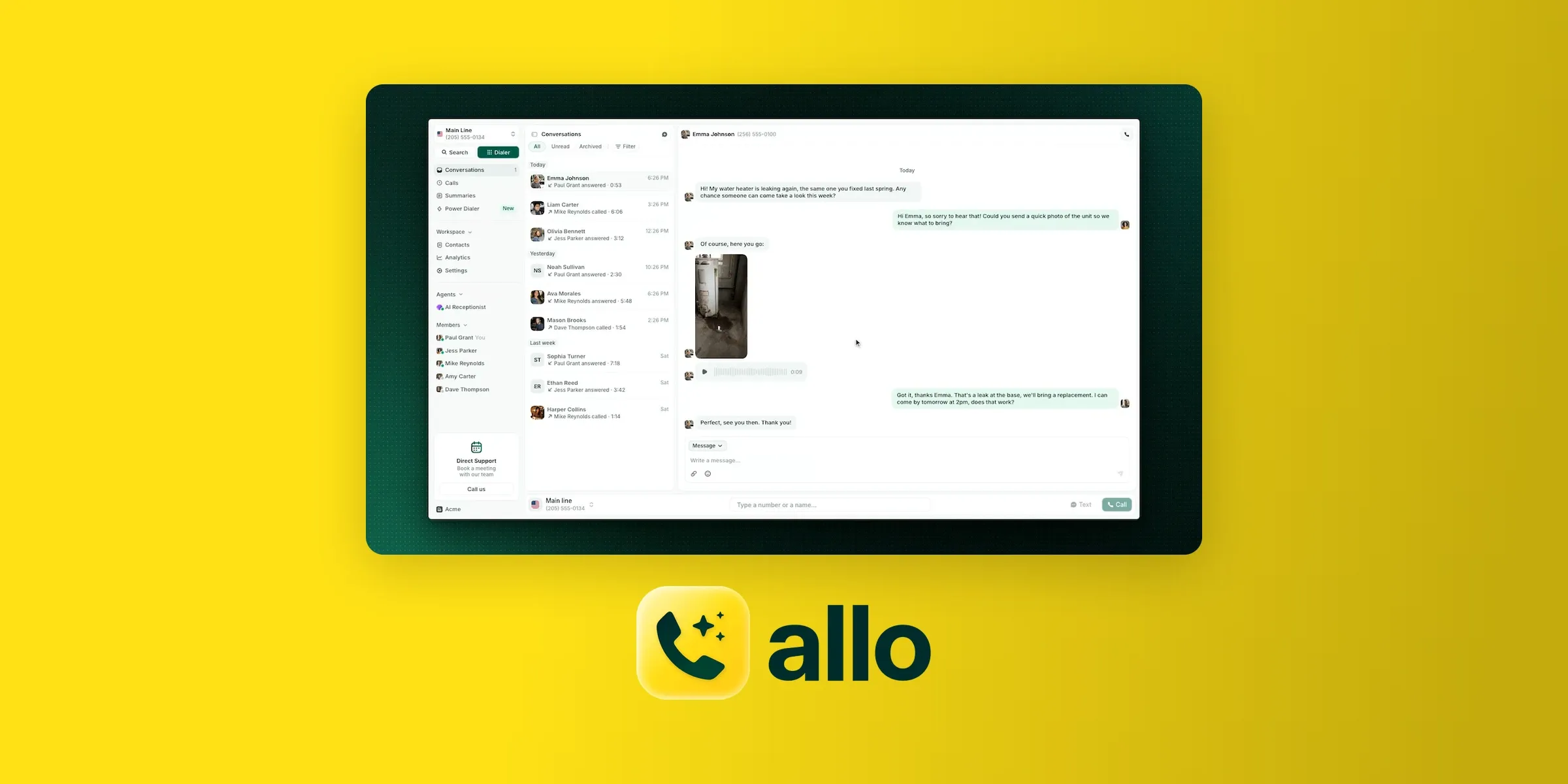
Allo puts calls and texts on the same business number, in one shared inbox.
When a customer misses you on the phone and then texts, the whole thread sits in one place. You write texts next to your calls and their AI summaries, and the person replying can see what was said on the phone first.
The Business plan costs $32 per user/month billed yearly and includes AI summaries and transcripts on every call, plus CRM sync with tools like HubSpot, Attio, Pipedrive and Salesforce.
Typed texts are included with up to 500 segments per user each month.
Who Allo works best for
Allo fits a team of two or more that takes customer calls and follows up by text. Five people pay $160 a month, and the 2,500 included segments cover our scenario even when every text runs to two segments.
Against Quo's Business plan, that's $8.70 more per person each month. Quo includes unlimited typed texts under fair use, while Allo includes 500 segments per user.
The Business plan has a two-seat minimum. A solo owner who needs to send texts pays $64 a month. The $10 Solo plan (billed yearly) can receive texts but not send them.
Allo doesn't fit text marketing. It has no bulk texting, by design, since bulk texts can get a business number flagged by carriers.
Allo texting features
You reply from one shared inbox on the number your customers already have. Your teammates see the same thread, which keeps two people from answering the same customer.
A missed call can become a text. With missed-call text back, Allo texts the caller from your business number automatically, and the reply lands in the shared inbox.
You can attach images and documents as multimedia messages (MMS) on U.S. and Canadian numbers. Texts go to numbers in the same country as your Allo number, and international texting isn't available yet.
Allo pricing
| Plan | Billed yearly | Billed monthly | Texting |
|---|---|---|---|
| Solo | $10 per user/month | $15 per user/month | Receive only |
| Business | $32 per user/month (2-seat minimum) | $45 per user/month | Send and receive, 500 typed segments per user/month |
| Ultra | $100 per user/month | $120 per user/month | Send and receive |
Receiving texts is free on every plan. MMS costs $0.03 per message, and automated texts (workflows, missed-call auto-replies, the API) cost $0.01 per segment.
Carrier registration is a one-time $24 for the whole company, covering every user and number. Approval takes three to seven business days.
Allo pros and cons
Pros
- Calls and texts in one shared inbox, on the number customers already know
- One-time $24 carrier registration for the whole company, with no monthly campaign fee. Quo's costs $55.50 over two years
- AI summaries and transcripts on every call, included in every paid plan
- CRM sync for follow-ups: "I really appreciate how Allo integrates with our Attio CRM, which is great and simplifies follow-up thanks to AI-generated summaries." (Jules D., Jan. 2026, G2 review)
Cons
- Typed texts are capped at 500 segments per user each month, where Quo's are unlimited under fair use
- Two-seat minimum on the Business plan: sending texts alone costs $64 a month
- No bulk texting or international texting yet
Allo demo
SimpleTexting: best for text marketing for a small team
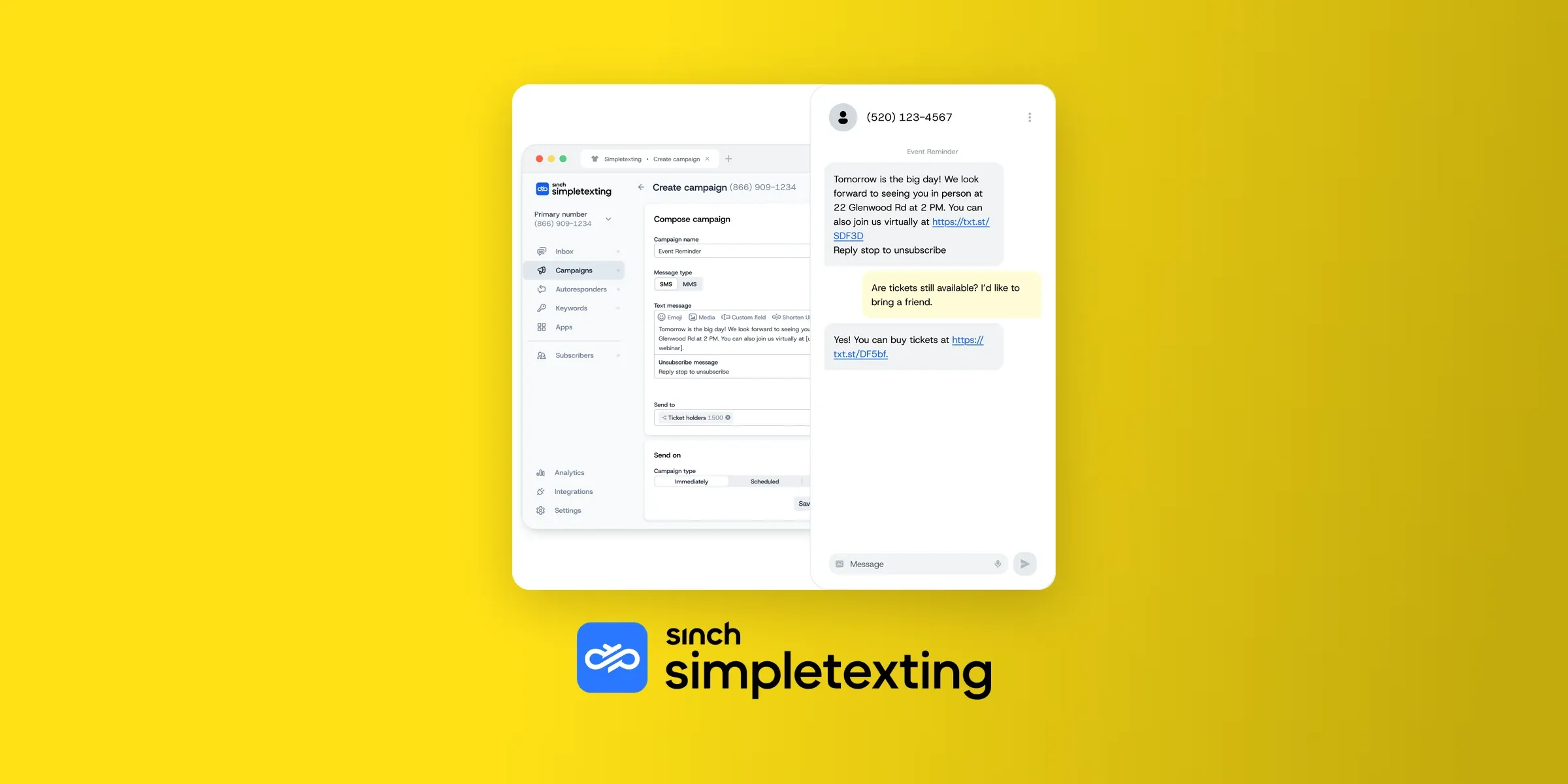
SimpleTexting is a marketing tool first, with keywords, web sign-up forms, drip campaigns and a two-way inbox for replies.
Its pricing page works as a calculator, showing the full monthly cost for your volume and number type. When we set the calculator to 1,000 texts, the monthly estimate went from $39 to $59, with the $10 local number shown as its own line. That's clearer than a headline price, and it let us price SimpleTexting to the cent.
Three user seats come with every paid plan. That makes it cheaper than it looks for teams of two or three.
Who SimpleTexting works best for
SimpleTexting fits a business sending campaigns to an opted-in list, with a few people handling replies. In our scenario, five users cost $91.70 a month, and $40 of that is the two extra seats.
A team of three sending 1,000 texts pays $51.70 a month on yearly billing. At that size it costs less than the phone systems, though it won't handle your calls.
SimpleTexting texting features
The marketing side includes keywords (customers text a word to join a list), web forms, scheduled and recurring texts, and drip campaigns.
The inbox side includes two-way texting, saved replies, away messages and conversation filters.
AI Assist helps you write and shorten messages. It's worth using, since a shorter text can drop from two credits to one.
Integrations include Mailchimp and Zapier.
SimpleTexting pricing
| Monthly texts | Billed yearly | Billed monthly |
|---|---|---|
| 500 credits | $23.20 | $29 |
| 1,000 credits | $39.20 | $49 |
| 2,000 credits | $63.20 | $79 |
Add $10 a month for a local number (a toll-free number has no extra fee) and $20 a month for each user beyond three. Registration is a one-time $4, and carrier fees run about $0.0025 per U.S. message.
Credits follow message length. A text up to 160 characters costs one credit, and one up to 306 characters costs two. An MMS costs three.
Incoming texts are free, while an incoming MMS uses one credit.
Extra credits cost 4 to 5.5 cents each, depending on your plan. There's a free trial with no credit card, and a 30-day money-back guarantee.
SimpleTexting pros and cons
Pros
- Pricing calculator shows the full monthly cost, including the number
- Three user seats on every paid plan
- Keywords, sign-up forms and drip campaigns built in
- Fewer phone calls: "I like SimpleTexting for its instant communication with clients, which means I don't have to try calling and getting voicemail." (James C., Oct. 2026, G2 review)
Cons
- Users four and up cost $20 a month each
- A 161-character text costs double
- Local numbers add $10 a month
- No one-click resend for failed texts: "It would be nice to have a feature on campaigns that have some numbers where the text failed to deliver to resend after the fix is in place just to those individuals." (July 2026, G2 review)
SimpleTexting demo
SlickText: best for text marketing on a tight budget
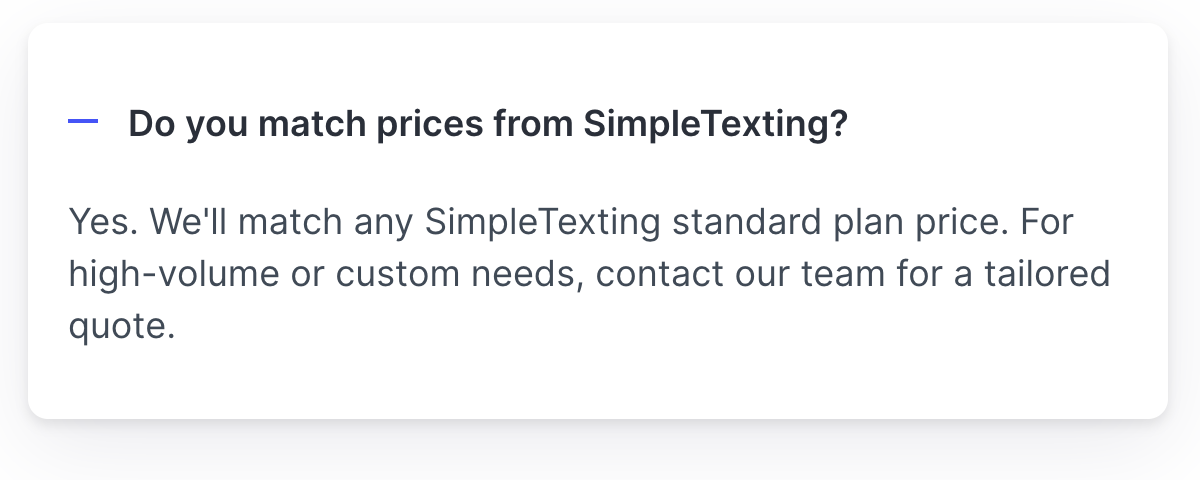
SlickText charges exactly the same credit prices as SimpleTexting ($29, $49 and $79 for 500, 1,000 and 2,000 credits a month). It includes a sending number in every plan, though, and lets unused credits roll over.
Its pricing FAQ even promises to match any SimpleTexting standard plan price. The two compete head to head.
It has the highest G2 rating in this guide, at 4.8 out of 5 from 1,940 reviews.
Who SlickText works best for
SlickText fits a business that sends campaigns to customers in the U.S. or Canada and wants the lowest monthly bill. Our scenario costs $45.03 a month on yearly billing, about half of SimpleTexting's $91.70.
The gap comes from the number fee and extra seats. You can add teammates, but SlickText's pricing doesn't list a price for them. Confirm it before you add a team.
SlickText texting features
Every plan includes every feature: campaigns, an inbox, workflows, web forms, website popups, keywords, segmentation and AI Compose. Integrations include Shopify and Zapier, and developers get an API with webhooks.
Unused credits roll over for one month on monthly plans and one year on yearly plans. That helps if you text more around holidays than in a typical month.
SlickText says many sending numbers get registered "within a few hours of your request." It supports U.S. and Canadian numbers only.
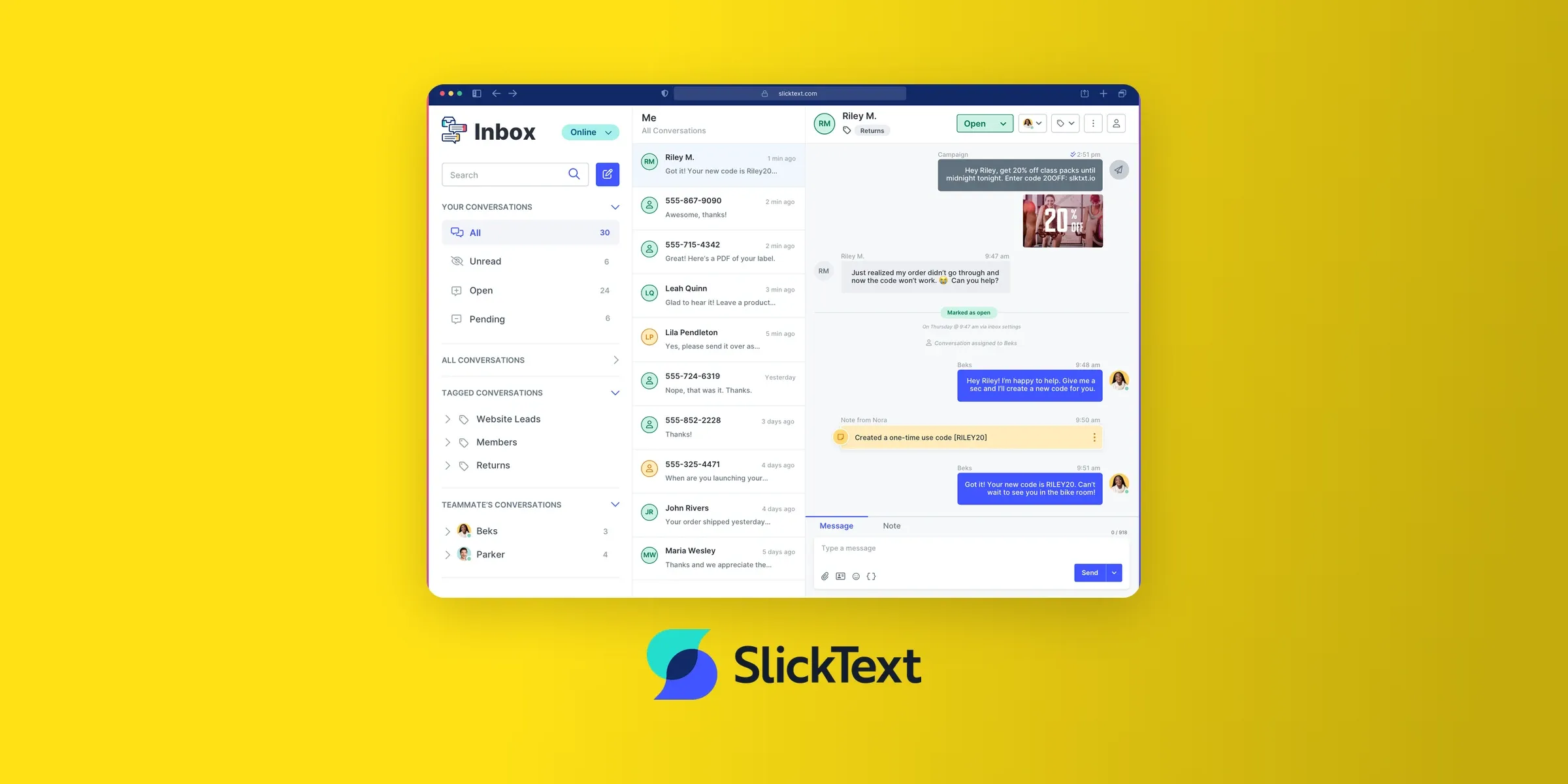
SlickText pricing
| Monthly credits | Billed monthly |
|---|---|
| 500 | $29 |
| 1,000 | $49 |
| 2,000 | $79 |
| 3,500 | $129 |
| 5,000 | $169 |
Yearly billing gives you two months free. That puts 1,000 credits at $490 a year, or $40.83 a month. One credit covers one 160-character segment to one contact, and an MMS uses three credits per segment.
Carrier fees are $0.0042 per U.S. SMS and $0.0087 per MMS, passed through without markup. There's a 14-day free trial with no credit card.
SlickText pros and cons
Pros
- Highest G2 rating here, from a large number of reviews
- Sending number included, and unused credits roll over
- Every feature on every plan
- Easy list growth: "The Join Link was so easy to set up and it's been helping my subscriber base grow steadily without much effort." (Blake T., Sept. 2026, G2 review)
Cons
- U.S. and Canadian numbers only
- Teammate pricing isn't published
- No overage price listed
- Steep jumps between plans: "the pricing feels a bit high when your text volume increases, and the jump between plans is quite steep." (Nitin V., June 2026, G2 review)
SlickText demo
Twilio: best for automated texts from your own software
Twilio is a developer platform. You get an API and phone numbers, and you build the app or workflow your business needs.
At $0.0083 per segment plus carrier fees, it's the cheapest way here to send 1,000 texts. Our scenario comes to about $14.50 to $16 a month, before the cost of building anything.
Who Twilio works best for
Twilio fits a business with a developer, sending reminders, alerts or login codes. If your booking or CRM software already connects to Twilio, you may not need to write code yourself.
It doesn't fit a team that wants an inbox to answer customers. Twilio's two-way threads run through its Conversations API, which a developer has to set up.
Twilio texting features
The Programmable Messaging API sends and receives SMS and MMS. You can text from local or toll-free numbers, and short codes are available for high volume.
The Twilio console includes registration tools for 10DLC (10-digit long code) and toll-free numbers. Add-ons like the Compliance Toolkit cost $0.015 per outbound SMS.
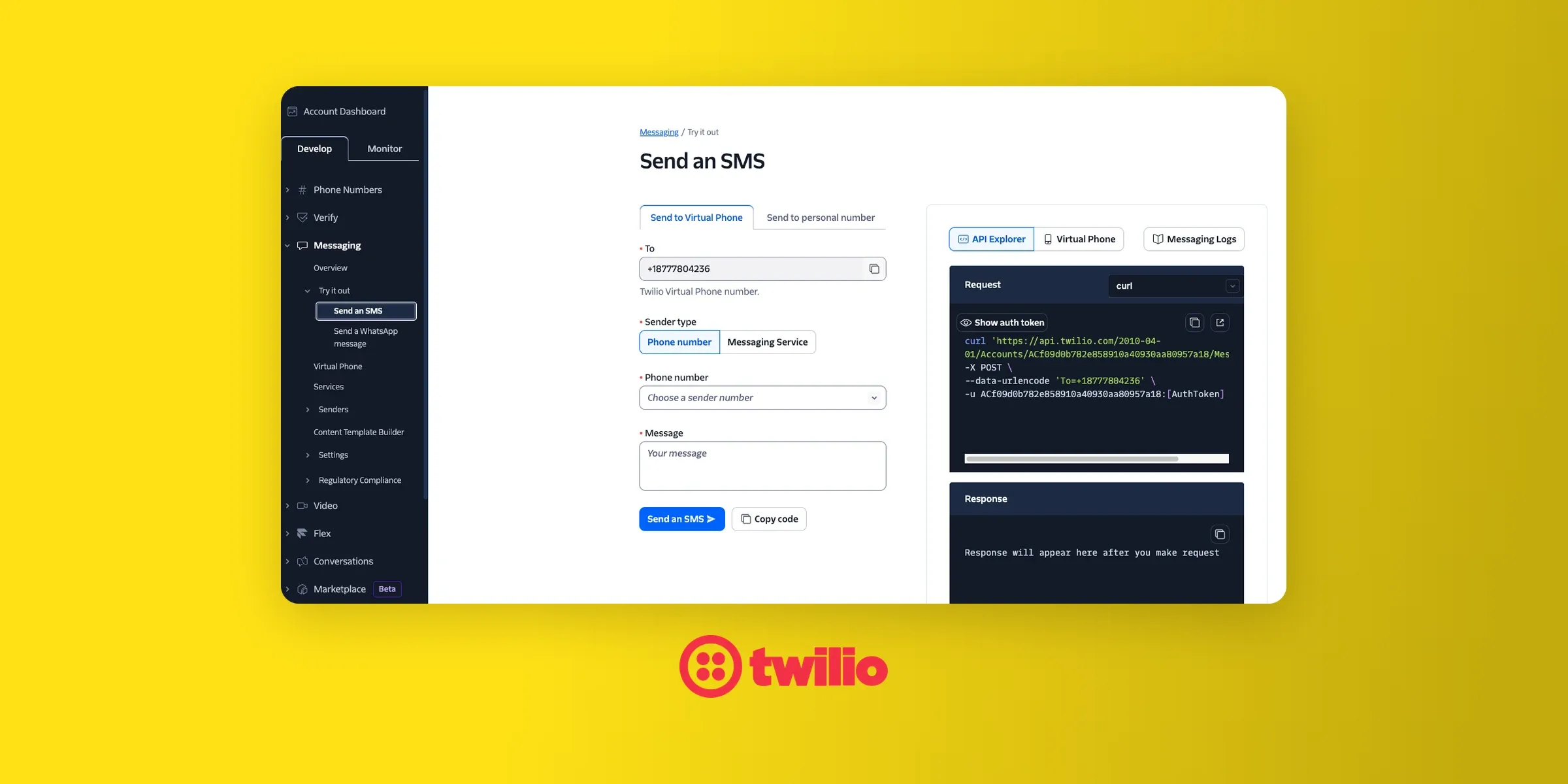
Twilio pricing
| Item | U.S. price |
|---|---|
| SMS, outbound or inbound | $0.0083 per segment |
| MMS, outbound | $0.022 per message |
| Carrier fee per outbound SMS (local numbers) | $0.0035 (AT&T) to $0.005 (Verizon) |
| Local number | $1.15 per month |
| Toll-free number | $2.15 per month |
Unlike most tools here, Twilio charges for incoming texts too, at the same $0.0083 per segment. If customers reply to half of your 1,000 texts, that adds about $4.15 a month.
A failed message costs $0.001.
Registration fees are passed through from carriers at cost. A small business with an employer identification number (EIN) pays $4.50 for brand registration and $15 for campaign vetting, then $1.50 a month.
These fees went up on Aug. 1, 2025, when brand registration rose from $4 to $4.50. Older guides still quote the lower numbers.
Twilio pros and cons
Pros
- Lowest price per text in this guide
- Short codes available for high-volume sending
- Registration tools built into the console
- Works with automation tools: "It's very easy to buy a phone number and connect it to n8n (or any other automation app) using an API or webhook." (Kristen C., June 2026, G2 review)
Cons
- Needs a developer or a connected app
- Incoming texts cost the same as outgoing ones
- Fees come from several places (segments, carriers, numbers, campaigns), which makes bills harder to predict
- Costs add up: "pricing can become expensive and complicated at scale, especially with carrier fees and compliance costs." (Janhvi P., May 2026, G2 review)
Twilio demo
ClickSend: best for pay-as-you-go texting without code
ClickSend sits between the marketing tools and the APIs. You top up a balance and send from a web dashboard or by email, with no subscription.
Users are unlimited, and you only pay for what you send. Our scenario comes to $36.09 a month.
Who ClickSend works best for
ClickSend fits a business that texts in bursts, like a monthly reminder round, and doesn't want a monthly plan. The minimum top-up is $20, which covers about 600 U.S. texts once the carrier fee is added.
It has the fewest G2 reviews in this guide, at 49. A 4.1 rating from that few reviews tells you less than SlickText's 4.8 from 1,940.
ClickSend texting features
You can send campaigns from the dashboard or text from your email inbox. Developers can connect through the API, and replies arrive free in the dashboard.
ClickSend says real people staff its chat 24 hours a day, every day of the year. It also offers a 99.95% uptime guarantee.
In the U.S., replies work through a toll-free number, which costs $3.49 a month. Toll-free numbers need verification before you can send, with business documents like your IRS EIN letter.
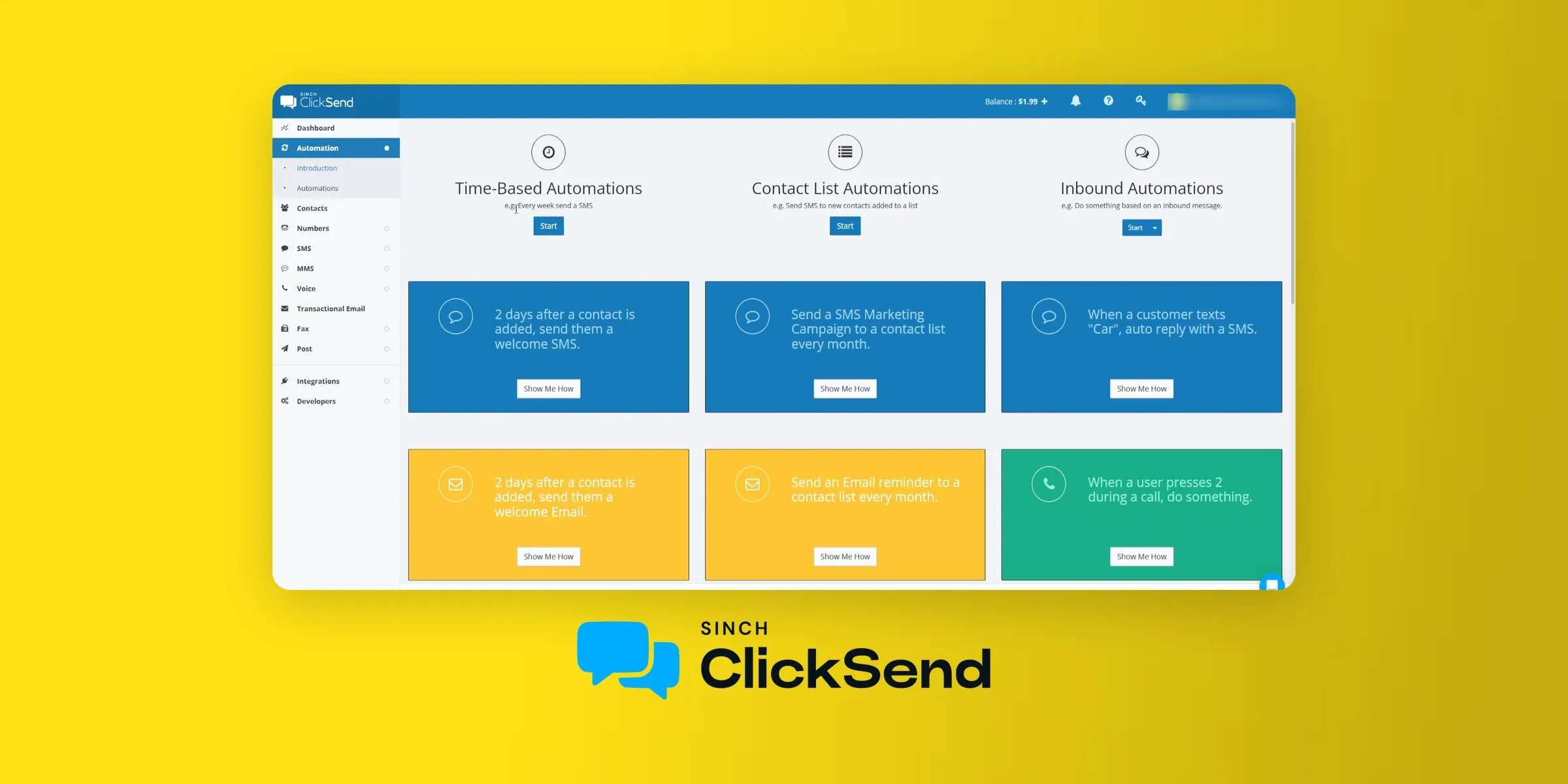
ClickSend pricing
| Top-up | Price per U.S. SMS |
|---|---|
| From $20 | $0.0285 |
| From $500 | $0.0203 |
| From $3,000 | $0.0131 |
| From $10,000 | $0.0093 |
ClickSend adds a flat carrier fee of $0.0041 per SMS. An MMS costs $0.037 plus a $0.0086 carrier fee.
At the entry tier, one text costs about 3.3 cents with the carrier fee. That's about two and a half times Twilio's rate, but you get a dashboard and don't need a developer.
ClickSend pros and cons
Pros
- No subscription, and users are unlimited
- Send from a dashboard or by email
- Round-the-clock live chat support
- Simple and affordable: "It's very easy to use, cost effective and useful for our SMS Marketing" (Justin T., Sept. 2025, G2 review)
Cons
- About 3.3 cents per text at the entry tier, about two and a half times Twilio's rate
- Only 49 G2 reviews
- U.S. two-way texting needs a toll-free number
- Basic feature set: "Lacks many of the bells and whistles of a more sophisticated program" (March 2025, G2 review)
ClickSend demo
What business texting really costs
Most tools bill per segment, and a segment is shorter than people expect.
A segment holds 160 characters of plain text. One emoji or a curly apostrophe switches the whole message to 70 characters per segment.
A 100-character message with a smiley face costs two segments. Accented letters like ç have the same effect, and phones often swap straight apostrophes for curly ones without asking.
Each recipient is billed separately. A two-segment message sent to 50 contacts uses 100 segments.
Here's the same 1,000 texts as in our main table, but with every message running to two segments.
| Tool | 1,000 texts, 1 segment | 1,000 texts, 2 segments | Difference |
|---|---|---|---|
| Quo | $76.50 | $76.50 | $0 |
| Allo | $160 | $160 | $0 |
| SimpleTexting | $91.70 | $118.20 | +$26.50 |
| SlickText | $45.03 | $74.23 | +$29.20 |
| Twilio | About $14.50 to $16 | About $26.25 to $29.25 | +$11.75 to +$13.25 |
| ClickSend | $36.09 | $68.69 | +$32.60 |
Quo and Allo don't change because typed texts are included in the seat price. Allo's 500 segments per user still cover 2,000 segments for five people.
Carrier fees add a fraction of a cent per segment on top. Most tools pass them through at cost, and they double along with your segments.
How to get 10DLC registration approved
10DLC is the U.S. system for registering business texts sent from local numbers. You register your business and your use case with The Campaign Registry, usually through your texting provider.
Until you're approved, you can't text U.S. numbers from that local number. Toll-free numbers go through a separate verification process.
What registration costs and how long it takes
| Tool | One-time fee | Monthly fee | Approval time the company quotes |
|---|---|---|---|
| Quo | $19.50 | $1.50 ($2 for sole proprietors) | Most in 24 to 48 hours, some up to 20 days |
| Allo | $24 for the whole company | None | Three to seven business days |
| SimpleTexting | $4 | Not listed | Not listed for local numbers |
| SlickText | Not listed | Not listed | Often within a few hours |
| Twilio | $19.50 ($4.50 brand + $15 campaign vetting) | $1.50 for low-volume use | Not listed |
Some applications take longer than 30 days on Quo when key details can't be verified. Plan for a week before your first campaign, and start registration the day you sign up.
The monthly fees add up. Over two years, registration on Quo costs $55.50 ($19.50 plus 24 × $1.50), against Allo's one-time $24.
Why registrations get rejected
Carriers reject registrations for a short list of reasons. Twilio publishes an error code for most of them, and the same rules apply whichever provider you use.
- Your privacy policy is missing or vague. It has to say you won't share mobile numbers or opt-in data with third parties for marketing (Twilio error 30908).
- Your consent checkbox is pre-checked. Customers have to tick it themselves.
- Texts are a condition of buying or signing up. Customers must be able to decline texts and still complete the purchase.
- Your opt-in is missing key language. It needs the message type, how often you'll text, "message and data rates may apply" and how to opt out.
- Your details don't match. Your EIN has to match your IRS paperwork (Form CP-575) exactly, and Quo notes it should be at least 30 days old.
If you're rejected, fix the specific issue and resubmit. On Quo, a resubmission costs $15.
How to choose a business texting service
Start with the job, then the team size. Here's what our scenario shows for each one.
Which service fits customer conversations?
A phone system with texting. Quo's Starter plan is the lowest-cost choice at $15 per user/month billed yearly.
If you also want AI summaries on every call and CRM sync, both put them on their Business plans: $23 per user on Quo and $32 on Allo.
Allo keeps those summaries next to the text conversation, on the same number your customers call.
Which service fits text marketing campaigns?
SlickText or SimpleTexting. SlickText costs less in our scenario ($45.03 against $91.70), with the number included and no published seat charge.
SimpleTexting suits a team that wants every cost published up front, with three seats included.
Keep messages under 160 characters with no emoji. That's the easiest way to halve your credit spend.
Which service fits automated reminders from your own software?
Twilio, if you have a developer or your software already connects to it. ClickSend, if you'd rather send from a dashboard or by email and pay as you go.
Twilio costs about 1.2 to 1.3 cents per segment with carrier fees. ClickSend costs about 3.3 cents at the entry tier, and you skip the build.
Conclusion
A business SMS service is the right choice only if it matches the job. Our six picks, by job:
- Customer conversations on a budget: Quo, at $76.50 a month for five people with texting included.
- Calls and texts in one shared inbox, with AI summaries: Allo, at $160 a month for five people on the Business plan.
- Text marketing at the lowest monthly price: SlickText, at $45.03 for 1,000 texts on yearly billing.
- Text marketing with every cost published: SimpleTexting, with three seats included and a calculator that shows the full cost.
- Automated texts from your own software: Twilio, at under 2 cents per segment with carrier fees.
- Pay-as-you-go texting without code: ClickSend, with a $20 minimum top-up and unlimited users.
Whatever you pick, budget for registration before your first text and keep messages under 160 characters. That second segment doubles the price on every tool that bills per text.
FAQ
Is there a free business SMS service?
Not one you can rely on for business. Most tools offer a free trial (SlickText gives 14 days), but texting to U.S. numbers needs carrier registration, and every provider passes on carrier fees. Google Voice is often called free, but its business plans start at $10 per user/month. The lowest entry cost in this guide is ClickSend: a $20 top-up with no subscription.
Is B2B texting legal?
Yes, as long as you have consent. Business-to-business (B2B) texts follow the same consent rules as texts to consumers. The person has to opt in, and they can reply "STOP" to opt out at any time. Registration enforces this. Carriers check your opt-in language and privacy policy before approving your number.
How do I get a business SMS number?
You get it from your texting provider when you sign up. Most offer a local number (10DLC) or a toll-free number, and some let you port an existing number. Before you can text U.S. customers, register the local number through The Campaign Registry or verify the toll-free number. Your provider handles the paperwork.
Can I text customers from my personal cell phone?
You can, but the conversation stays on your phone. When an employee leaves, the customer's texts and number leave with them. A business number keeps every thread in a shared inbox your team can see. It also gets registered for business texting, which carriers expect for messages a business sends.
Can I use a toll-free number for business texting?
Yes. Toll-free numbers go through toll-free verification instead of 10DLC registration, and you'll need business documents like your EIN letter. Toll-free works well for national campaigns, and ClickSend uses toll-free numbers for two-way texting in the U.S. Some features differ, though: on Quo, group texts only work from local numbers.
Sources
- Quo pricing
- Allo pricing
- SimpleTexting pricing
- Twilio U.S. SMS pricing
- ClickSend U.S. pricing
- Twilio campaign rejection error codes