HIPAA BAA for a business phone system: what it must cover
A signed BAA doesn't mean your AI receptionist is covered. What a phone-system BAA should include, what no BAA can cover, and 8 questions to ask before you sign.
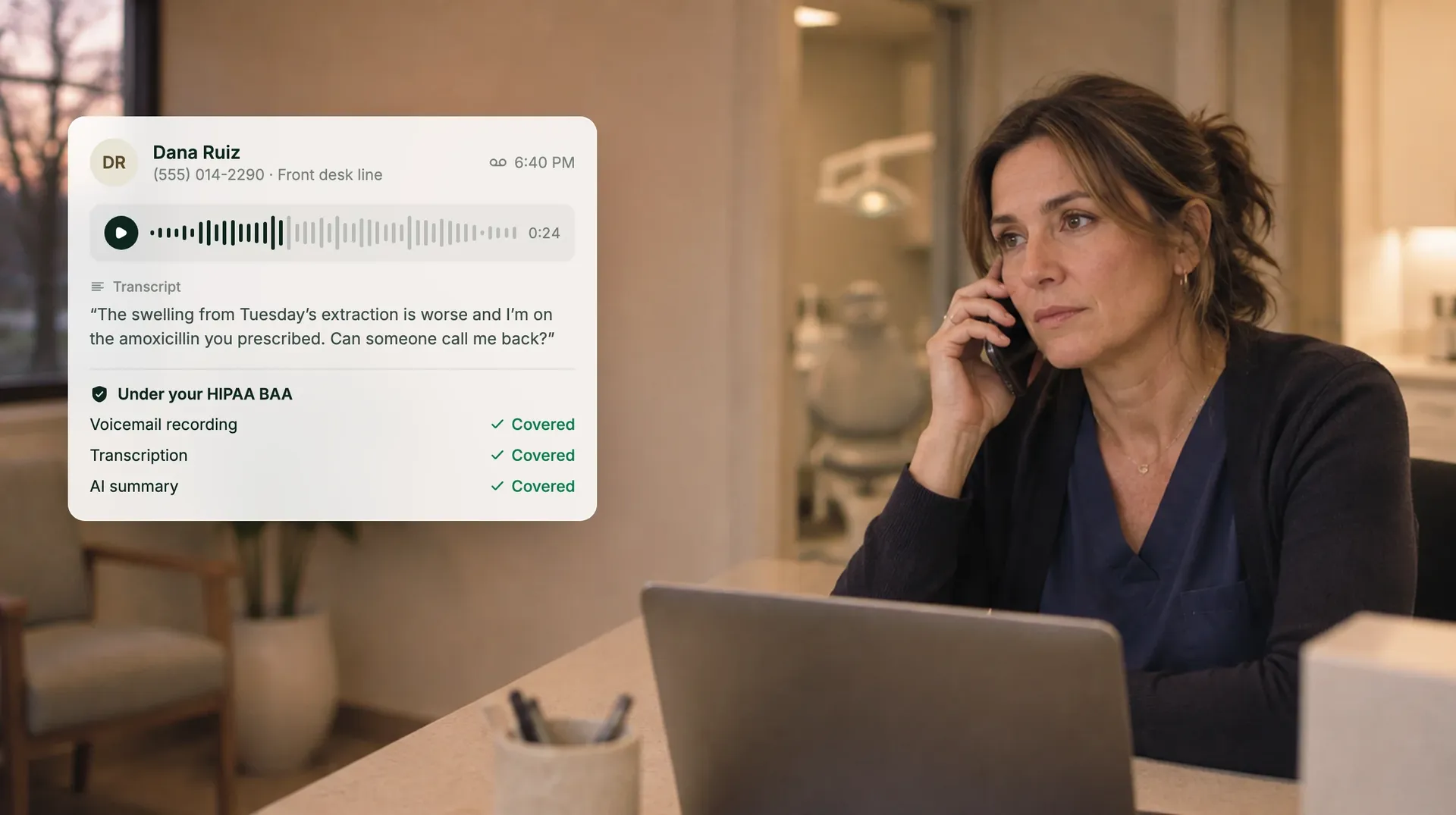

If your practice handles patient calls, the business associate agreement (BAA) with your phone provider is one of the most important contracts you sign. It's also one that a lot of providers handle loosely: they offer a BAA, but leave out the features that now touch the most patient data, like transcription and AI. To see why that matters, follow one ordinary call.
A patient calls your front desk at 6:40 p.m. Nobody picks up, so they leave a voicemail: "Hi, it's Dana Ruiz, date of birth March 3rd. The swelling from Tuesday's extraction is worse and I'm on the amoxicillin you prescribed. Can someone call me back?"
In under a minute, that voicemail contains a name, a date of birth, a procedure, a symptom and a prescription. It's protected health information (PHI). And on a modern phone system, it doesn't stay in one place. It gets stored as audio, turned into a text transcript, maybe summarized by AI, pushed as a notification to a staff member's phone, and possibly copied into a CRM.
Each of those places is either covered by your vendor's business associate agreement (BAA) or it isn't. Most practices sign the BAA and never check which.
This guide is about that contract: what a BAA for a business phone system needs to cover, why AI features are where most of them fall short, what no phone BAA can cover, and the questions to ask before you sign. If you're looking for a side-by-side of providers and prices instead, we covered that in our HIPAA-compliant VoIP comparison.
A quick disclosure: Allo is our own product, and we'll show you what our BAA covers and what it doesn't. Every claim about another vendor links to that vendor's own documentation, checked in November 2026.
What a BAA is, and why your phone system needs one
HIPAA applies to covered entities (health care providers that bill electronically, health plans and clearinghouses) and to their business associates, the companies that "create, receive, maintain, or transmit" PHI on their behalf. (If you want to read more in detail you can always go to 45 CFR 160.103).
A business associate agreement is the contract between the two. HIPAA requires it before the vendor touches any PHI, and 45 CFR 164.504(e) lists what it must contain: what the vendor may and may not do with the data, the safeguards it must use, how it reports breaches, how it binds its own subcontractors, and what happens to the data at the end of the contract.
The "conduit exception" : why your old phone line didn't need one
Your landline carrier never asked you to sign a BAA, and it didn't have to. HIPAA makes an exception for companies that only carry information from one place to another without keeping it. It's just like the postal service: the mail carrier moves your letter, but doesn't open it, copy it or store it once it's delivered.
A traditional phone line works the same way. The carrier connects the patient's voice to your receptionist's handset in real time. When the call ends, nothing about what was said stays with the carrier. Any contact it had with the information was brief and incidental, so it isn't your business associate.
The exception is narrow, though. In its FAQ on cloud service providers, HHS says the conduit exception is "limited to transmission-only services." The moment a provider keeps patient data, it's a business associate, "even if the CSP (cloud service provider.) does not actually view the information." In other words, it doesn't matter whether anyone at the vendor ever listens to a recording. Storing it is enough.
A cloud phone system doesn't just carry calls. It keeps what happens on them:
| Conduit (traditional phone line) | Business associate (cloud phone system) | |
|---|---|---|
| What it does with a call | Connects it, then forgets it | Connects it and keeps records of it |
| Voicemail | Kept on your own answering machine, not by the line | Stored on the vendor's servers |
| Recordings and transcripts | None | Stored, often processed by AI |
| Call logs and contact notes | None that include patient details | Stored, searchable, often synced to other tools |
| Needs a BAA? | No | Yes |
What happens without a BAA
The fines for skipping a BAA are real and public. A few HHS Office for Civil Rights (OCR) settlements:
- Raleigh Orthopaedic Clinic, $750,000: it handed X-ray films and PHI for 17,300 patients to a vendor without a signed BAA. (HHS)
- North Memorial Health Care, $1.55 million, and Care New England, $400,000: both over missing or outdated business associate agreements. (HIPAA Journal's settlement list)
- The Center for Children's Digestive Health, $31,000: a pediatric practice that had shared PHI with its records-storage company since 2003, but neither side could produce a signed BAA from before 2015. (HHS)
None of these were phone systems. But the logic is identical: if a vendor holds your patients' information and you can't show the contract, the practice is the one OCR settles with.
What a good phone-system BAA should cover
A phone system touches patient information in more places than most practices realize. Here's the Dana Ruiz voicemail from the top of this article, followed through a typical cloud phone system:
| Step | What happens | Where the PHI ends up | Covered by the BAA? |
|---|---|---|---|
| 1. The call rings | Caller ID, call routing, phone menu | Call log: who called, when, which line | Should be |
| 2. Voicemail | Audio is recorded and stored | Vendor's storage | Should be |
| 3. Transcription | Audio is sent to a speech-to-text engine | Vendor or its AI subcontractor | Varies the most |
| 4. AI summary and tags | A language model reads the transcript | Vendor or its AI subcontractor | Varies the most |
| 5. Notification | Staff gets a push or email alert | Phone lock screen, email inbox | Push yes, email depends on your email vendor |
| 6. Callback | Staff calls back, call is recorded | Vendor's storage | Should be |
| 7. Text follow-up | "Please come in tomorrow at 9" | Carriers, the patient's phone | No vendor can fully cover it |
| 8. CRM sync | Notes copied to your CRM or EHR | The third party's servers | Only that third party's BAA covers it |
Eight steps, at least eight copies of the same information. A BAA that just says it covers "the services" doesn't tell you which of these steps are included. Look for a contract (or an exhibit to it) that names them.
At a minimum, a phone-system BAA should cover:
- Inbound and outbound calls, including call metadata like numbers, timestamps and durations.
- Voicemail, both the audio and its transcription.
- Call recordings, wherever they're stored.
- Phone menus (IVR) and call routing, since callers often say or press things that identify them.
- Number management, including porting, because the porting process involves account and caller records.
- The vendor's own apps (desktop, mobile, web), and the API if you'll use it.
- Any AI feature you plan to turn on. This is the part to read twice.
The AI question: transcription, summaries and AI receptionists
Five years ago, a phone system stored audio and that was about it. Now it transcribes every call, writes a summary, tags the call ("new patient," "billing question") and in some cases answers the phone with an AI receptionist.
Each of those features sends patient information somewhere new, usually to an AI provider the phone vendor uses as a subcontractor. That's why AI is where BAA coverage splits into three scenarios.
Scenario 1: AI is excluded or switched off
Some vendors handle the risk by disabling AI features for HIPAA customers, or by leaving them outside the BAA. You keep the phone system, but lose transcription or summaries, sometimes without a clear list of which features are affected.
Three examples from vendors' own documentation:
- RingCentral: its support article says "if HIPAA compliance is turned on, voicemail-to-text will be turned off" (RingCentral support). Its AI transcription page, meanwhile, says voicemail-to-text "automatically adjusts" for HIPAA customers. When two pages from the same vendor disagree, ask which one your contract follows.
- Zoom: AI features are available with a BAA, but "certain AI features may not be available at this time" for healthcare customers, and Zoom doesn't say which ones (Zoom support).
- Nextiva: its HIPAA feature table leaves voicemail transcripts, voicemail-to-email and SMS unchecked in the HIPAA column, even though its newer AI receptionist, XBert, is described as HIPAA-eligible with a BAA.
None of this makes these products bad choices. It means the feature you bought the phone system for might be the one that's off once the BAA is signed.
Scenario 2: AI is allowed, but the risk is yours
Others let you use AI but put conditions on it that move the responsibility to your practice.
Quo (formerly OpenPhone) is the clearest example, and to its credit, its HIPAA help page spells it out. Under Quo's BAA, your practice may use AI-powered features only if all of these are true:
- Patients are told when AI is used and when a call is recorded.
- You "obtain authorization from the patient before communicating through an AI-assisted voice or messaging session."
- You limit the PHI the AI processes to the minimum necessary.
- You document the decision and its risks in your HIPAA policies.
- You put safeguards in place, like access controls and staff training.
The page then says your organization "assumes full responsibility for any PHI processed through AI-powered features."
The second condition is the one to think through. Under HIPAA, an authorization is a specific, signed document with required elements, described in 45 CFR 164.508. It's not the same as a recorded notice at the start of a call.
Here's where it gets practical. Say a new patient calls your med spa at 9 p.m. and Quo's AI agent, Sona, picks up. That caller has never signed anything with you. If you take Quo's condition literally, you'd need their authorization before the AI-assisted conversation starts, which is hard to arrange for someone you've never met. Talk to your compliance advisor about how your practice would meet that condition before you turn AI answering on.
Scenario 3: AI is a covered service
The third option is a BAA that lists AI features as covered services, alongside calls and voicemail, and then binds the AI providers behind them with the same obligations.
When a BAA covers AI, check three things in the contract:
- The AI subcontractors are bound. HIPAA already requires every subcontractor that handles PHI to agree to the same restrictions (45 CFR 164.502(e)(1)(ii)). The BAA should say so for AI providers specifically.
- No training on your data. The contract, not just a marketing page, should say patient data won't be used to train or improve AI models. A privacy page can change without notice. A signed contract can't.
- No reuse or extra retention. The AI provider should keep data only as long as it needs to deliver the service, and never use it for anything else.
What Allo's BAA covers
Allo's BAA (August 2026 version) is in camp 3. It lists these as covered services:
- Core apps, inbound and outbound calls, voicemail, phone menus and routing, number management and the API.
- Call recording, AI call transcription and voicemail transcription.
- AI call summaries and call tags.
- The AI receptionist, including the messages callers leave with it and its call notes.
Three clauses go further than the HIPAA minimum:
- Section 2.2, no training: patient data is never used to train or improve AI models.
- Section 2.7, AI vendors: every AI provider that processes your data must sign an agreement with the same obligations, can't keep the data longer than needed, and can't reuse it.
- Breach notice: Allo notifies you without unreasonable delay, and within 60 days at most, which matches the outer limit HIPAA sets in 45 CFR 164.410.
One good example is Allo, where the BAA is available on the Business and Ultra plans, billed annually, as a $50 per month add-on for the whole workspace, whatever the number of seats.
It doesn't cover everything, and we'd rather you hear it from us. These are outside Allo's BAA:
- SMS and MMS (more on why below).
- Voice agents other than the AI receptionist, and the AI Call Assistant.
- AI-drafted emails and messages, and post-call actions.
- AI calendar booking, because the booking is written into a third-party calendar.
- CRM and calendar integrations, and the MCP that connects Allo to AI assistants.
In practice: the AI receptionist can answer a patient, take their message and write call notes under the BAA. If you also let it book the appointment into Google Calendar, the calendar entry lives at Google, under whatever agreement you have with Google.
What no phone BAA can really cover
Some gaps aren't about which vendor you pick. They come from how the technology works, and a vendor that claims to cover them deserves a follow-up question.
SMS and MMS
A text message leaves your phone vendor's systems and travels through the carrier chain: your vendor's messaging provider, intermediary networks and the patient's wireless carrier. None of those companies are bound by your vendor's BAA, and standard SMS isn't end-to-end encrypted. That's why Quo's help page says texting "is not a Covered Service under the Quo BAA due to technical limitations," and why Allo's BAA excludes it too.
Texting patients isn't banned, though. HHS's FAQ on email says the Privacy Rule "does not prohibit the use of unencrypted e-mail for treatment-related communications," as long as you apply reasonable safeguards, like limiting what you send. And patients have a right to ask to be contacted by alternative means under 45 CFR 164.522(b). Most compliance advisors apply the same logic to texts.
How to work around it:
- Get consent to text, and document it. Note that the patient was told texts aren't secure.
- Keep clinical details out. "Your appointment is confirmed for Thursday at 9:00. Reply C to confirm" works. "Your biopsy results are in" doesn't.
- Move anything sensitive to a covered channel, like a callback or your patient portal.
- Mind carrier rules too. US carriers' A2P 10DLC rules apply on top of HIPAA, and they block some content, including messages promoting prescription drugs, as Quo's help page notes.
Third-party integrations
When your phone system pushes a call summary into a CRM, a calendar or a spreadsheet, the data now sits with that third party. Your phone vendor's BAA ends at its own systems. Both Allo and Quo exclude integrations from their BAAs for this reason.
How to work around it: only connect tools that sign their own BAA with you (Google Workspace and some EHRs do), or keep PHI out of what you sync. A summary that says "patient called about a scheduling change" is safer to sync than one with symptoms in it.
Email notifications and personal devices
Voicemail-to-email and missed-call emails copy PHI into your inbox. That's fine if your email provider is under a BAA, and a problem if it isn't. The same goes for lock-screen previews on a staff member's phone: the BAA doesn't control who's looking at the screen.
How to work around it: turn off voicemail-to-email unless your email is covered, hide notification previews, and require a passcode on any device that runs the phone app.
Allo vs Quo vs other phone systems: BAA coverage compared
All details come from each vendor's public documentation, checked in November 2026. "Not published" means we couldn't find it on the vendor's site, not that it doesn't exist. Ask the vendor.
| Vendor | Who can get the BAA | AI transcription and summaries | AI receptionist or agent | SMS/MMS | "No training on your data" | Integrations |
|---|---|---|---|---|---|---|
| Allo | Business and Ultra plans, annual. $50/month per workspace | Covered | AI receptionist covered, incl. caller messages and notes. Other voice agents excluded | Excluded | In the BAA (section 2.2) | Excluded |
| Quo | Business and Scale plans | Allowed only with patient notice and authorization. Practice "assumes full responsibility" | Same conditions apply to Sona | Excluded | Not stated on its HIPAA page | Excluded |
| Zoom Phone | Pro, Business, Business Plus, Enterprise | Available, but "certain AI features may not be available." Not named | Not specified | Not addressed on its BAA page | Stated on its BAA support page | Not specified |
| RingCentral | On request. Plans not published | Voicemail-to-text turned off with HIPAA on, per support | Not published | Not listed in its BAA scope | On privacy and AI pages, not shown in the BAA | Not specified |
| Dialpad | All paid accounts, self-signed by an admin | Coverage not stated | Coverage not stated | Not published | Accounts with a BAA are excluded from AI training | Not specified |
| Google Voice | Workspace "managed users only" | Gemini in Workspace is on the covered list. Voice transcription not addressed separately | Not applicable | Not addressed separately | On product pages, not in the BAA | Third-party add-ons excluded |
| Nextiva | Required for HIPAA products. Plans not on its HIPAA page | Voicemail transcripts unchecked in its HIPAA table | XBert "HIPAA-eligible" with a BAA | Unchecked in its HIPAA table | Not published | CRM unchecked |
Sources: Allo, Quo, Zoom, RingCentral, Dialpad and its healthcare page, Google, Nextiva.
Two patterns stand out. First, every vendor excludes or skips SMS, which confirms it's a technology limit, not a vendor choice. Second, only a few vendors put the no-training promise anywhere near the BAA. Most put it on a privacy or marketing page, which the vendor can update on its own.
For Quo specifically, the comparison comes down to AI. Quo's BAA is honest about its limits, and for calls, voicemail and a shared inbox it does the job. But if your practice wants AI to answer, transcribe or summarize patient calls, Quo makes that your responsibility, with patient authorization first. Allo's BAA makes it a covered service.
8 questions to ask a phone vendor before you sign the BAA
Copy these into an email to the vendor. Ask for the answers in writing, ideally as part of the BAA or an exhibit to it.
- Which services are covered? Ask for a list naming calls, voicemail, recordings, transcription, AI summaries, the AI receptionist, the mobile app and the API. "All services" isn't an answer.
- Which features are excluded or switched off under the BAA? Get the exclusions in writing too, including SMS, integrations and any AI feature.
- Do you need my patients' authorization to use AI features? If yes, ask how they expect you to get it from a first-time caller.
- Which AI providers process my calls, and have they signed equivalent terms? Ask where in the contract the AI subcontractors are bound.
- Will my data be used to train AI models? Look for a clause in the contract, not a line on a marketing page.
- How fast will you tell me about a breach? HIPAA's outer limit is 60 days from discovery. Many vendors commit to less, and the faster you know, the sooner you can meet your own obligations to patients.
- Which plans include the BAA, and what does it cost? Some vendors require a specific plan or annual billing, and some charge a fee per workspace or per user.
- What happens to my data if I leave? HIPAA requires the vendor to return or destroy PHI at the end of the contract where feasible. Ask how, and how long it takes. Also ask about retention settings: can you delete recordings and transcripts automatically after a set number of days?
After you sign: 6 settings to check in week one
The BAA covers the vendor. Your practice still has to run its own risk analysis under the Security Rule and set the system up sensibly.
- One login per person. No shared front-desk accounts, so you can tell who accessed what.
- Recording consent. About a dozen states, including California, Florida, Pennsylvania and Washington, require all-party consent to record a call. Play a consent message at the start of recorded calls.
- AI disclosure, if you're in California. California's AB 3030 requires clinics using generative AI for patient communications about clinical information to disclose it and explain how to reach a human, unless a licensed provider reviews the message first.
- Store less. If you don't need call audio, a privacy mode that keeps transcripts but drops the recording reduces what you hold. Allo's privacy mode and retention settings do this.
- Rewrite your greeting and voicemail prompt. "Please leave your name and number, and don't share medical details" cuts how much PHI ends up in voicemail.
- Turn off what isn't covered. If an integration, email notification or AI feature sits outside your BAA, switch it off until you've decided how to handle it.
Coming soon: annual vendor verification
In January 2025, HHS proposed the first major update to the HIPAA Security Rule since 2013. Among other changes, the proposed rule would require covered entities to get written verification from each business associate, at least once a year, that it has deployed the required technical safeguards. As of late 2026 the rule hasn't been finalized (HIPAA Journal, Compliancy Group). If it passes as proposed, your phone vendor will be on that list, so it's worth choosing one that can document its safeguards now.
Frequently asked questions
Is a HIPAA-compliant phone system enough on its own? No. HHS doesn't certify phone systems, so "HIPAA compliant" on a vendor's site means the vendor signs a BAA and has safeguards in place. Compliance also depends on how your practice uses the system: who has access, what you record, what you text and what you connect to it.
Is SMS HIPAA compliant? Texting patients isn't prohibited, but no phone vendor can fully cover SMS under a BAA, because texts pass through carriers outside the vendor's control. Get the patient's consent, warn them texts aren't secure, and keep clinical details out of messages.
Can an AI receptionist be HIPAA compliant? Yes, if the vendor's BAA covers it as a service, binds the AI providers behind it to the same terms, and doesn't use your data for training. Check the BAA's covered services list: some vendors exclude AI, and some allow it only with patient authorization. Allo's BAA covers its AI receptionist, including caller messages and call notes.
Do I need a BAA for voicemail? Yes. Voicemails often include names, dates of birth and symptoms, and a cloud phone system stores them. HHS treats a vendor that stores PHI as a business associate, so voicemail needs to be covered by your BAA, along with its transcription.
Are AI call transcripts covered by a standard BAA? Not always. Transcription usually runs on a third-party AI engine, so check that transcription is a named covered service and that the AI provider is bound by equivalent terms.
Does the BAA cover my CRM or EHR integration? Usually not. Once your phone system sends data to another tool, that tool needs its own BAA with you. Check each integration separately.
How long does a vendor have to report a breach? Under 45 CFR 164.410, a business associate must notify you without unreasonable delay and no later than 60 calendar days after discovering a breach.
Do therapists and med spas need a BAA for their phone system? A therapist who bills insurance electronically is a covered entity, so yes. Med spas vary: if a medical provider on staff bills health plans electronically, HIPAA likely applies. If you're not sure whether HIPAA applies to you, ask a healthcare attorney before patient information goes through your phone system.
Request Allo's BAA
If you want AI transcription, summaries and an AI receptionist on your practice's phone line, and want them under the BAA, Allo signs one on the Business and Ultra plans.
https://help.withallo.com/en/support/contact
*This article is general information, not legal advice. For decisions about your practice's HIPAA obligations, talk to a healthcare attorney or compliance advisor.