










The call ends. A summary lands in your CRM. Your rep moves on to the next prospect.
That workflow happens thousands of times a day across sales teams everywhere. And in most of those cases, no one has stopped to ask a simple but important question: was that legal?
Somewhere between "this call may be recorded for quality purposes" and actually being compliant, there's a gap that most sales teams are quietly living in.
Get it wrong, and you're not just looking at an awkward conversation with legal, you're looking at criminal penalties, civil suits, and regulatory fines that can reach into the millions.
This guide breaks down what call recording compliance actually means, where the legal lines are drawn, and how Allo's built-in compliance tools make it possible to stay protected without sacrificing the call intelligence your team depends on.
Legal Highlight
Everything in this guide is designed to help you understand your options and configure Allo's compliance tools effectively. It is not legal advice. Recording laws are genuinely complex, they vary by jurisdiction, and they change. For any specific compliance question about your business, particularly if you're in a regulated industry, operating across multiple countries, or have had any regulatory inquiries, consult legal counsel.
Allo's compliance tools are designed to make compliance achievable without sacrificing the call intelligence your team depends on. But the configuration decisions are yours to make, ideally in consultation with someone who knows the specific laws that apply to your situation.
Quick reading
Here's how to think about this practically, depending on how your team operates.
If you're primarily inbound: Turn on a consent message org-wide. Every caller is notified before the call connects. You're covered in all-party consent states, under GDPR, and in every other jurisdiction that requires notification. Store recordings according to your retention policy.
If you're primarily outbound, calling across the US: Enable Privacy Mode for your outbound lines. This means no audio files are stored, which eliminates exposure under all-party consent statutes. You keep full transcripts and AI summaries. Train reps to open calls to dual-consent state prospects with a verbal disclosure. Apply the same approach when the area-code-based automatic compliance feature ships.
If you're calling into the EU: Enable the consent message for inbound calls with an affirmative opt-in mechanism (press 1 to consent). Use Privacy Mode for outbound calls to minimize data collection. Configure recording at the line level to maintain proportionality: not every line needs to record every call. Sign a DPA with Allo, set retention to 6 months for audio (CNIL recommendation), and consider switching to Mistral for European AI processing if data jurisdiction matters to your customers.
If you're calling into Canada: Enable the consent message for all inbound calls. For outbound calls, train reps to verbally disclose recording at the start. Treat Canada as an all-parties consent jurisdiction, not a one-party consent one. If you serve Canadian financial services clients, be prepared to answer questions about data residency and storage location.
If you're in healthcare: Contact Allo support about the HIPAA BAA, configure retention to meet the 6-year minimum, and make sure your consent disclosures specifically cover AI analysis of call content.
If you have high call volume in Illinois: Get specific legal advice about BIPA and speaker identification features before enabling any voice biometric analysis.
*All terms and specifications are explained below. * For enterprise customers, Allo provides a comprehensive Data Processing Agreement (DPA) as part of its Master Service Agreement. The DPA contractually defines the responsibilities of each party under GDPR, covering data storage, retention, deletion, and access rights.

The Problem: Recording Laws Are Fragmented and Unforgiving
Most sales teams operate under the assumption that recording a call is fine as long as there's a quick disclaimer at the start. And in some places, that's true. But "some places" is doing a lot of work in that sentence.
In the United States alone, there is no single federal standard for call recording consent. The federal baseline, set by the Electronic Communications Privacy Act, follows a one-party consent model, meaning only one person on the call (typically you, the person recording) needs to be aware the recording is happening. That sounds simple enough. But 13 US states have passed their own, stricter all-party consent laws that require every participant on a call to be notified and to consent before recording begins.
Now imagine you're running a 15-person outbound sales team dialing across all 50 states. Your rep in Austin calls a prospect in California. Texas follows federal one-party consent rules. California is the strictest all-party consent state in the country, with criminal penalties for violations. Which law applies? The stricter one. Always.
Across the Atlantic, the EU's General Data Protection Regulation establishes a uniform framework across member states, but it comes with its own set of requirements around consent, data storage, deletion timelines, and documentation that go well beyond a pre-call announcement. France's data protection authority, CNIL, adds yet another layer of enforcement.
Canada's federal PIPEDA framework requires knowledge and consent of all parties for call recording, making it closer to the EU model than the US one-party baseline. Quebec's Law 25 adds additional provincial requirements on top of this. The UK maintains GDPR-equivalent standards post-Brexit, with additional regulations around internal recordings under RIPA.
The point is not to overwhelm you with acronyms. The point is that the patchwork of overlapping laws creates real exposure for any team that records calls without a deliberate compliance strategy. And the consequences are not abstract.
One-Party vs. All-Party Consent: The Core Distinction
The most fundamental thing to understand about call recording compliance is the difference between one-party and all-party (also called two-party or dual-party) consent frameworks.
One-party consent means only one person on the call needs to know the recording is happening. If you are the one recording, you satisfy the requirement simply by being present. You don't need to notify the other party. This is the federal baseline in the US, and it applies in the majority of US states, as well as in certain Australian states like Queensland.
All-party consent means every participant on the call must be informed and must consent before the recording begins. This is the standard in 13 US states including California, Florida, Illinois, Massachusetts, Pennsylvania, and Washington, across the EU under GDPR, under GDPR-equivalent frameworks in the UK, in Canada under PIPEDA, and in Australian states like New South Wales and Victoria.
There's an important nuance here: in the US, "consent" doesn't necessarily mean an explicit verbal "yes." In many US jurisdictions, continued participation in the call after a clear disclosure counts as implied consent. This is why pre-call announcements like "This call may be recorded for quality and training purposes" are so widely used, they satisfy the notification requirement, and the caller's decision to stay on the line constitutes consent in most US all-party jurisdictions. Under GDPR, however, the standard is different: implied consent is not sufficient, and businesses must either obtain affirmative agreement or rely on a separate legal basis like legitimate interest. That distinction is covered in detail in the EU section below.
The challenge for sales teams doing outbound calls is that you can't always control where your prospects are located. A prospect with a 617 area code (Boston) is calling from Massachusetts, one of the strictest states in the country. A prospect with a 213 (Los Angeles) or 310 (Beverly Hills) area code is in California. These aren't obscure edge cases, these are major business markets that any outbound team will regularly be calling.
For inbound calls, a pre-call consent message solves the problem cleanly. For outbound calls, the solution requires a different approach, which is where Allo's compliance toolset becomes critical.
US All-Party (Dual) Consent States: 13 States
These states require all parties to consent before a call can be legally recorded.
All other states follow one-party consent (federal baseline).
The Three-Tier Model
Different purposes require different levels of data collection. A sales team coaching session might need the full transcript but not the audio. A compliance team might need all three. A customer support line might only need the AI summary. Allo lets each team, each line, each user choose the right level.
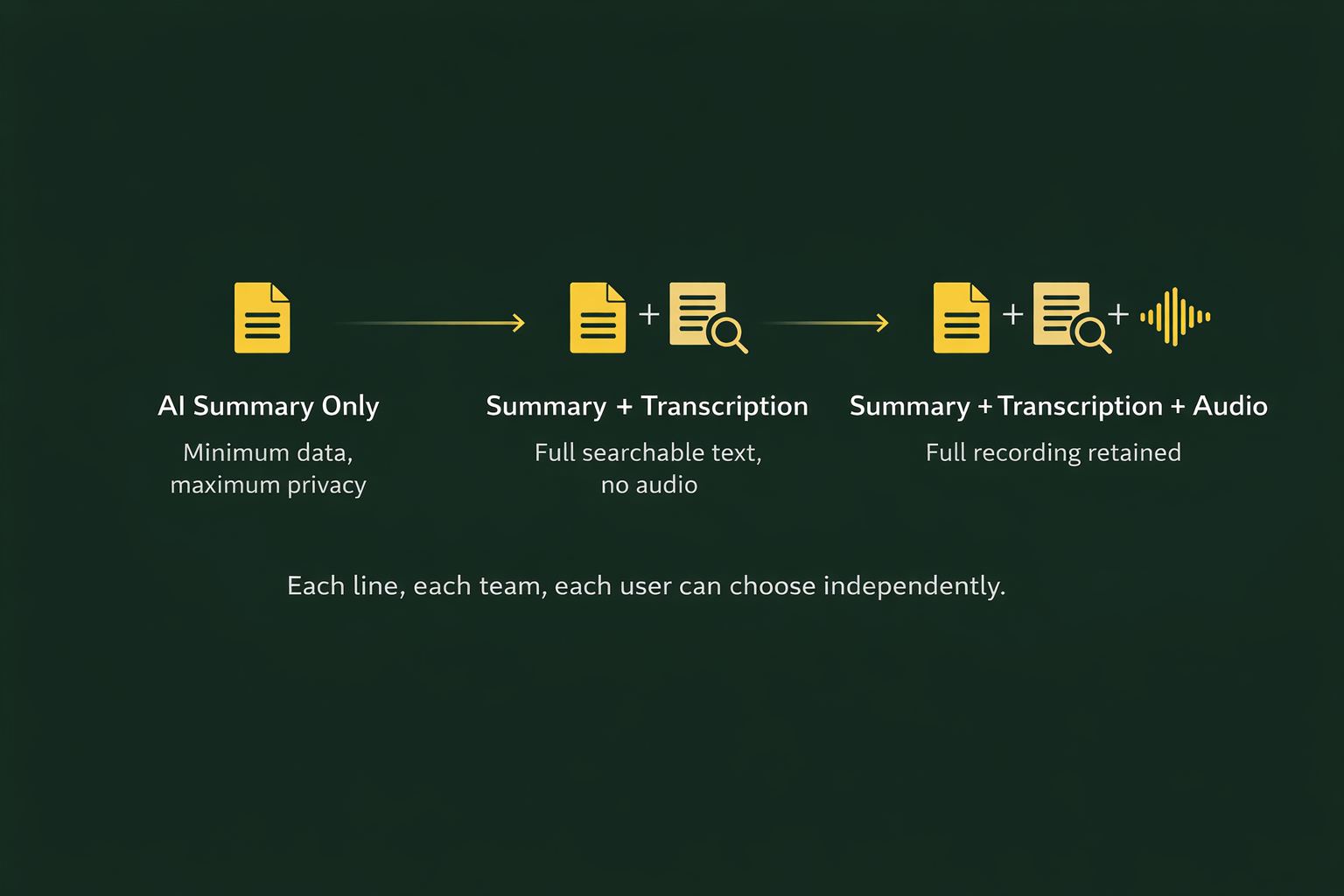
The three tiers:
- AI summary only: minimum data, maximum privacy. No transcript, no audio. Just the AI-generated call note.
- Summary + transcription: full searchable text of the call, plus AI summary. No audio file.
- Summary + transcription + audio: full recording retained.
How Allo Approaches Compliance
Allo gives you four tools to configure compliance across your organization: the Consent Message, Privacy Mode, Transcription Control, and AI Provider Choice. Each one addresses a different dimension of the compliance picture, and they can be combined based on your specific needs.
1. Consent Message
The consent message is an automated announcement that plays before the call connects, notifying the caller that the conversation will be recorded. The caller hears it before anyone picks up, and by staying on the line, provides implied consent in most US jurisdictions.
This tool is designed for inbound calls. It's the single most reliable way to satisfy notification requirements across all-party consent states and EU/GDPR jurisdictions simultaneously. The message is customizable so you can tailor the language to your specific legal requirements or brand voice, and it can be toggled per phone number or applied org-wide.
For any business receiving inbound calls from customers across multiple jurisdictions, the consent message should simply be on, always. There is no practical downside to notifying callers, and it eliminates your exposure in every two-party consent jurisdiction at once.
How it works:
- Message plays automatically before the phone rings
- Caller hears it before anyone picks up
- Customizable text
- Toggle per phone number or org-wide
2. Privacy Mode
Privacy Mode is the most important tool for outbound sales teams calling into all-party consent states, and it's worth spending some time on why it works the way it does.
When Privacy Mode is enabled, Allo never stores the audio recording file. The call is not recorded in the traditional sense. What Allo does instead is generate a full transcription and AI-powered summary from the live conversation in real time, and those outputs, the transcript and the summary, are stored and synced to your CRM normally.
Privacy Mode significantly reduces your data exposure by eliminating the audio recording file entirely. This is especially valuable in all-party consent jurisdictions where the audio file is the primary legal concern. Under GDPR, both audio and transcription are personal data, but removing the audio file reduces the volume and sensitivity of stored data, which aligns with GDPR's data minimization principle. You keep the intelligence (transcripts, AI summaries, CRM sync), you lose the most sensitive data artifact.
What you keep with Privacy Mode enabled: the full verbatim transcript, the AI-generated call summary, CRM sync of both the transcript and summary, and all call metadata including duration, time, and outcome. What's removed is exactly one thing: the audio file. No playback in the Allo app, no audio link in email notifications.
Enable privacy mode
- Reach out to Allo support to enable privacy mode
- Choose scope: per line, per user, or org-wide
- Support will confirm once enabled. Changes take effect immediately.
*Privacy mode is ideal for outbound sales teams. You still get transcripts pushed to your CRM (Attio, HubSpot, Salesforce, etc.) — just no audio file.
3. Transcription Control
For teams that need an even higher level of data minimization, Allo offers Transcription Control, which disables verbatim transcription entirely. Instead of a word-for-word record of the conversation, only AI-generated summaries are produced.
This is useful for organizations operating under frameworks that specifically discourage storing detailed conversation records, or for businesses that want to minimize the personal data they retain from customer calls. Under GDPR's data minimization principle, retaining only what you need for a legitimate purpose is both a best practice and, in some interpretations, a requirement.
With Transcription Control enabled, you keep the AI summary, call metadata, and CRM sync of the summary. What's removed is the full searchable transcript and speaker-attributed text. Audio recording behavior is controlled separately.
Enable transcription control
Contact Allo support to disable transcription per line or org-wide. Audio recording behavior is controlled separately.
4. AI Provider Choice
This tool is specifically relevant for businesses operating under EU data jurisdiction requirements or for companies that have made explicit commitments to keeping data processing within European infrastructure.
Allo's default AI provider processes transcription and summary generation through standard cloud infrastructure. For teams that need European data processing, Allo offers the option to switch to Mistral, a French AI company, for all AI analysis tasks. This keeps your call data within European infrastructure throughout the AI processing pipeline, which can be directly relevant for GDPR compliance documentation and for satisfying data residency requirements with enterprise customers.
Switching to Mistral doesn't change anything about the features themselves, you get the same quality summaries, the same CRM sync behavior, the same everything. It's purely an infrastructure decision, but for some organizations it's a critically important one.
Switch AI provider
Contact Allo support to switch to Mistral. Available on all plans.
[[first-button]]
The US: A State-by-State Reality
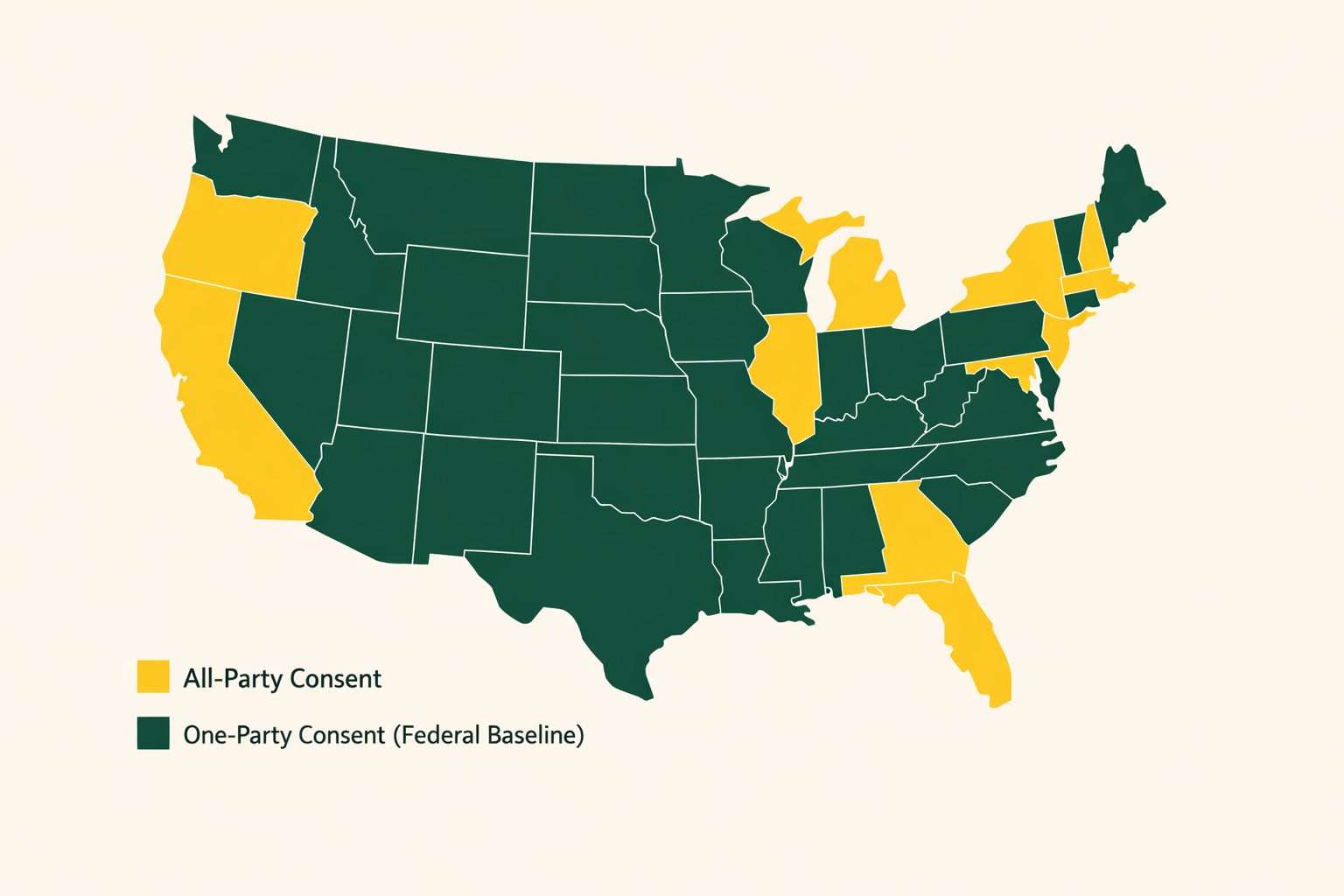
For US-based businesses, here's the practical breakdown of what you're dealing with.
The 13 all-party consent states are California, Connecticut, Delaware, Florida, Illinois, Maryland, Massachusetts, Michigan, Montana, New Hampshire, Nevada (with some court variability on phone specifically), Pennsylvania, and Washington. Every other state follows the federal one-party consent baseline.
A few specific notes on the strictest jurisdictions:
California is the most litigated all-party consent state in the country and has the most active plaintiff's bar around recording violations. If your team regularly calls California prospects, treating California as a special compliance case is not overcautious, it's necessary.
Massachusetts, as mentioned, treats secret recording as a felony. This is genuinely unusual even among all-party states. There is no gray area here.
Illinois is notable because it has BIPA, the Biometric Information Privacy Act, which may apply if your AI tools are doing speaker identification, which could be classified as collection of biometric data (specifically voiceprints). If you handle calls with Illinois residents and your system does any speaker recognition, that's a separate legal question worth discussing with counsel.
The recommended configuration for outbound sales teams calling all 50 states:
Enable the consent message for all inbound calls, which covers you across every US jurisdiction for inbound traffic. Enable Privacy Mode for outbound calls, which means there's no audio file to trigger all-party consent statutes in the 13 dual-consent states.
Train your reps to open outbound calls to prospects in dual-consent states with a quick verbal disclosure: "I want to let you know this call may be transcribed for quality purposes." And sync everything to your CRM through Allo's standard integrations, you keep the intelligence, you lose the liability.
Allo is also building area-code-based automatic compliance rules as a roadmap feature. This will allow you to set rules like "calls to 415, 213, 310, and other California area codes automatically use Privacy Mode, while calls to Texas numbers record normally." When that ships, a significant amount of manual configuration goes away.
EU, UK, and International: What GDPR Actually Requires
For businesses operating in or calling into the EU, GDPR establishes the framework, but it's worth being precise about what it actually requires rather than treating it as a vague prohibition on data collection. This section covers the eight areas that matter most.
1. Processor vs. Controller: Who Is Responsible for What
The first thing to understand is how GDPR assigns responsibility.
Under GDPR, Allo operates as a data processor (sous-traitant in French law): we process call data on behalf of our customers, but we don't determine the purpose or means of that processing. Your organization is the data controller (responsable de traitement), which means you're responsible for determining the lawful basis for recording, the scope and proportionality of what you record, and how long you retain it.
Allo's job is to give you the technical tools to implement those decisions. This isn't about shifting blame, it's about clarity. When your legal team asks "who is responsible for GDPR compliance on call recording?", the answer is: your organization makes the decisions, Allo provides the infrastructure to execute them compliantly. If your configuration choices turn out to be disproportionate or unjustified, that's a controller-level issue. If Allo fails to provide the technical controls you need, that's a processor-level issue.
In practice, this means Allo gives you the levers (per-number recording toggles, Privacy Mode, transcription controls, retention settings, AI provider choice) and you decide how to set them based on your legal obligations and business needs.
2. Legal Basis: Consent vs. Legitimate Interest
GDPR requires that you have a legal basis for recording calls. The two most commonly applicable bases are consent and legitimate interest, and they work very differently.
Consent under GDPR means affirmative agreement. Unlike US-style implied consent, where staying on the line after a disclosure is enough, GDPR requires consent to be freely given, specific, informed, and unambiguous. A passive "this call may be recorded" announcement, without giving the caller a way to actively agree or decline, does not meet the GDPR standard if you're relying on consent as your legal basis. In practice, this means offering callers an affirmative opt-in mechanism (press 1 to consent to recording) or a clear opt-out (press 2 to decline). The Danish Data Protection Authority fined a government agency for recording calls with only a pre-call notification and no affirmative opt-in, making this a real enforcement risk, not a theoretical one.
Legitimate interest under GDPR Article 6(1)(f) is a separate legal basis that does not require explicit consent. If your business has a documented, legitimate reason for recording calls, such as training, quality assurance, fraud prevention, or contractual proof, and that interest doesn't override the caller's privacy rights, you can record without affirmative consent. But this requires a documented Legitimate Interest Assessment (LIA), which is a formal balancing test showing that your need for the recording outweighs the individual's right to privacy. You still need to inform callers that recording is happening, but you don't need their explicit agreement.
Most sales and customer service teams rely on a combination of both approaches: consent (with an affirmative opt-in) for inbound calls where the consent message can handle the workflow cleanly, and legitimate interest (with proper documentation) for outbound calls where an opt-in mechanism would be impractical.
France's CNIL, which is notably one of the most active GDPR enforcement authorities in Europe, adds specific requirements around consent quality: it must be freely given, specific, and informed. If your consent message for French calls is vague or buried in a long automated menu, it may not satisfy CNIL standards. Recordings used for AI training purposes may also need to be anonymized or consented to separately under CNIL guidance.
3. Proportionality: The Rule Everyone Misses
The CNIL requires that call recording be proportionate to its stated purpose. This is where many businesses run into trouble, because the default instinct is to record everything.
For quality monitoring and training, the standard industry practice recognized by the CNIL is to record around 20-30% of calls, not all of them. Systematic, permanent recording of every call is generally prohibited unless a specific legal obligation requires it (such as for financial services transactions under MiFID II, insurance sales under the French Code des assurances, or emergency services like SAMU). This 20-30% figure is not a hard legal threshold, the CNIL has never set a specific cap, but it appears consistently in enforcement decisions and industry guidance as a reasonable benchmark for proportionality.
The key principle is that if you only evaluate four calls per employee per month for training purposes, you cannot justify recording 100% of that employee's calls. The CNIL sanctioned a company in SAN-2020-003 for exactly this: recording all calls when the training supervisor only listened to one recording per employee per week.
This is where Allo's per-number configuration becomes critical for EU compliance. By enabling recording on some lines (e.g., sales outbound) and disabling it on others (e.g., support or internal), you can demonstrate proportionality at the organizational level. Allo's three-tier model (AI summary only, summary + transcription, or summary + transcription + audio) gives you additional granularity to match the level of data collection to each use case.
One additional point that works strongly in Allo's favor: internal calls between Allo numbers are automatically excluded from recording. When your team members call each other, no audio, transcript, or AI summary is generated, and managers have no access to internal call data. This directly addresses CNIL requirements around employee privacy and prevents the kind of permanent internal surveillance that regulators consider disproportionate.
4. Employee Protections
Call recording compliance in the EU, and especially in France, isn't only about the people you're calling. It's also about the employees making those calls. French labor law and the CNIL impose specific obligations on employers who record their employees' calls:
Employees must be informed. Before any recording system is deployed, employees must be told that their calls may be recorded, during which periods, for what purposes, and who will have access to the recordings. This information must be specific enough that employees understand when they are and aren't being recorded.
Employee representatives must be consulted. If your organization has a CSE (Comité Social et Économique), it must be informed and consulted before any call recording system is put in place. This is a procedural requirement under French labor law, and skipping it can invalidate the entire recording system.
Employees must have access to non-recorded lines. The CNIL requires that employers provide phone lines or a technical mechanism that lets employees make personal calls without being recorded. The same applies to calls made by employee representatives in the exercise of their union or representative duties.
Recording cannot be constant. Even beyond the proportionality rule for customers, the CNIL is especially strict about employee recordings. You cannot record an employee's calls 24/7. If the purpose is training, recordings should be limited to specific periods and a defined subset of calls.
Allo addresses several of these requirements out of the box. Internal calls between Allo numbers are not recorded, giving employees a built-in channel for unrecorded internal communication. Each user can also maintain a personal favorites list of contacts who are excluded from recording, providing a simple mechanism to respect personal call privacy. And per-number and per-user recording toggles let organizations configure exactly which lines are recorded and which are not.
5. Information Obligations: The Two-Tier CNIL Model
The CNIL recommends a two-level information approach for call recording, which goes beyond a simple pre-call announcement.
First level: brief oral mention at the start of the call. This should cover the existence of the recording, the purpose (quality monitoring, training, contractual proof, etc.), and the caller's right to object or, if applicable, the need to give consent. It should also mention the possibility of concluding the interaction by other means if relevant (e.g., online, by mail). This is what Allo's consent message handles.
Second level: referral to detailed information. Because the full Article 13 RGPD disclosure is too long to read over the phone, the CNIL recommends referring callers to a website URL or a keypress option (e.g., "press 1 for more information about our privacy practices") where they can access the complete privacy notice covering: the identity of the data controller, the purposes and legal basis of the recording, the data retention period, the recipients of the data, and the caller's rights (access, rectification, deletion, objection).
In practice, this means your consent message should not just say "this call may be recorded." It should state the purpose and direct the caller somewhere they can get the full privacy disclosure. For example: "This call may be recorded for quality and training purposes. For more information about how your data is processed, visit withallo.com/privacy or press 1."
6. Retention: How Long You Can Keep What
Compliance doesn't end when the call does. The CNIL provides specific retention guidance based on the purpose of the recording:
Audio recordings for quality and training: maximum 6 months from collection. This is the CNIL's standard recommendation, and it's the benchmark most organizations should align with.
Analysis documents (call summaries, evaluation grids, coaching notes derived from recordings): maximum 1 year. This includes AI-generated summaries.
Recordings as contractual proof (e.g., a verbal agreement to a sale that was concluded over the phone, where no written contract exists): up to 5 years, which corresponds to the general prescription period under French civil law. Once a written contract or other proof is obtained, the recording should be deleted.
Industry-specific requirements override the general rules. HIPAA requires a minimum 6-year retention for healthcare records, which can include call records involving patient information. SOX requires 7-year retention for financial records. MiFID II requires retention of calls related to investment services for 5 to 7 years depending on the member state.
CCPA requires responding to deletion requests within 45 days.
Allo stores recordings for up to three years by default. For organizations that need CNIL-aligned retention, Allo can configure auto-deletion at 6 months for audio recordings and 12 months for transcripts and analysis documents, matching CNIL recommendations. For enterprise customers, custom retention policies are available on request.
7. Data Subject Rights: Access, Deletion, and the Right to Be Forgotten
Under GDPR, the people whose calls you record have specific rights that your organization must be able to fulfill:
Right of access (Article 15): Any person can request a copy of their call recording and any data derived from it (including transcripts and AI summaries). You must respond within 30 days (extendable to 90 days for complex requests). This means your system needs to be able to search, locate, and export specific recordings on demand.
Right to erasure / right to be forgotten (Article 17): A person can request that you delete all data you hold about them, including call recordings, transcripts, and AI summaries. You must comply unless you have a legal obligation to retain the data (e.g., financial regulatory requirements) or the data is still necessary for its original purpose. When a contact is deleted in Allo, all associated recordings, transcripts, and summaries are deleted as well.
Right to object (Article 21): If your legal basis for recording is legitimate interest (not consent), the caller has the right to object to the recording. If they do, you must stop recording unless you can demonstrate compelling legitimate grounds that override their interests. In practice, this means your reps need a way to stop or disable recording mid-call if a caller objects, or the system needs to be configured to respect opt-outs.
Right to rectification (Article 16): If personal data in a recording or transcript is inaccurate, the individual can request correction. For audio recordings this is impractical, but for transcripts and AI summaries, it may mean updating or annotating inaccurate information.
One important note: these rights apply to data wherever it lives. If you push recordings and summaries to your CRM (HubSpot, Salesforce, Attio, Pipedrive), a deletion request means deleting the data from both Allo and the CRM. Your CRM retention policies need to align with your Allo retention policies.
8. DPA and Documentation
For enterprise customers and any organization that takes GDPR compliance seriously, the contractual layer matters as much as the technical one.
Allo provides a comprehensive Data Processing Agreement (DPA) as part of its Master Service Agreement. The DPA contractually defines the responsibilities of each party under GDPR: Allo as data processor and your organization as data controller. It covers data storage locations, retention and deletion obligations, sub-processor disclosures, breach notification procedures, and audit rights.
If you're in the process of evaluating Allo for an enterprise deployment, the DPA is the document your legal team will want to see. It clarifies in writing what happens to your data, who is responsible for what, and what Allo commits to contractually. For regulated industries or organizations that have undergone a GDPR audit, the DPA provides the paper trail that demonstrates your supply chain is compliant.
Beyond the DPA, organizations operating under GDPR should maintain:
- A record of processing activities (Article 30) that includes call recording as a data processing activity, with its purpose, legal basis, retention period, and data recipients.
- A Legitimate Interest Assessment if you rely on legitimate interest as your legal basis for recording.
- Documentation of employee information and consultation if you've deployed call recording in a French workplace.
UK and Canada: Jurisdiction-Specific Notes
For UK operations, the framework is GDPR-equivalent under UK GDPR, with the addition of RIPA (Regulation of Investigatory Powers Act), which allows recordings for purely internal purposes (training, fraud prevention) without explicit consent as long as the recordings stay internal and meet data protection requirements.
For Canadian calls, federal PIPEDA requires informed consent from all parties, including notification of the recording, its purposes, and each person's agreement to proceed. Quebec's Law 25 adds stricter provincial requirements on top of the federal framework. Enabling the consent message for all Canadian inbound calls is essential, and for outbound calls, reps should verbally disclose recording at the start of each conversation. Canadian financial regulators have been increasingly active on data privacy enforcement, and prospects in regulated industries like financial planning will expect you to demonstrate where call data is stored and how it is protected.

AI Summaries and Transcription: The Same Rules Apply
One question that comes up regularly: does using AI to transcribe and analyze calls create separate compliance obligations on top of call recording rules?
The short answer is yes, with nuance. Real-time transcription and AI analysis are generally treated the same as recording under most consent frameworks, the same consent that covers the recording covers the transcription. But there are specific situations where additional considerations apply.
Illinois BIPA is the main one to watch in the US. If your transcription system is doing speaker identification or voice biometrics, that may qualify as collection of biometric data under BIPA, which has its own consent and disclosure requirements. This is an active area of litigation in Illinois and worth specific attention if you have significant call volume with Illinois-based contacts.
California's AB 2013 and Texas law both require disclosure when AI is used to analyze calls. Your consent message should explicitly mention AI analysis, not just recording. "This call may be recorded and analyzed using AI for quality and training purposes" is more legally complete than "This call may be recorded."
AI-generated summaries are treated as derived data under most frameworks. The same retention and access rules that apply to recordings apply to the summaries. If a customer in the EU requests deletion of their data, that includes the AI summary of their call.
There is also a specific CNIL consideration around banking data: if your team handles calls where customers share credit card numbers or banking information, the CNIL requires that your recording system have the ability to pause or exclude that portion of the call. The CNIL has issued multiple enforcement decisions on this point, treating banking information as requiring heightened protection due to fraud risks. If Allo is recording a call where a customer reads out a card number, that segment should ideally be excluded from the recording and transcription.
Conclusion
Call recording compliance is not a once-and-done checkbox. It's an ongoing configuration decision that reflects where you operate, who you call, and what you do with the data you collect. The good news is that with the right tools in place, staying compliant doesn't mean giving anything up. Allo's Privacy Mode, consent message, transcription controls, and AI provider options are designed specifically to let sales teams capture the intelligence they need from every call, while eliminating the legal exposure that comes with unmanaged recording practices.
If you're not sure where your current setup stands, that's a good reason to spend 30 minutes reviewing your Allo configuration. The compliance conversation is much easier to have before something goes wrong than after.
.jpg)