
Key Takeaways
• Allo is best for electricians who want a single system that handles phone calls and AI answering together — unlimited AI receptionist from $18/user/month (billed yearly), fully controllable from your phone, and no separate tools to manage.
• Rosie is best for solo electricians or very small crews on a tight budget who just need a reliable message-taker layered over their current phone number — $49/month flat with unlimited minutes and a 7-day free trial.
• Quo Sona is best for electrical contractors who need advanced call workflows like automated SMS with directions, appointment links, and multi-step call routing — though the per-call pricing can add up during busy weeks.
–––––––––
When a homeowner's panel starts buzzing at 9 PM, they don't leave a voicemail and wait until Monday. They call the next electrician on the list.
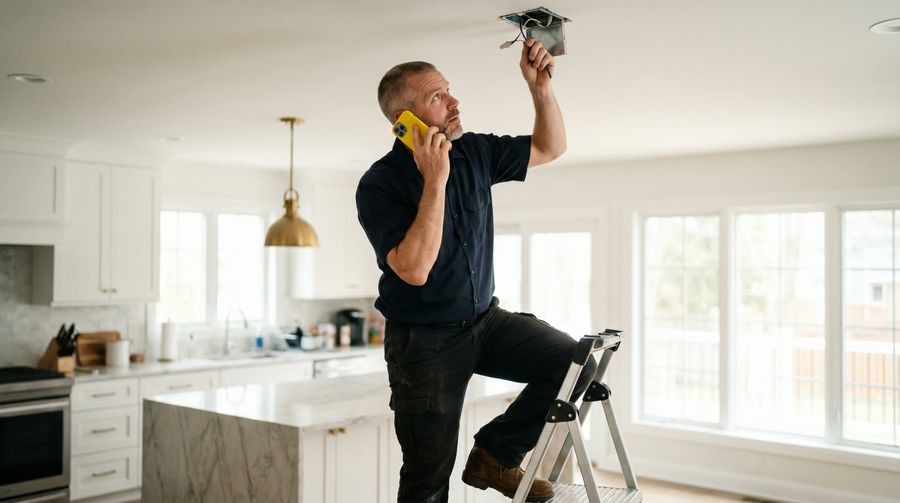
The problem isn't that you don't care about answering. It's that you're wrist-deep in a junction box, halfway through a conduit run, or driving to the next site. Your hands are literally full.
An AI phone answering service picks up those calls for you, greeting customers, capturing job details, answering common questions, and routing emergencies.
But the market is crowded and pricing structures vary wildly. Some providers charge flat monthly fees, some bill per call or per minute, and some bundle AI answering into a full phone system.
This article compares six options that make sense for electrical contractors: Allo, Quo Sona, Rosie, Nextiva Xbert, Goodcall, and RingCentral AIR. For each one, we'll break down what it does, what it costs, and whether it actually fits the way electricians work.
Comparison overview
| Solution | Starting Price | Best For | G2 Rating |
|---|---|---|---|
| Allo | $18/user/mo Phone system + AI included | Small electrical teams that want phone + AI in one affordable package. Best value | 4.7 / 5 |
| Quo Sona | $25/mo add-on + Quo phone subscription | Contractors who need advanced call workflows and SMS automation. Advanced workflows | 4.7 / 5 |
| Rosie | $49/mo Standalone, unlimited minutes | Solo electricians who need a simple, flat-rate message-taker. Solo-friendly | Not listed on G2 |
| Nextiva Xbert | $99/mo per 100 interactions + Nextiva subscription | Existing Nextiva users who want appointment scheduling and multi-channel support. Multi-channel | 4.5 / 5 |
| Goodcall | $79/agent/mo Standalone, 100 unique customers | Businesses focused on reducing inbound calls through self-service. Call deflection | Not listed on G2 |
| RingCentral AIR | $39/mo for 100 min + RingCentral subscription | Multi-location electrical companies already on RingCentral. Enterprise-ready | 4.2 / 5 |
Allo
What is Allo?
We launched Allo in 2024 with a simple idea: small teams shouldn't need enterprise budgets or IT departments to get a modern phone setup with AI built in.
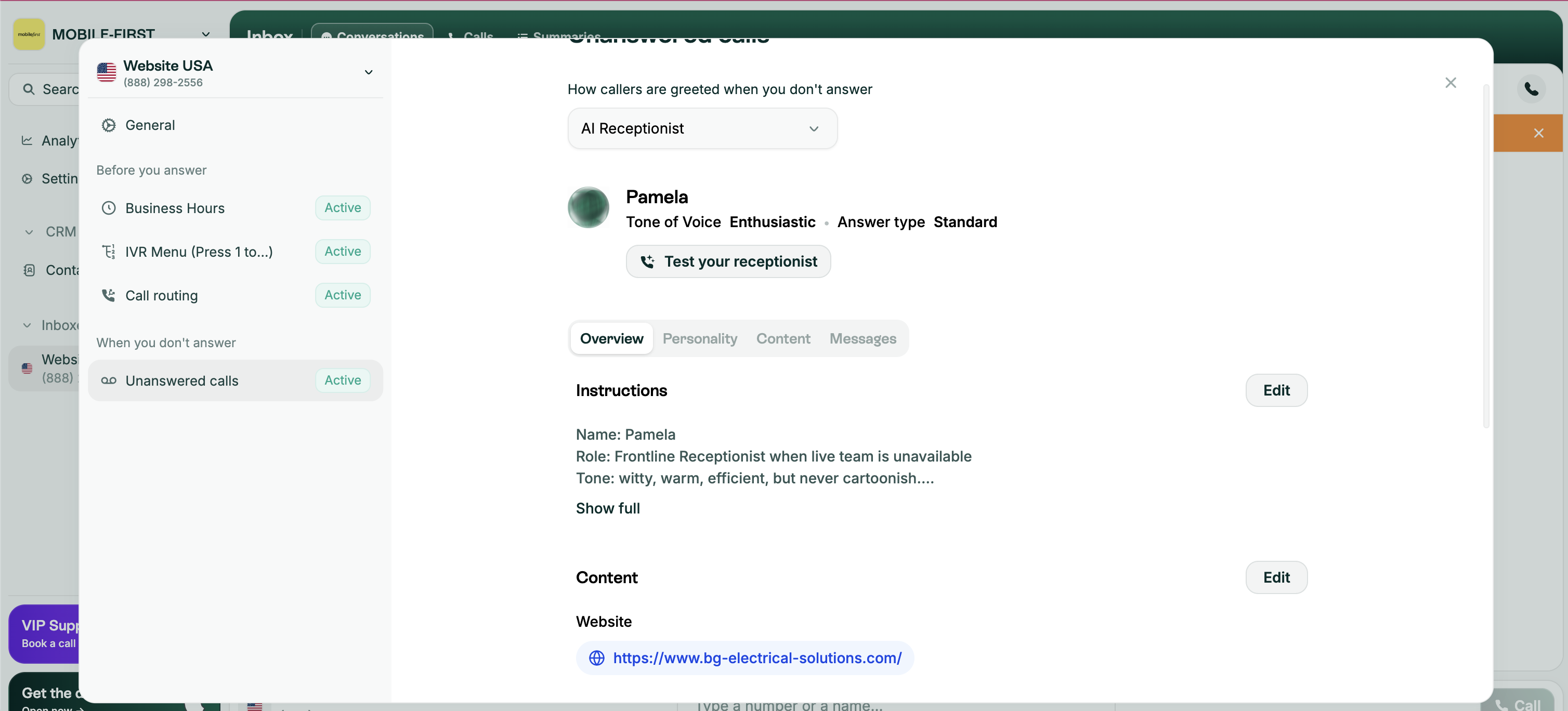
Unlike standalone answering services that sit on top of your existing phone line, Allo replaces your phone system entirely, giving you business numbers, call routing, team management, and an AI receptionist in a single app. It was designed mobile-first, which means the phone in your pocket is the control center, not a desktop dashboard you'll never open on a job site.
Why Allo is a good fit for electricians
The biggest advantage for electrical contractors is simplicity. You're not stitching together a phone provider and a separate AI service: it's one subscription, one app, one login.
The AI receptionist handles after-hours calls, takes messages, answers FAQs (you train it on your website or upload your own docs), and syncs everything to your CRM automatically. Every call gets recorded and transcribed, so when a customer describes a flickering panel or a buzzing outlet, you've got the details before you call back.
Mobile control is where Allo stands apart for tradespeople. You can tweak your AI greeting, adjust its tone, or update your FAQ answers from your iPhone or Android — no laptop required. For an electrician between service calls, that's the difference between actually using the tool and ignoring it.
On the integration side, Allo connects to HubSpot, Salesforce, Pipedrive, Attio, and 1,000+ apps through Zapier. If you're using a field service platform that ties into Zapier, you can pipe call data straight into your workflow.
The trade-off: Allo doesn't handle appointment scheduling directly yet, and it doesn't support complex multi-step call workflows.
Allo pricing
Allo keeps it clean — two plans, no hidden fees:
- Solo: $18/month per user (billed yearly). Includes the full phone system plus unlimited AI receptionist, one business number, unlimited national calls, SMS, and CRM autofill.
- Business: $45/month per user ($32 billed yearly). Everything in Solo plus all integrations, power dialer, analytics, and the Allo MCP.
No add-ons, no per-minute overage charges — unlimited AI receptionist is included on both plans.
For a two-person electrical crew, that's $90/month total on the Business plan for phones and unlimited AI answering.
Both plans include pay-as-you-go international calling and one local or toll-free number (extra numbers $5/month), backed by a 30-day money-back guarantee.
Demo video of Allo
Quo Sona
What is Quo Sona?
Quo (formerly OpenPhone) is a Canadian phone system founded in 2018. They went through Y Combinator and rebranded from OpenPhone to Quo in 2025. Sona, their AI receptionist feature, launched in April 2025.
Like Allo, Quo is a full phone system. Sona isn't a third-party add-on but a native feature within the platform. That means your call recordings, transcripts, and AI summaries all live in the same place as your regular business calls.
Why Quo Sona is a good fit for electricians
Where Sona shines is workflow customization. You can build multi-step call flows: collect the caller's address, ask about the type of electrical issue, decide whether to transfer to a team member or take a message, and send an SMS with your service area or booking link — all within a single call.
For electricians who handle both residential and commercial work, this kind of routing logic is useful. A homeowner calling about a ceiling fan install can get a different flow than a property manager reporting a tripped main breaker at a commercial building.
Sona also sends automatic texts during calls — sharing directions, links, or forms — which can cut down on back-and-forth after the call ends. The voices sound natural, and the customization options (operating hours, team introductions, detailed FAQ) are thorough.
The downsides: Sona only supports English, only works in the US and Canada, and there's no free trial for the AI feature specifically. You'll need a paid Quo subscription first, and Sona is layered on top as an add-on. The per-call pricing model also means costs can climb quickly during peak weeks — something electricians dealing with storm-related surge calls should factor in.
Mobile control is solid, though. You can configure Sona from both iPhone and Android.
Quo Sona pricing
Quo Sona requires a Quo phone subscription, then charges for the AI add-on based on call volume:
- Quo base subscription starts at around $15–$19/user/month (varies by plan)
- 10 calls/month included free with any Quo plan
- 40 calls: $25/month
- 100 calls: $49/month
- 250 calls: $99/month
- 600 calls: $199/month
No free trial for Sona specifically, even though Quo itself offers one.
For a small electrical crew getting 80 calls a month to the AI, you'd be looking at roughly $49/month for Sona plus your Quo subscription per user.
Demo video of Quo Sona
Rosie
What is Rosie?
Rosie is a standalone AI answering service launched in 2024 by Jordan Gal, a serial entrepreneur. The pitch is simple: small businesses miss too many calls, and voicemail isn't cutting it. Rosie picks up, answers questions, takes a message, and notifies you instantly.
It's not a phone system: you keep your existing number and forward calls to Rosie when you can't answer. That makes it the easiest option to set up if you don't want to change your phone provider.
Why Rosie is a good fit for electricians
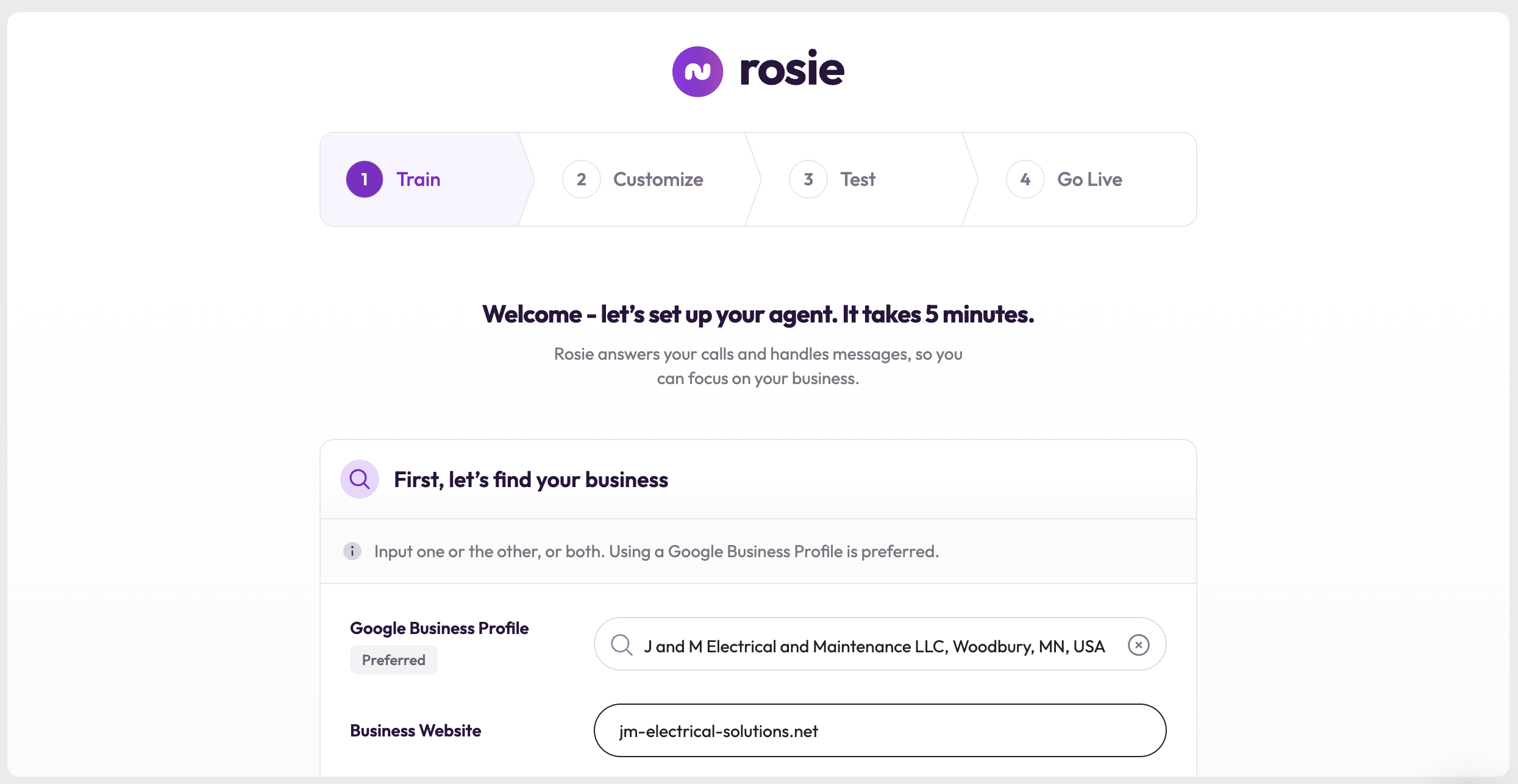
Rosie works best for solo electricians or tiny crews who just need something to catch the calls they're missing. Setup is fast: Rosie scans your website and Google Business Profile to learn about your services, and you can add custom FAQs on top.
When a call comes in, Rosie greets the caller, answers what it can, and takes a detailed message if the caller needs a callback. You get an instant notification with an AI-generated summary. For a one-person operation juggling residential rewires and panel upgrades, that's often enough — you'll see the summary between jobs and call back within the hour.
Rosie also handles SMS, which is handy if customers text your business number. And the flat-rate pricing with unlimited minutes means no surprises during busy months.
The limitations are real, though. On the base Professional plan ($49/month), Rosie can't transfer calls, book appointments, or send texts during calls. Those features only unlock on the Scale plan at $149/month. And since Rosie isn't a phone system, you're paying for it on top of whatever you already use for your business line.
Rosie pricing
Straightforward, flat monthly fees with unlimited minutes on every plan:
- Professional: $49/month. Message-taking, FAQ answering, instant notifications, Zapier integration.
- Scale: $149/month. Adds appointment links, call transfers, and in-call texting.
- Growth: $299/month. Adds training on uploaded files (like your pricing sheet or service catalog).
7-day free trial on all plans.
Remember: you'll still need a separate phone system, so factor in that cost on top.
Demo video of Rosie
Nextiva Xbert
What is Nextiva Xbert?
Nextiva has been in the business communications game since 2008. Xbert is their AI receptionist, and it goes beyond phone calls — handling text messages, web chat, and messaging apps from a single interface.
Xbert is built into the Nextiva phone system, so like Allo and Quo, it's not a third-party service. But unlike those two, Nextiva has been around for nearly two decades and targets a broader range of businesses.
Why Nextiva Xbert is a good fit for electricians
Xbert's strongest feature for electricians is appointment scheduling. It integrates directly with Google Calendar, Calendly, and Cal.com, so callers can book a time slot without you lifting a finger. It even sends SMS confirmations automatically. For an electrical contractor running a steady flow of residential jobs, that's a real time-saver.
The multi-channel angle is also interesting. If your customers reach out via text or web chat as well as phone, Xbert handles all three — reducing the chance that a lead slips through because it came in on a channel you weren't watching.
Xbert supports English, Spanish, French, and Portuguese, and can be trained on your website and uploaded documents. It records and transcribes calls, and includes a dedicated reporting dashboard with call volume trends and knowledge gap insights.
On the downside, the starting plan doesn't include call recording — which feels like a miss for a service where documentation matters. You also can't configure Xbert from your phone, there's no mobile configuration for the AI receptionist. And because it requires a Nextiva subscription underneath, the total monthly cost stacks up faster than it first appears.
Nextiva also offers direct CRM integrations (Zoho by default, with Salesforce and HubSpot available through a manual activation that takes 2–4 business days).
Nextiva Xbert pricing
Xbert charges per interaction on top of a Nextiva phone subscription:
- Xbert: $99/month per 100 interactions, then $0.99 per interaction after that
- Nextiva base subscription: starts at $23/user/month (billed monthly)
An "interaction" counts when a call lasts 30+ seconds or a text/chat gets 3+ AI responses.
No free trial for Xbert.
For a two-person electrical team getting 150 AI-handled interactions a month, expect roughly $99 (Xbert) + $46 (two Nextiva users) = $145/month minimum.
Demo video of Nextiva Xbert
Goodcall
What is Goodcall?
Goodcall was founded in 2021 by Bob Summers, a tech veteran and former Google employee. The goal: bring AI agents to small businesses so fewer calls need a human on the other end.
It's a standalone service, not a phone system. You forward your calls to Goodcall, and it handles the rest.
Why Goodcall is a good fit for electricians
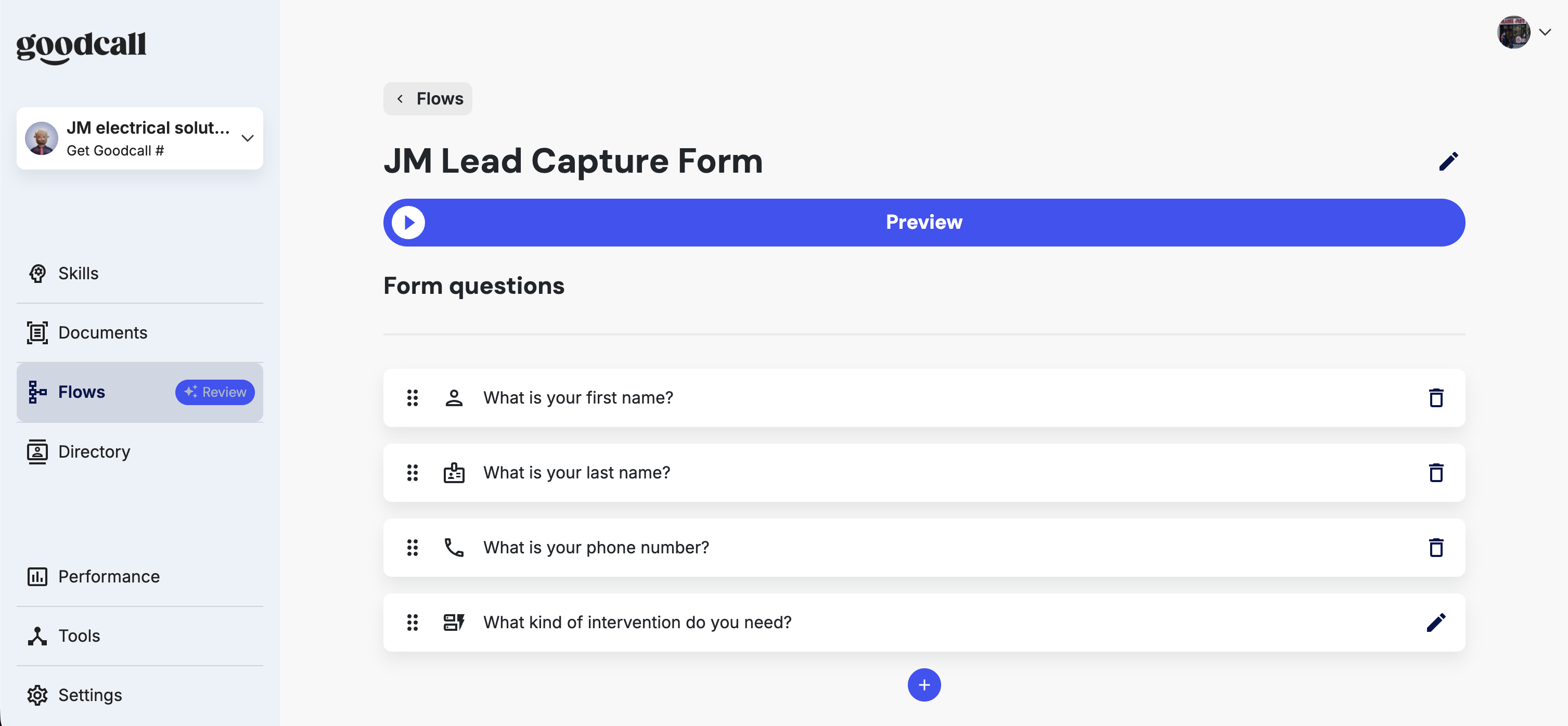
Goodcall's approach is more aggressive than a typical message-taker. During a call, it can ask the caller specific qualification questions you've defined — like "Is this residential or commercial?" or "Is this an emergency?" — and collect their contact details in a structured format. That means when you check your Goodcall dashboard, you've got organized lead data, not just a voicemail transcript.
For electrical businesses that want to pre-qualify leads before calling back, that's useful. You can prioritize the emergency panel replacement over the "I'm thinking about adding an outlet someday" call.
Goodcall supports English, Spanish, and French and integrates with Zapier for connecting to other tools. It also works with Google Voice, which some smaller electricians use as their business line.
The weak spots: Goodcall is notably more expensive than most alternatives — starting at $79/month per agent, with a cap of 100 unique customers before overage charges kick in at $0.50 each. It doesn't support SMS, has limited voice options, and there's no mobile app for configuration. You'll also need a separate phone system since Goodcall doesn't provide one.
Goodcall pricing
Pricing is per agent, with caps on unique customers per month:
- Starter: $79/month per agent. 100 unique customers, then $0.50 per additional customer.
- Growth: $129/month per agent. 250 unique customers included.
- Scale: $249/month per agent. 500 unique customers included.
All plans include unlimited minutes within their customer caps.
14-day free trial.
Add your existing phone system cost on top. For a solo electrician handling 120 unique callers a month, that's $79 + $10 overage = $89/month before your phone bill.
Demo video of Goodcall
RingCentral AIR
What is RingCentral AIR?
RingCentral has been around since 1999, one of the longest-standing names in business communications. AIR (their AI receptionist) launched in November 2025, making it the newest entry on this list. Access is still gated through their sales team, so you can't just sign up and start using it.
Why RingCentral AIR is a good fit for electricians
If you're already running your electrical business on RingCentral, AIR is the path of least resistance. It plugs directly into your existing setup which means no migration, no new app, no separate login.
AIR can answer FAQs (trained on your website and uploaded docs), book appointments via Google or Outlook Calendar, send SMS confirmations and directions, transfer calls to your team, and record and transcribe every AI-handled interaction. It also includes a dedicated reporting dashboard showing call volume trends, transcript access, and knowledge gaps the AI is struggling with.
The language support is a standout. English, French, Spanish, Italian, German, and Portuguese — useful if your service area has a diverse population and you want callers to be understood in their preferred language.
Direct CRM integrations cover HubSpot, Zoho, and Salesforce for lead capture.
The downsides are significant for small electrical crews, though. AIR charges $39/month for just 100 minutes, with $0.50/minute overages billed in 30-second increments. For a busy electrician whose AI receptionist handles 200 minutes of calls a month, that's $89/month — just for AIR, before your RingCentral subscription. There's no mobile configuration for the AI receptionist, and you need a sales call just to get started. RingCentral's interface is also widely considered less intuitive than newer competitors.
RingCentral AIR pricing
Minute-based pricing on top of your RingCentral phone subscription:
- AIR: $39/month for 100 minutes included
- Overage: $0.50 per minute (billed in 30-second increments)
- RingCentral base subscription: varies by plan, but typically starts around $20–$30/user/month
No free trial. Requires a sales call to activate.
For a two-person electrical team using 150 AI minutes a month: $39 (AIR) + $25 overage (50 min × $0.50) + ~$50 (two RingCentral users) = roughly $114/month.
Demo video of RingCentral AIR
Conclusion
There's no single best AI phone answering service for every electrician — but there is likely a best fit for your situation:
- If you want to keep things simple with one app, one bill, and full mobile control, Allo gives you the most value per dollar — unlimited AI answering is included on every plan, from $18/user/month (billed yearly). For a two-person crew, it's hard to beat $90/month on the Business plan for a full phone system plus AI.
- If you're happy with your current phone setup and just want a flat-rate answering layer, Rosie is the easiest add-on at $49/month — though you'll outgrow the base plan quickly if you need call transfers or appointment links.
- Quo Sona is the pick for contractors who want granular call flow control and automated SMS during calls, but watch the per-call costs during busy periods.
- Nextiva Xbert and RingCentral AIR both make the most sense if you're already on their respective phone systems and want to avoid adding a third-party tool.
- Goodcall is worth a look if your priority is lead qualification over simple message-taking, but the pricing is steep for what you get.
Whatever you pick, the math is simple: a few missed calls a week costs more than any of these services. The real question is which one fits the way you already work.
Frequently asked questions about AI call answering services
How much does an AI phone answering service cost for an electrician?
It depends heavily on the pricing model. Flat-rate services like Rosie start at $49/month with unlimited minutes. Bundled phone systems like Allo range from $18 to $45/user/month with AI included. Per-call or per-minute models like Quo Sona and RingCentral AIR can cost anywhere from $39 to $199/month depending on your call volume — plus your base phone subscription. For a typical small electrical crew, expect to spend between $50 and $150/month total.
Who is the best AI receptionist for electricians?
For most small electrical teams, Allo offers the strongest combination of affordability, mobile access, and ease of use. You get a full phone system and unlimited AI answering from $18/user/month (billed yearly), all configurable from your phone between jobs. If you're a solo operator and don't want to switch phone systems, Rosie at $49/month flat is the simplest option. The right choice depends on your team size, call volume, and whether you want a standalone service or a bundled phone system.