Main takeaways
- Ditch traditional role-play. Real cold call practice means calling real prospects, then listening back to your recordings. That’s how you build muscle memory, not by rehearsing fake scenarios.
- Build a sales book, not a script. A flexible framework with hooks, objections, and open questions beats a rigid script every time. It keeps you human on the phone.
- Use AI where it actually helps. AI tools are powerful for preparation and post-call analysis. But during the call itself, you’re on your own. And that’s a good thing.
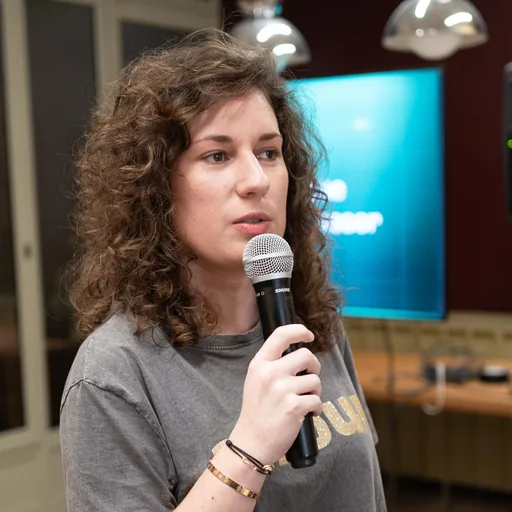
Pauline Perez spent her childhood racking up phone bills.
Her mom wasn’t thrilled. But that habit turned into a career.
Twelve years later, Pauline has trained hundreds of salespeople, built an outsourced prospecting agency, and launched her own training organization.
Cold calling isn’t just her job, it’s a passion.
Most salespeople don’t share that enthusiasm. 63% say cold calling is the worst part of their job.
But according to Pauline, the problem isn’t the phone. It’s that nobody taught them how to use it properly.
We sat down with her to understand what real cold call practice looks like. What actually works, what doesn’t, and how to get better fast.
Why traditional cold call role-play doesn’t work
If you’ve ever done a cold call role-play exercise in a training session, you know the feeling. It’s awkward. It’s artificial. And it doesn’t prepare you for what actually happens on a live call.
Pauline is categorical about this. She never does role-play in her training sessions.
“I hate that. I never do. Because humans are unpredictable. I can’t say I’m going to play the prospect.”
The issue is simple. In a role-play, both people know it’s fake. The “prospect” either makes it too easy or throws curveballs that would never happen in real life. You’re rehearsing for a situation that doesn’t exist.
Pauline tested an AI-powered role-play solution for her e-learning program. Same conclusion.
“What I realize is that it’s not useful. Why? Because it’s not their specific case. So, it’s a fake case.”
Generic practice creates generic habits. You need context. You need stakes. You need the real thing.
How to actually practice cold calling
Pauline’s training method is refreshingly blunt.
“Pick up your phone and call the prospect. That’s it. Simply. And then listen back to the calls.”
That’s her entire cold call practice framework in two sentences. Call. Listen. Repeat.
But within that simplicity, there are layers worth unpacking.
Start with real calls, not simulations
The fastest path to improvement is live reps. Every real call teaches you something a role-play can’t: how to handle genuine surprise, real objections, and the unpredictable flow of human conversation.
Pauline pushes her trainees to start calling after the theoretical training, even if they don’t feel “ready.” Waiting for readiness is a trap.
“People think they know, but they don’t know how to do it.”
Listen back to every call
This is the part most salespeople skip. And it’s the part that matters most.
Listening to your own recordings forces you to confront your tics, your hesitations, and the moments where you lost the prospect. Pauline says she can identify optimization points within seconds of listening to a trainee’s call.
“If the opening isn’t good, the opening, the pitch. So it lets you already optimize.”
With a tool like Allo, every call gets recorded and transcribed automatically. You don’t need to be in front of your computer taking notes. You can focus entirely on the conversation, then review the transcript after.
Analyze what went wrong (and what went right)
After a bad session, don’t just move on. Break it down.
“You want to try to understand why. Is it maybe that the target isn’t the right one? Is it the hook that isn’t good? There could be lots of reasons.”
Pauline recommends checking several variables: your database quality, your hook, your target, and even the day and time you called. Often the problem isn’t your delivery. It’s your preparation.
Build a sales book, not a script
One of Pauline’s strongest opinions: never use a script.
“I hate that word ‘script’ because when someone says that word to me, I imagine the scenario where if the person says hello, then you say this sentence.”
Scripts make salespeople robotic. They follow a predetermined path and crumble the moment the prospect says something unexpected. Pauline has seen it firsthand: rigid scripts “infantilize and stupefy” the salesperson.
What she recommends instead is a sales book. Think of it as a flexible toolkit rather than a step-by-step guide.
What a sales book contains
A good sales book covers several structured elements:
- Your personas: who you’re calling, what their constraints are, what their goals are
- Hooks by persona: tailored opening angles that highlight pain points you solve
- Open questions: to guide discovery without forcing a script
- Objection handling: common objections and industry-specific ones, with suggested rebounds
- Key value points: what your solution does for each persona, in their language
“The sales book, you’re going to tell yourself okay, I have all the information here I need. And I’m going to pick from it depending on how the person reacts.”
Adapt the hook to the persona
This is where many salespeople fall short. They use the same opening line for everyone. Pauline insists on tailoring hooks to each persona.
A CEO cares about numbers. An HR director cares about recruiting and retention. Even if you’re selling the same product, the angle is different.
“You can bet that the interest of one and the other isn’t the same. Yet you have a solution that is the same. It’s just that you’re going to arrive with different speeches, different approaches.”
The manager’s role in cold call coaching
Salespeople don’t improve in a vacuum. Managers have a direct responsibility to set their teams up for success.
Don’t just train once
Pauline created a dedicated training program for managers after a client told her:
“Your training was great. Except for us, managers, we are incapable of managing the salespeople through prospecting.”
Good management means regular team meetings, individual coaching, and gamified objectives.
“Whoever takes the most meetings this week, wins a movie ticket. You see, it motivates the whole team.”
Track the right metrics
Data turns cold calling from guesswork into a system.
| KPI | Who tracks it |
|---|---|
| Number of calls made | Salesperson + Manager |
| Pick-up rate | Salesperson + Manager |
| Meetings generated | Salesperson + Manager |
| Call duration | Manager |
| Conversion rate (meeting to client) | Manager |
With Allo integrated into your CRM, these metrics are tracked automatically. No manual reporting, no guessing whether someone actually made their calls.