
That confusion is not harmless. It makes small business owners buy the wrong thing, spend on the wrong tool, and wait for magic that never comes. So let me clear it up. Agent vs workflow is the most important distinction in AI right now. Get it right and you save months and a lot of money. Get it wrong and you burn both. I run Allo, an AI business phone for small companies. We are 22 people. Six of our employees are AI. So this is not theory for me. This is how we work every day.
Workflow, skill, agent: the only three words you need
Three words. Learn them and you will see through 90% of the hype.
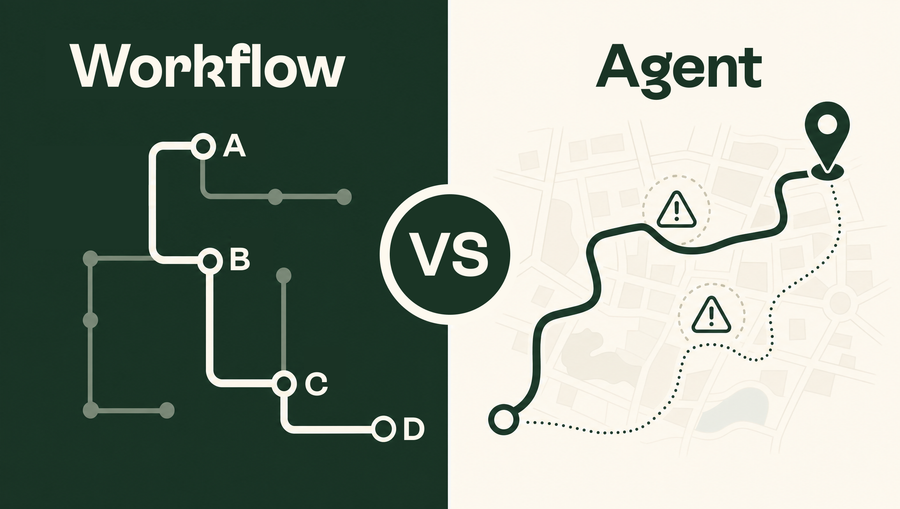
A workflow is a trigger and an action. Something happens, so something else happens. A new lead lands in your CRM, so a Slack message fires. You have seen these for years. Zapier, Make, n8n. They are reliable. They almost never break. They are also dumb on purpose, and that is their strength.
A skill is a single request to an LLM. You ask the model to do one thing that needs a bit of judgment. We have a skill that takes a LinkedIn comment, enriches the email, checks if the person is already in our CRM, and sorts the lead. A workflow could not do that well. It needs reading and reasoning. That is a skill.
An agent is an employee. It runs 24/7, not only when something triggers it. It has its own email address and its own Slack profile. It can do specialist work or generalist work. It talks to your whole team. And it improves itself from the feedback it gets. That last part is the line most people miss.
Here is the simple version.
| Workflow | Skill | Agent | |
|---|---|---|---|
| What it is | Trigger and action | One ask to an LLM | An AI employee |
| Runs | Only when triggered | When you call it | 24/7 |
| Judgment | None | Some | High |
| Self-improves | No | No | Yes |
| Tools | Zapier, Make, n8n | Claude, Cowork | OpenClaw, Hermes |
| Breaks? | Almost never | Rarely | Needs care |
What changed this year is simple. Two technologies finally got mature enough for real agents: OpenClaw and Hermes. Before that, most "agents" were demos. Now they hold a real job.
The 80/20 rule nobody tells you
Read this part twice.
For 80% of the automation you need in your company, a workflow is the right answer. It will do the job and it will never break. You do not need an agent to move a lead from a form to a CRM. You need a workflow.
The other 20% is where it gets interesting. Cases with heavy personalization. Cases with judgment. Cases with a stack of rules that change. That is where a skill or an agent becomes your best weapon.
So the order matters. Most people reach for the agent first because it sounds impressive. Wrong move. Start with the boring workflow. Reach for the agent only when the boring tool runs out of road.
That single rule will save you more money than any tool I could recommend.
Agent vs workflow inside a real 22-person company
Let me make it concrete. We run both. Workflows do the boring plumbing. Agents do the work that needs judgment.
Start with the workflows, because they carry the 80%.
A call ends, so the recording and summary land in the CRM. Nobody touches it. A new company signs up, so a welcome SMS goes out and the right rep gets a Slack ping. A deal is marked won, so the invoice gets created and the team gets a notification. None of these need an LLM. They are triggers and actions. They run on n8n. They never break, and they never asked for an agent.
That is most of the automation in the company. Plain pipes that just work.
Now the harder 20%. Here are three of our six AI employees.
Compliance. At Spendesk, where I was employee number four, compliance was a full department. At Allo it is one agent. It verifies registrations, collects documents, and hunts for fraud. It spots a signup logging in through a VPN, an account with strange call volumes, a trial abuser opening his fifth free account. Then it acts. It blocks, it bans, it asks for documents, it raises a flag. It is our most mature agent and it runs on its own.
Chief of Staff. Every Monday morning it builds a snapshot of the whole company in Notion. It checks three things. Are the sales reps contacting enough leads? Is the CRM clean, with meetings logged and deals sorted and quotes matching the calls? Are we on pace to hit the number? Then it sits in Slack all week. Anyone can ask it "what were our top three clients this week" and get an answer. My engineers ask it "what did prospects complain about most in demos" before they decide what to build. A manager would take days to answer that. The agent answers in seconds.
Sarah, our AI SDR. She sends around 400 first SMS and 400 first emails a day. She costs about 10,000 euros a month, close to one full salary. She works the signups and low-score leads my human reps would never reach. She reads the CRM and our PostHog analytics, then tailors each message to where the lead came from. A lead from a competitor ad gets a different message than a lead from organic. She qualifies, books meetings, and blocks calendars. And she finds use cases we never planned for, like questions about SIM cards we did not even know people had.
None of these replaced a person we let go. They did work we could never have afforded to staff. That is the real unlock for a small company.
Where AI agents actually fail
I am not here to sell you a dream. Here is where agents fall flat today.
Cold calling. A human crushes an AI on a cold call. Connection rates, trust, the read on a hesitation in someone's voice. AI is not close. I have not run it at giant scale, so I stay open. But on pure cold outbound, I am skeptical, and you should be too.
Where AI on the phone does work is the opposite case. The call the person expects. An admin reminder. An unpaid invoice. A support follow-up after a known issue. There the AI is calm, consistent, and never forgets to call back. That is a real win. Cold calling a stranger to charm them is not, at least not yet.
Anyone who tells you AI closes cold deals on the phone today is selling you something.
How to start without lighting money on fire
You do not need a budget like ours. You need a method.
First, the money. Budget your AI spend at 10 to 20% of your payroll. Or count it against the software you can now delete. One employee at 35,000 euros a year? You can afford maybe two Claude subscriptions. Start there.
Then climb three levels, in order.
- Claude. Start here. It is the easiest. My email triage runs on it and cuts 1,000 emails a week down to 200. Five times less noise, for almost nothing.
- Workflow tools. n8n, Make, Zapier. With Claude Code you can now build them without writing real code. This is your 80%.
- Real agents. OpenClaw or Hermes. This is the 20%. Only come here when you are chaining several skills into a real job.
The first question to ask yourself is small. Is there a skill I would use ten times a day if it were faster? Build that. Only when you find yourself chaining many of those together do you need a true agent.
One more thing, and it is not optional. The founder has to be the power user. When the internet arrived you could not hire one WordPress freelancer and call it done. You had to learn it. AI is the same. It is as big as electricity. Run AI office hours once a week, one hour, your best AI engineer in the room, two people bringing the thing they want to build. That is how it spreads.
Where this goes for Allo
This is exactly where we are taking the phone.
By the end of 2026, Allo calls will take action on their own. Transfer a call. Book a reservation. Send an SMS mid-conversation. Open a support ticket. Build a quote off what was said. Half the calls handled by a human, half by AI, with the AI creating the CRM opportunity and the follow-up automatically.
The point is never the AI. The point is the hour it gives back to the owner. The plumber great at pipes and scared of his inbox. The florist doing invoices on a Sunday night. We ask one question about every feature we build. What took hours that AI can do in seconds?
That is the whole game.
The honest closing
Most people want to run a marathon in September. They have not learned to run yet.
There are steps. Master Claude. Then master workflows. Then master agents. Skip them and you will quit in a month, convinced AI was hype.
It is not hype. But it is not magic either. Agent vs workflow is where it starts. Learn the difference, run the boring workflow for the 80%, and save the agent for the 20% that earns it.
So here is my question for you. What is the one task in your business that eats hours every week and should not? Start there.
FAQ
¿Puede la IA reemplazar a mi equipo de ventas?
No, and that is the wrong goal. AI runs the pipeline: qualification, follow-up, scheduling, admin calls. Humans do what AI cannot: convince, reassure, and close. The future is your team working with AI, where the AI handles volume and your people handle the relationship.
¿Las pequeñas empresas realmente necesitan agentes de IA?
Most need workflows first. For 80% of tasks a simple workflow wins and never breaks. You only need an agent for the 20% that demands personalization and judgment. Start with the boring tool. Reach for an agent when it runs out of road.
¿Cuánto cuestan los agentes de IA para una pequeña empresa?
Budget 10 to 20% of your payroll for AI, or count it against the software you can cut. Our AI SDR costs about 10,000 euros a month and does the work of a full hire. You can start far cheaper. A Claude subscription handles real work for under 100 euros a month.
¿Es un agente de IA lo mismo que Zapier?
No. Zapier is a workflow tool. It connects apps and fires actions on a trigger. It is reliable and it covers most of what a small business needs. An AI agent uses tools like OpenClaw or Hermes, runs on its own, and handles tasks that need reasoning. Many real setups use both: Zapier for the simple 80%, an agent for the hard 20%.
¿Cuál es la diferencia entre un agente de IA y un flujo de trabajo?
A workflow is a trigger and an action. Something happens, so something else happens, every time, the same way. An AI agent is closer to an employee. It runs around the clock, makes judgment calls, talks to your team, and improves from feedback. A workflow follows rules. An agent decides.