
TL;DR
- Allo is best for small teams and SMBs because AI IVR, AI receptionist, and call transcription are included in every plan, starting at $16/month with no add-ons.
- RingCentral is best for larger companies that want one suite for everything because its AI receptionist plugs into 500+ integrations, but it's a separate add-on (from $39/month) on top of a $30/user/month plan.
- Retell is best for developers because it's a voice API rather than a phone system: you can build a fully custom AI call assistant for roughly $0.07 to $0.31 per minute, but you'll write the logic yourself.
Introduction
Here's an uncomfortable stat for anyone running a business on the phone: a huge share of calls to small businesses simply go unanswered. And most callers who hit voicemail don't leave a message. They call your competitor.
That's the problem AI call assistants were built to solve. Over the past two years, they've gone from gimmick to genuinely useful. I've spent a lot of time testing them for this blog, and the good ones now route callers correctly, answer questions in a natural voice, and hand you a clean summary of every conversation.
The catch? "AI call assistant" means three different things depending on who's selling it. Some products are smart call menus. Some are full AI receptionists that answer when you can't. Some just transcribe and summarize. A few do all three.
In this guide, I'll explain what an AI call assistant actually is and what it can do for your business. Then I'll compare seven options I've researched and tested: Allo, Quo, RingCentral, Dialpad, Goodcall, Fonio, and Retell. For each one, you'll get real pricing, real ratings, and my honest opinion on who it fits. I'll also cover the DIY route (building your own assistant on a voice API) and answer the questions I hear most often.
What is an AI call assistant?
Definition
An AI call assistant is software that handles part of your phone conversations for you. It listens, speaks, takes notes, or routes callers, all without a human touching the phone.
In practice, the term covers three distinct jobs:
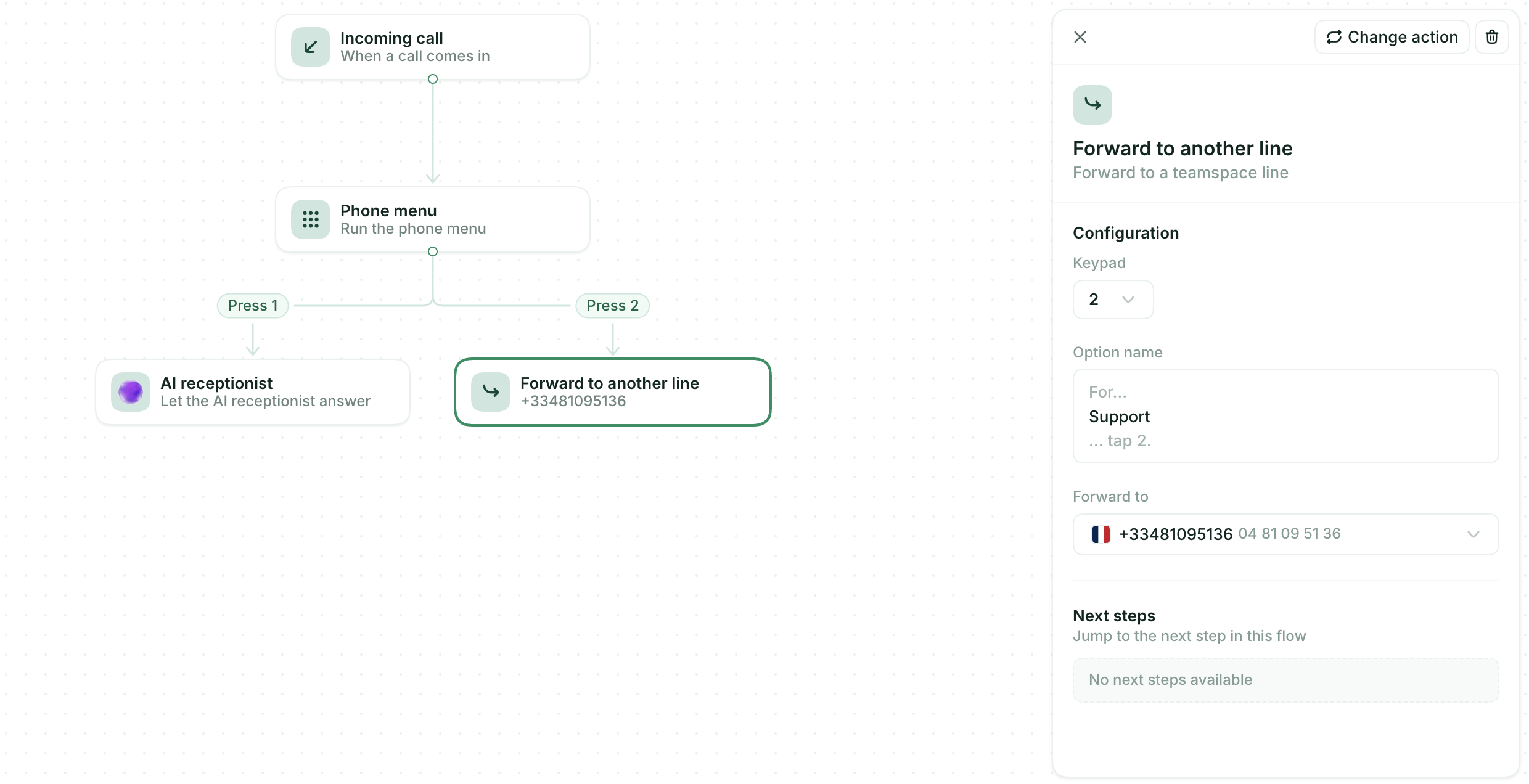
- AI IVR to filter and route calls. A classic IVR makes callers punch through rigid menus. An AI IVR routes them based on what they need, either through a smart self-routing menu or by understanding natural language, and sends them to the right person, team, or answer.
- AI receptionist to handle calls when you're busy. It picks up when you can't. It answers common questions, takes structured messages, books appointments, and transfers urgent callers to a human. Think of it as a front desk that never takes a lunch break.
- AI call transcription and summarization to save time on notes and follow-ups. Every call gets transcribed and condensed into a summary, ideally synced straight to your CRM so nobody types call notes ever again.
Some products only do one of these jobs. The best ones do all three inside a single phone system.
Benefits of AI call assistants
AI call assistants can impact both your revenue and your productivity:
- You stop losing revenue to missed calls. Every unanswered call is a lead you paid to generate and then dropped. An AI receptionist answers 100% of calls, 24/7, including weekends and holidays.
- You save hours on admin every week. Automatic transcription and summaries eliminate manual note-taking. In my own use, the difference is dramatic: I end a call and the summary, the action items, and even a draft follow-up email are already waiting. Multiply that by 20 calls a day per rep and the math gets serious.
- Your callers get routed right the first time. An AI IVR filters spam, sends sales calls to sales, and support calls to support. Fewer transfers, fewer repeated explanations, happier callers.
- You get a memory of every conversation. Searchable transcripts synced to your CRM mean any teammate can pick up a customer relationship mid-thread. No more "what did we promise them last month?"
- It costs a fraction of a human answering service. A traditional answering service or part-time receptionist costs hundreds to thousands per month. Most AI call assistants below start between $16 and $99 per month.
Best AI call assistants
Here's how the seven solutions compare at a glance. I go deeper on each one below.
/
| Solution | AI IVR | AI Receptionist | Transcription & summaries | G2 score | Starting monthly price |
|---|---|---|---|---|---|
| Allo | ✓ Yes | ✓ Yes, unlimited No add-on | ✓ Yes 36 languages | 4.7 / 5 | $16/mo 1 user. Teams: $45/user/mo |
| Quo | ✗ No Standard phone menus only | ✓ Yes Sona: 10 calls/mo, then $0.75/call | ✓ Yes Business plan only | 4.7 / 5 | $19/user/mo AI summaries: Business, $33/user/mo |
| RingCentral | ✓ Yes Via AI Receptionist add-on | ✓ Yes Add-on from $39/mo (100 min) | ✓ Yes Included from Core plan | 4.2 / 5 | $30/user/mo AI Receptionist billed separately |
| Dialpad | ✗ No Standard auto-attendant | ~ Partial AI agents via separate products | ✓ Yes All plans, 9 languages | 4.4 / 5 | $27/user/mo |
| Goodcall | ✓ Yes Routing & directories | ✓ Yes Core product, 24/7 | ~ Partial Transcripts, no auto summaries | Too few reviews | $79/agent/mo Unlimited minutes, 100 callers/mo |
| Fonio | ~ Partial Conversational routing only | ✓ Yes Core product, 25+ languages | ✓ Yes Sent by email after each call | 4.7 / 5 | €119/mo 1,000 minutes included |
| Retell | ✓ Yes Intent-based, you build it | ✓ Yes Build your own, 31+ languages | ✓ Yes Plus post-call analysis | 4.8 / 5 | Usage-based ~$0.07 to $0.31/min, no seat fee |
Allo
What is Allo?
Allo is an AI-first business phone system built for small teams, SMBs, and salespeople. It launched in 2024, which makes it the newest full phone system on this list, and it shows in a good way: AI isn't bolted on as an add-on, it's the core of the product. The company takes a mobile-first approach, so your business line lives in your pocket rather than on a desk phone.
Full disclosure: Allo is our product, so I'm biased. But I'll stick to facts you can verify.
How can Allo's AI call assistant help?
Allo is one of the few solutions here that covers all three AI call assistant jobs in one subscription:
- AI IVR. Callers route themselves with a keypad menu of up to 8 options ("Press 1 for sales..."). Each option triggers an action: play an announcement, ring a line or a specific person, forward to another number, or hand the caller to the AI receptionist. A natural-language voice IVR is in beta.
- AI receptionist. The AI answering service picks up when you're busy or closed, interacts with callers, answers questions, and gathers details. It speaks English, French, and Spanish.
- Transcription and summaries. Every call is transcribed (36 languages supported) and summarized. Allo also drafts follow-up emails.
Everything syncs natively to HubSpot, Pipedrive, Salesforce, Attio, and 14 other tools, including call recordings and transcripts. The HubSpot integration is rated 5/5 on the HubSpot marketplace.
There's even an MCP server to connect Allo to Claude or other AI assistants.
Allo ratings
- G2: 4.7/5
- App Store: 4.3/5 (101 ratings)
- HubSpot marketplace: 4.7/5
Allo pricing
- Starter: $18/month for one user (annual commitment). Includes unlimited calls, a local number, AI summaries, unlimited AI receptionist, and IVR.
- Business: $45/user/month. Adds integrations, international calls, integrations.
AI is included in all plans. There are no add-ons, and you get a 7-day free trial.
You can cancel anytime from the app, no retention call required.
Demo of Allo's AI call assistant
Quo
What is Quo?
Quo (formerly OpenPhone) is a business phone system started in 2018 by two Canadian founders who went through Y Combinator. It rebranded from OpenPhone to Quo in 2025. It targets SMBs and small teams with a clean, collaborative product: shared inboxes, threads, internal comments, and a built-in lightweight CRM.
How can Quo's AI call assistant help?
Quo's AI call assistant story centers on Sona, its AI receptionist. Sona answers calls you miss, handles questions, and takes messages. Every plan includes 10 Sona-handled calls per month; after that, it's $0.75 per call, which I find fair for low volumes but worth watching if your line is busy.
Call transcription and AI summaries are solid (34 languages supported) but reserved for the Business plan at $33/user/month. Voicemail transcription is included everywhere.
The gap: there's no AI IVR. Quo offers standard phone menus and call routing, which work fine, but callers can't self-route through anything intelligent. Also note that numbers are US and Canada only, and Quo explicitly prohibits cold calling.
Quo ratings
- G2: 4.7/5 (3,374 reviews)
- Trustpilot: 3.9/5
- App Store: 4.4/5 (11,000 ratings)
Reviewers consistently praise the intuitive interface and responsive support. The most common complaints are occasional bugs and calls that sporadically fail to connect.
Quo pricing
- Starter: $19/user/month. Local number, unlimited US/Canada calling and texting, voicemail transcripts, 10 Sona calls.
- Business: $33/user/month. Adds AI call summaries and transcripts, call transfers, analytics, HubSpot and Salesforce integrations.
- Scale: $47/user/month. Adds dedicated onboarding and priority support.
7-day free trial.
Demo of Quo's AI call assistant
RingCentral
What is RingCentral?
RingCentral is the incumbent. It's been around since 1999, and it's everywhere: calls, SMS, video meetings, fax, webinars, and more than 500 native integrations. If a tool exists, RingCentral probably connects to it.
How can RingCentral's AI call assistant help?
RingCentral has recently invested heavily in AI:
- AI Receptionist (AIR). An add-on that answers and routes calls, takes messages, and can even look up Shopify orders during a call. It speaks English, French, and Spanish. Pricing starts at $49/month for 100 minutes.
- AI IVR and routing come along with the AI Receptionist add-on, on top of RingCentral's traditional multi-level auto-attendant.
- Transcription and summaries are included from the base Core plan, plus AVA, an AI assistant you can question about your call data.
The AI is real and it works. My reservation is structural: this is legacy software. The admin backend is notoriously complex, the AI receptionist is a metered add-on rather than a built-in, and cancellation requires calling support with a 30-day notice. For an enterprise with an IT team, fine. For a 5-person business, that's a lot of friction.
RingCentral ratings
- G2 (RingEX): 4.2/5 (1,402 reviews)
- Trustpilot: 1.9/5 (yes, you read that right)
- App Store: 4.8/5 (74,000 ratings)
That Trustpilot score is worth reading into: complaints cluster around billing practices, hard-to-reach support, and cancellation.
RingCentral pricing
- Core: $30/user/month. Unlimited domestic calling, recordings, meetings.
- Advanced: $35/user/month. Adds CRM integrations and reporting.
- Ultra: $45/user/month. Unlimited storage, webinars, device analytics.
- AI Receptionist: add-on from $49/month (100 minutes included).
14-day free trial.
Demo of RingCentral's AI call assistant
Dialpad
What is Dialpad?
Dialpad was founded in 2011 by Craig Walker, the man behind GrandCentral, the product that became Google Voice. Half of Dialpad's first 30 hires came from Google, and the company has been developing its own AI models since 2018, long before it was fashionable. It serves SMBs up to large mid-market companies through three products: Connect, Support, and Sell.
How can Dialpad's AI call assistant help?
Dialpad's strength is the third job: transcription and summaries. Real-time transcription, AI call summaries, live coaching, and call scoring are included free in every plan, in 9 languages. G2 reviewers mention the AI notes constantly, including the fact that they flow automatically into the CRM.
Where it's weaker for this list: there's no AI IVR (the auto-attendant is a traditional menu system), and there's no packaged AI receptionist in the core phone product. Dialpad's AI agents live in its separate Support product, priced and sold for contact centers. If what you want is "AI answers my missed calls," Dialpad Connect alone won't do it.
I'd pick Dialpad if AI note-taking across a whole team is the priority and you don't need an AI to actually answer calls.
Dialpad ratings
- G2: 4.4/5 (4,192 reviews)
- Trustpilot: 4.1/5
- App Store: 4.6/5
Praise centers on the AI transcription and the clean interface. Recurring complaints: advanced features gated behind pricier tiers, a real learning curve, and support that can be slow.
Dialpad pricing
- Standard: $27/user/month. Unlimited calling (domestic, US, Canada), a local number, call recording, AI transcription and summaries, up to 3 departments.
- Pro: $35/user/month. Adds SSO, phone support, 25 departments.
14-day free trial.
Demo of Dialpad's AI call assistant
Goodcall
What is Goodcall?
Goodcall is a dedicated AI phone agent, not a phone system. It was founded in 2021 in Palo Alto by Bob Summers, a former Google Speech AI product manager who built its predecessor, CallJoy, inside Google's Area 120 incubator. It's aimed squarely at local service businesses: restaurants, salons, home services.
How can Goodcall's AI call assistant help?
Goodcall answers your existing business line 24/7. It handles FAQs (hours, pricing, directions), captures leads, books appointments through configurable "logic flows," and routes callers to people or departments through its directory feature. Lead details land in SMS, email, Google Sheets, or your CRM via Zapier.
Keep in mind that the pricing model is per unique caller, not per minute: fine for modest call volumes, expensive past a few hundred callers per month. Reviewers also flag a somewhat robotic voice and Zapier-dependent integrations.
The flip side: minutes are unlimited, billing is predictable, and setup via your Google Business Profile is genuinely fast.
Goodcall ratings
Goodcall's review footprint is too thin to be meaningful: its G2 listing has almost no reviews, and Trustpilot shows just 3 (negative, mostly billing complaints). I'd treat ratings as unavailable and rely on a trial instead.
Goodcall pricing
- Starter: $79/agent/month. Unlimited minutes, 1 logic flow, 100 unique callers/month.
- Growth: $129/agent/month. 3 logic flows, 250 unique callers/month.
- Scale: $249/agent/month. 25 logic flows, 500 unique callers/month.
Overage runs $0.50 per additional unique caller. Annual billing takes 15% off. 14-day free trial, no credit card.
Demo of Goodcall's AI call assistant
Fonio
What is Fonio?
Fonio is an AI receptionist built in Vienna, Austria. Launched in 2024, it raised a $17M seed led by 20VC, one of Austria's largest seed rounds ever, and claims more than 9,500 customers. Its positioning is distinctly European: servers in Nuremberg, GDPR and EU AI Act compliance, and an in-house voice stack rather than white-labeled US services.
How can Fonio's AI call assistant help?
Fonio answers inbound calls 24/7 with a natural-sounding AI that qualifies inquiries, answers FAQs, books appointments, and transfers callers to the right human when needed. Setup is genuinely no-code; their pitch is "create your AI in about 60 seconds," and reviewers back up how quick onboarding is. After each call, the transcript and the caller's request are sent to you by email, with recordings and analytics in the dashboard.
It supports 25+ languages and 20+ voices, though the product is German-first (it comes from the DACH market), and reviewers note occasional speech-recognition stumbles on dialects. Integration depth is the other limitation: CRMs and calendars connect via generic categories and API rather than a large native connector catalog.
There's no classic IVR builder; routing is conversational (the AI decides where to send you), which is arguably the future but gives you less deterministic control.
Fonio ratings
- G2: 4.7/5 (29 reviews)
- Capterra: 4.9/5 (102 reviews)
Fonio pricing
- Solo: $119/month ($99 annual). 1,000 minutes included, 1 user, 1 number.
- Team: $349/month ($299 annual). 3,000 minutes, unlimited users, 3 concurrent calls, outbound campaigns, SIP.
- Scale: from $599/month. 5,000+ minutes, custom voice, custom SLA.
No free trial, but there's a free instant demo call on their site and a 30-day money-back guarantee.
Demo of Fonio's AI call assistant
Retell
What is Retell?
Retell AI is the odd one out on this list, deliberately. It's not a phone system or an off-the-shelf receptionist: it's a voice AI platform and API for building your own phone agents. Founded in 2023 and part of Y Combinator's W24 batch, it reportedly reached around $36M ARR with a team of roughly 20 people. Developers, agencies, and contact centers use it to build agents for healthcare, insurance, logistics, home services, and more.
How can Retell's AI call assistant help?
If you can describe it, you can probably build it on Retell:
- AI IVR and routing. Real-time intent-based routing replaces menu trees entirely, with warm and cold transfers based on intent, availability, or even caller sentiment.
- AI receptionist. An inbound agent that answers 24/7, qualifies, books, and transfers. It's a use case you assemble, not a product you toggle on.
- Transcription and summaries. Real-time transcription plus structured post-call analysis with custom fields, sentiment, and outcomes.
It supports 31+ languages with automatic language switching, integrates with HubSpot, Salesforce, Zapier, Make, and n8n, and connects to telephony via its own numbers ($2/month), your Twilio account, or SIP trunking.
The trade-off is right there in the pitch: this is developer-first infrastructure. Reviewers praise the ~600ms latency and natural turn-taking, but flag a steep learning curve and pricing complexity at scale. I would not recommend Retell to a non-technical business owner who just wants missed calls answered; I would absolutely recommend it to a team with an engineer and a specific workflow in mind.
Retell ratings
- G2: 4.8/5 (2,639 reviews)
Retell pricing
Pay-as-you-go, per minute: roughly $0.07 to $0.31/minute all-in, depending on the LLM and voice you pick. Phone numbers are $2/month, and new accounts get $10 in free credits. There's no seat fee, so a low-volume agent can cost just a few dollars per month; a serious production deployment can run to thousands.
Demo of Retell's AI call assistant
How to build an AI call assistant from scratch
Off-the-shelf not your style? You can assemble your own AI call assistant. Here's what that actually involves.
The stack. Every DIY voice agent has four layers:
- Telephony: a provider like Twilio, Vonage, or Telnyx gives you phone numbers and carries the calls (typically ~$1 to $2/month per number plus ~$0.01/minute).
- Speech-to-text: transcribes the caller in real time.
- An LLM: decides what to say next, checks your calendar, looks up an order.
- Text-to-speech: turns the response back into a natural voice.
The shortcut. Platforms like Retell (covered above) bundle layers 2 through 4 into one API with sub-second latency, so you're mostly writing prompts and business logic instead of stitching audio streams. Expect $0.07 to $0.31 per minute all-in. Wiring the raw components yourself is cheaper per minute but, having watched teams try, I'd budget weeks of engineering for interruption handling, latency tuning, and edge cases alone.
The honest math. A DIY assistant makes sense if you have an engineer, a high call volume, and a workflow no packaged product supports (say, verifying insurance details against an internal database mid-call). For a typical small business, the economics rarely work: a $45/month phone system with AI included costs less than the monthly bill for a moderately busy custom agent, before you count a single hour of development time.
My rule of thumb: buy the phone system, and only build when you've outgrown what it automates.
Final thoughts
Seven solutions, three very different philosophies:
- All-in-one phone systems with AI built in: Allo is the standout for small teams (all three AI jobs, from $16/month, no add-ons). Quo is a polished alternative if you mainly want an AI receptionist for overflow calls.
- Big suites with AI added on: RingCentral fits larger organizations that want everything from fax to webinars and can absorb add-on pricing. Dialpad is the pick if world-class transcription and coaching matter more than an AI answering your calls.
- Dedicated AI receptionists and platforms: Goodcall and Fonio bolt an AI agent onto your existing setup (Fonio being the stronger, more polished of the two, especially in Europe). Retell is the developer platform for building exactly what you want.
Start from the job you need done (routing, answering, or note-taking), check the table above for who actually includes it, and use the free trials. An hour of testing beats any comparison post, including this one.
Frequently asked questions about AI phone call assistants
Are there any free AI call assistants?
Not that we know of. You can either pick an AI call assistant off the shelf and leverage the free trial if they offer one to test the waters (Allo, Quo, RingCentral, Dialpad, and Goodcall all do). Or you can build your own call assistant using voice APIs, but these APIs are definitely not free: expect to pay per minute of conversation.
What is an AI call assistant?
An AI call assistant is software that handles phone calls for your business using artificial intelligence. Depending on the product, it can route callers through an AI IVR, answer calls autonomously as an AI receptionist, or transcribe and summarize every conversation so you never take notes manually. The best solutions combine all three in one phone system.
What's the best AI call assistant?
It depends on the job. For small teams that want everything included, I'd pick Allo ($18/month, billed yearly, AI IVR, receptionist, and transcription in every plan, 4.7/5 on G2). For large companies already on a unified suite, RingCentral's AI receptionist add-on is solid. For developers building something custom, Retell (4.8/5 on G2) is the strongest platform I've tested.