AI Medical Answering Service: 7 Solutions Compared for 2026
7 AI answering services for medical offices compared — with honest takes on HIPAA, costs, and what actually works.


Key Takeaways
• Nextiva Xbert is best for established medical practices that need HIPAA compliance, appointment scheduling, and direct integrations with patient management systems like Opus Dental or Core Practice — especially if you're already a Nextiva customer or willing to become one.
• Allo is best for small, mobile-first teams that want a full AI phone system at a fraction of the cost of legacy providers while ensuring HIPAA compliance
• Rosie is best for smaller clinics and solo practitioners looking for an affordable, HIPAA-compliant standalone service that doesn't require switching phone providers — starting at just $49/month with unlimited minutes.
–––––––––––––––
Your receptionist is on a call. Two lines are ringing. A patient just walked in for their 2:30 appointment. Another one is trying to reschedule their follow-up.
Sound familiar?
Medical offices deal with a unique kind of phone pressure. Calls aren't just customer inquiries — they're appointment requests, prescription refill questions, insurance verifications, and sometimes urgent health concerns. Miss one, and it's not just a lost lead. It could be a patient who needed to get through.
That's where AI answering services come in. They pick up every call, 24/7, and handle the routine stuff — scheduling, basic questions, message-taking — so your staff can focus on the people standing in front of them.
But here's where it gets tricky for healthcare. You can't just grab any AI answering tool off the shelf. Patient calls involve protected health information, which means HIPAA compliance isn't optional. Some services check that box. Others don't.
You'll also need to decide: do you want a standalone AI answering service that works alongside your current phone system? Or a phone system that has AI answering built right in? Each path has different costs, setup requirements, and trade-offs.
In this comparison, we review seven AI answering services through the lens of what actually matters for medical practices — HIPAA compliance, pricing transparency, and real-world fit. No vague feature lists. Just the information you need to make a smart call (pun intended).
| Solution | Starting Price | Best For | G2 Rating |
|---|---|---|---|
| Allo | $18/user/moUnlimited AI on every plan · billed yearly | Small clinics wanting an affordable AI phone system with no add-ons. Best value | 4.7 / 5 |
| Quo Sona | $25/mo add-on + Quo subscription required | HIPAA-compliant practices wanting workflow customization and SMS automation during calls. Workflow builder | 4.7 / 5 |
| Rosie | $49/mo Unlimited minutes included | Solo practitioners and small clinics who need a HIPAA-compliant add-on without switching phone systems. Simple & affordable | Not listed on G2 |
| Smith.ai | $95/mo For 50 calls/month | Practices that prefer a human safety net — AI handles routine calls, live agents take over complex ones. AI + human hybrid | Not listed on G2 |
| Goodcall | $79/mo/agent 100 unique customers included | Offices that want to reduce call volume by deflecting routine inquiries to self-service flows. Call deflection | Not listed on G2 |
| RingCentral AIR | $39/mo 100 min + RingCentral sub required | Multi-location practices already on RingCentral that need HIPAA-compliant AI answering with broad language support. Global coverage | 4.2 / 5 |
| Nextiva Xbert | $99/mo 100 interactions + Nextiva sub required | Medical and dental offices that need patient management integrations and multi-channel AI support. Healthcare integrations | 4.5 / 5 |
Allo
What is Allo?
Allo launched in 2024 with a straightforward mission: help small teams get more done with AI.
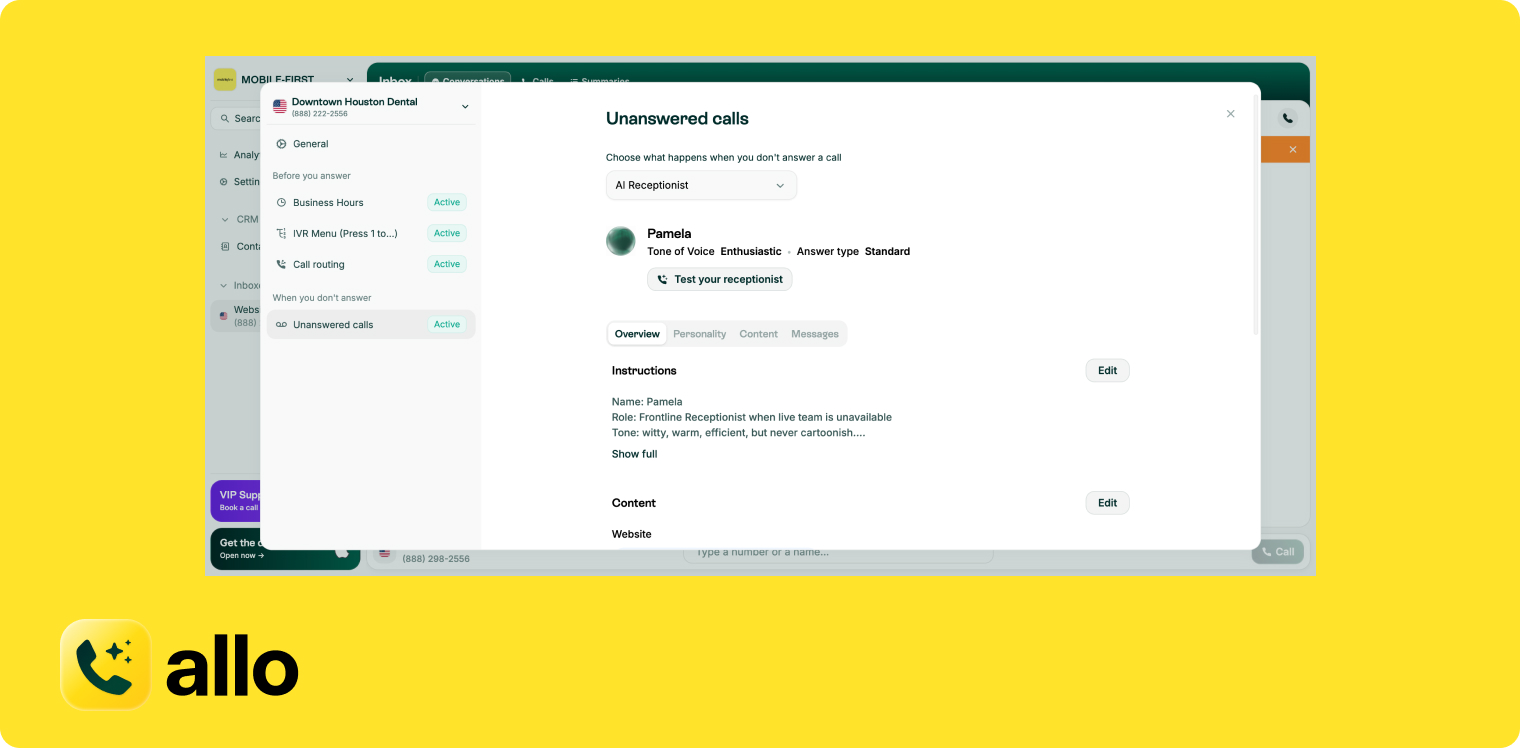
Unlike legacy phone systems that added AI features as an afterthought, Allo was built from scratch with AI at its core. It's a complete phone system — calls, numbers, CRM and texts — with an AI receptionist baked in from day one.
What sets Allo apart is its mobile-first design. The app was built for teams that aren't sitting behind desks all day, which makes it a natural fit for practitioners who move between consultation rooms, home visits, or multiple offices. Every call handled by the AI receptionist gets recorded, transcribed, and synced to your CRM automatically.
Why Allo is a good fit for medical teams
Allo's strongest card is its pricing. At $18/user/month on the Solo plan or $45/user/month on the Business plan — both with unlimited AI receptionist included — it's the most affordable full phone system on this list. For a two-person wellness practice or a therapy office, that's a fraction of what legacy systems charge before you even add AI features.
The AI receptionist is genuinely customizable. You can choose a tone of voice (friendly, professional, or enthusiastic), personalize greeting and closing messages, and train the AI on your website or uploaded documents. It supports English, French, and Spanish, which is a real advantage for practices serving multilingual communities.
The main limitation: Allo doesn't support appointment scheduling through the AI receptionist yet and the HIPAA compliance is only offered in the Business plan.
Allo Pricing
Allo keeps it simple. Two plans, no add-ons for the AI receptionist:
- The Solo plan costs $18/month per user (billed yearly) and includes unlimited AI receptionist, one business number, unlimited national calls, SMS, and CRM autofill.
- The Business plan is $45/month per user ($32 billed yearly) and adds HIPAA compliance, all integrations, power dialer, analytics, and the Allo MCP on top of unlimited AI receptionist usage.
Both plans include pay-as-you-go international calling and one local or toll-free number (extra numbers $5/month), backed by a 30-day money-back guarantee. No setup fees, no hidden charges. What you see is what you pay.
Demo Video of Allo
Quo Sona
What is Quo Sona?
Quo (formerly OpenPhone) started in 2018 in Canada, co-founded by Mahyar Raissi and Daryna Kulya. The original idea came from a problem they saw constantly — business owners juggling personal and professional calls on the same phone. After going through Y Combinator and rebranding from OpenPhone to Quo in 2025, the company launched Sona, its AI answering feature, in April 2025.
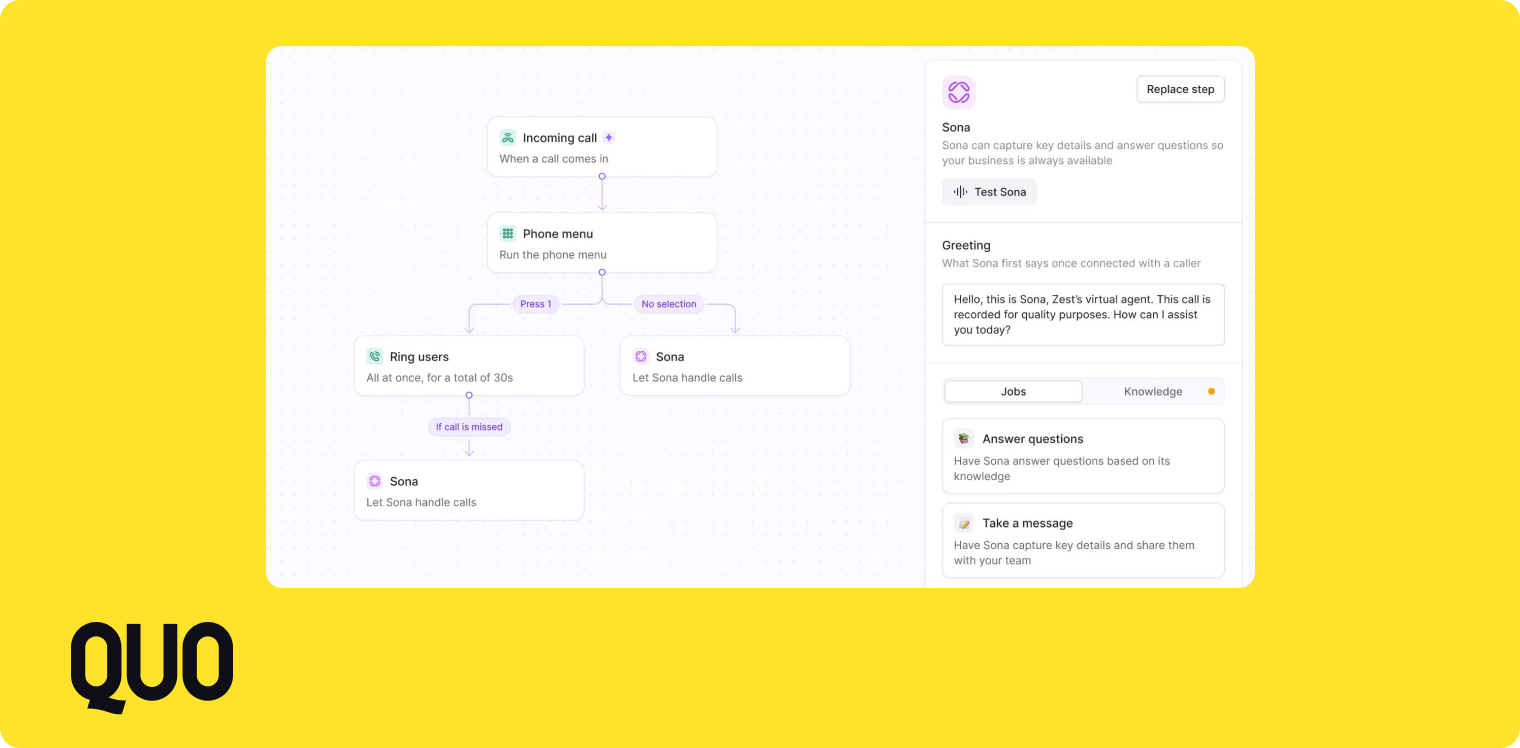
Like Allo, Quo is a full phone system. But Sona brings something different to the table: a visual workflow configuration screen. You can decide exactly what happens at each step of a call — when to take a voicemail, when to transfer, when to collect contact details, and when to send an SMS with a link or directions.
Why Quo Sona is a good fit for medical teams
Sona is HIPAA compliant, which immediately puts it in the running for any medical practice. The workflow builder is its biggest differentiator — you can design call flows that mirror how your front desk actually operates. For example: greet the patient, ask if they're calling about an appointment or a prescription, route accordingly, and send a confirmation text.
The AI can send SMS during calls too — handy for sharing directions, intake form links, or appointment confirmations. Voices sound natural, and you get AI call summaries and transcripts for every Sona interaction.
The downsides? Sona only supports English, which limits its usefulness for multilingual practices. There's also no free trial for Sona specifically — you can try Quo's phone system for free, but Sona requires a paid subscription to test. And the pricing model is per-call, which can add up fast for high-volume offices. At $199/month for 600 calls, a busy practice might find the costs climbing quicker than expected.
Quo Sona Pricing
To use Sona, you first need a Quo phone subscription. Sona is then added on top.
Every Quo plan includes 10 free Sona calls. Beyond that, packages start at $25/month for 40 calls, scaling up to $49/month for 100 calls, $99/month for 250 calls, and $199/month for 600 calls.
There's no free trial for Sona. You need an active Quo subscription to access it, and the add-on billing starts immediately.
Demo Video of Quo Sona
Rosie
What is Rosie?
Rosie was built in 2024 to solve a very specific problem: small businesses that lose leads when calls go to voicemail.
It's not a phone system — it's a standalone AI answering service that sits on top of whatever phone setup you already have. Think of it as a smart safety net for missed calls.
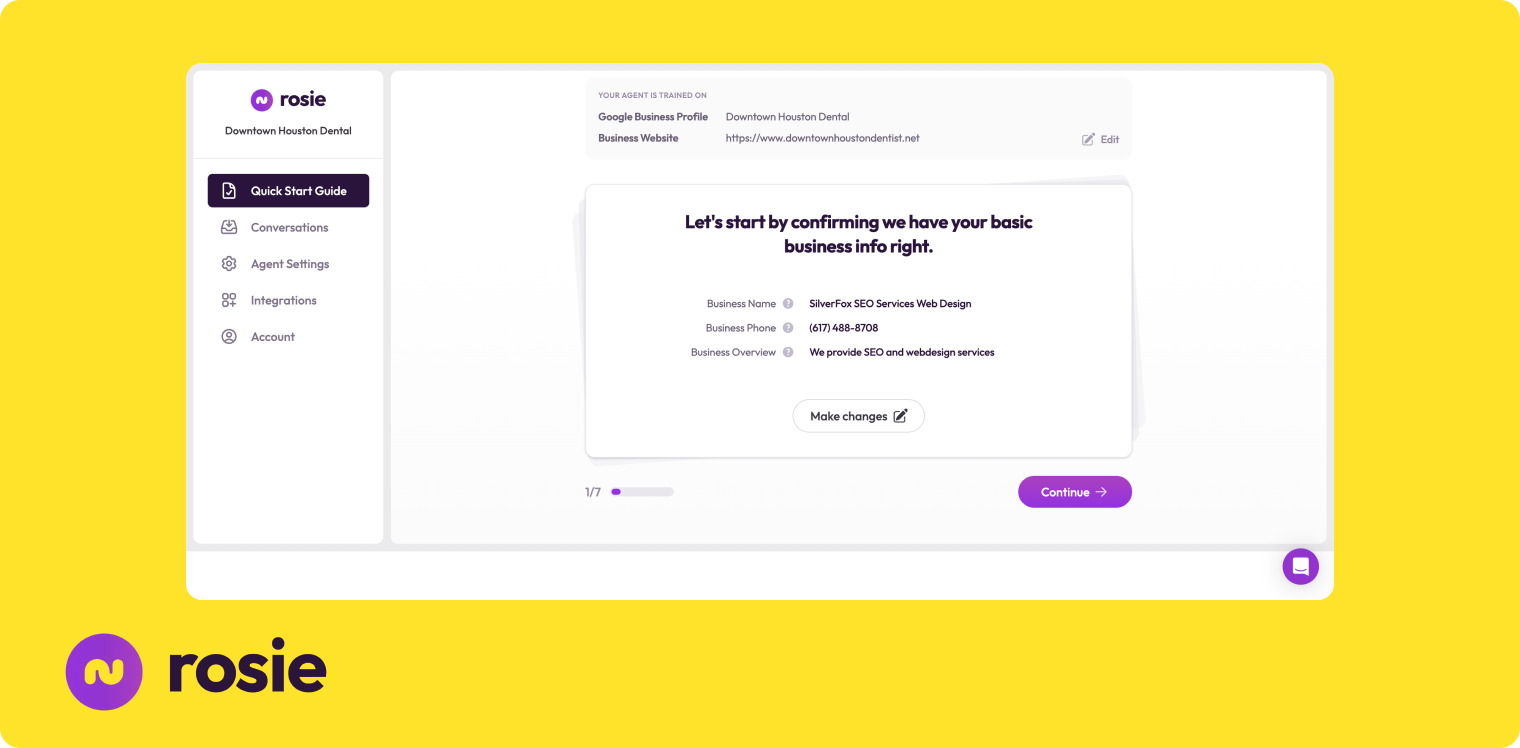
Rosie scans your website and Google Business Profile to train itself, so it can answer basic questions about your practice from day one. On higher-tier plans, you can upload internal documents — pricing sheets, service menus, insurance info — to make the AI sharper.
Why Rosie is a good fit for medical teams
For a solo practitioner or small clinic, Rosie hits a sweet spot. It's HIPAA compliant, affordable, and doesn't require you to change your phone system. You keep your current number, your current provider, and just forward missed calls to Rosie.
The AI takes messages, answers FAQs, and sends you instant notifications with AI-generated summaries when calls end. On the Scale plan ($149/month), it can also schedule appointments through integrations with Google Calendar, Calendly, and Acuity, transfer calls, and send text messages with links during calls.
Rosie's flat pricing is a real plus for medical offices. Every plan includes unlimited minutes and message-taking, so you never have to worry about overage charges during a busy flu season.
Where Rosie falls short: the base Professional plan is quite limited — no call transfers, no appointment booking, no SMS. You'll need the Scale plan for those features, which jumps to $149/month. And since Rosie doesn't provide a phone system, you're managing two separate services.
Rosie Pricing
Rosie offers three flat-rate plans, all with unlimited minutes:
- Professional at $49/month covers message-taking and FAQ answering.
- Scale at $149/month adds appointment links, call transfers, and SMS during calls. Growth at $299/month includes the ability to upload training files for deeper AI customization.
There's a 7-day free trial to test the service before committing.
Demo Video of Rosie
Smith.ai
What is Smith.ai?
Smith.ai has been around since 2015, founded by Aaron Lee, former CTO of Home Depot.
It's the old guard of this list — and intentionally so. Smith.ai was designed for businesses that need reliable coverage but aren't ready to trust AI with every conversation. Its model blends AI with human receptionists based in North America.
The AI handles routine tasks — screening, basic questions, initial call routing — while human agents step in for anything more complex. It's closer to a traditional answering service than a pure AI play, and that's by design.
Why Smith.ai is a good fit for medical teams
If you're a practice owner who's skeptical about handing patient calls entirely to a machine, Smith.ai's hybrid model is reassuring. A real person is always in the loop for nuanced conversations. The company also offers outbound calling — human agents can place follow-up calls on your behalf, which is useful for appointment reminders or post-visit check-ins.
Smith.ai integrates with CRMs scheduling tools (Calendly, Google Calendar), and connects through Zapier and Make for broader workflows.
However, Smith.ai is not HIPAA compliant — their own website states this clearly. For practices that handle protected health information during calls, this is a hard stop. The pricing is also steep compared to fully AI-powered alternatives. Starting at $95/month for just 50 calls, costs escalate quickly for high-volume practices. There's also a manual onboarding process that can take a few weeks.
Smith.ai Pricing
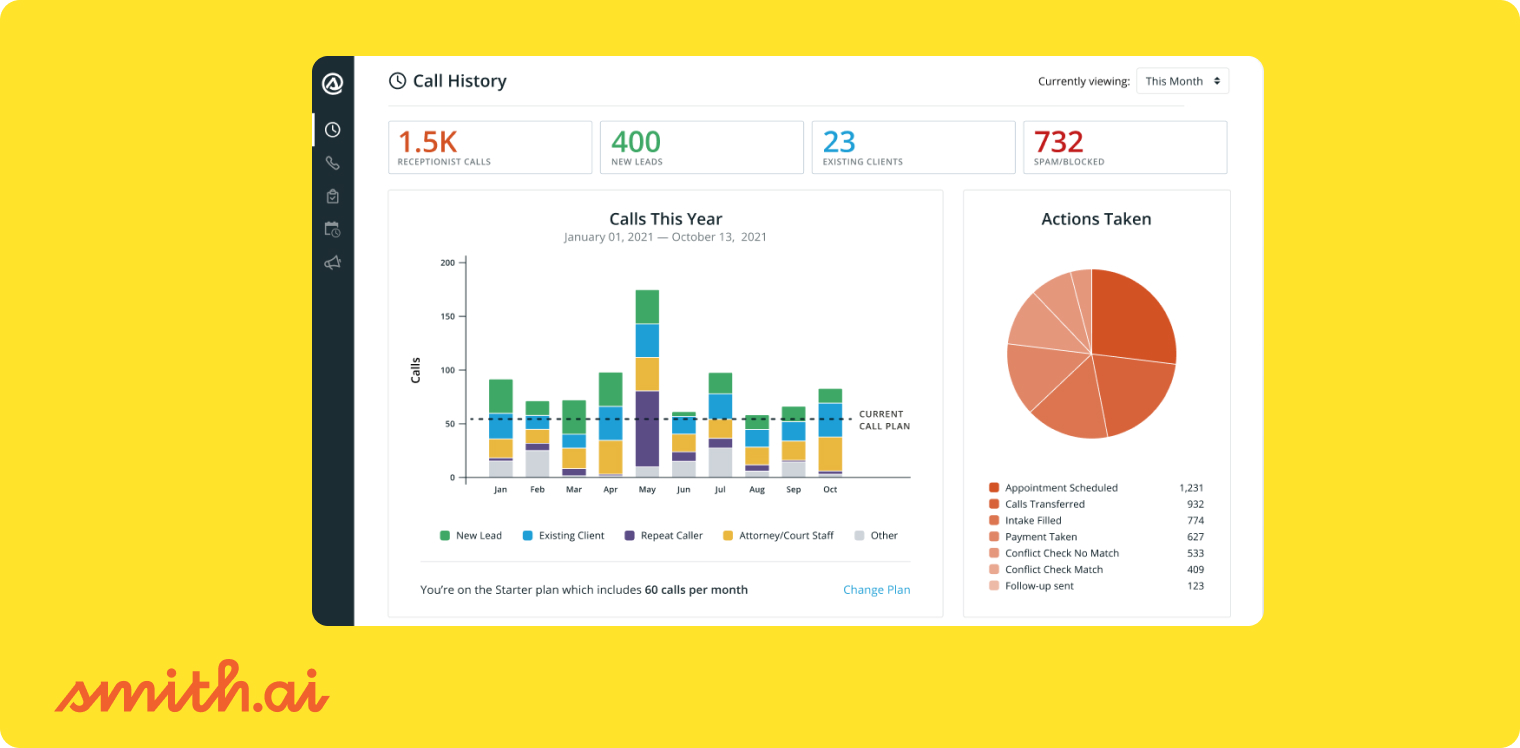
Smith.ai charges based on the number of calls received. The entry point is $95/month for 50 calls, with higher tiers for more volume.
There's no free trial. Given the human component, Smith.ai requires an onboarding process before you go live, which typically takes a few business days to a couple of weeks.
Demo Video of Smith.ai
Goodcall
What is Goodcall?
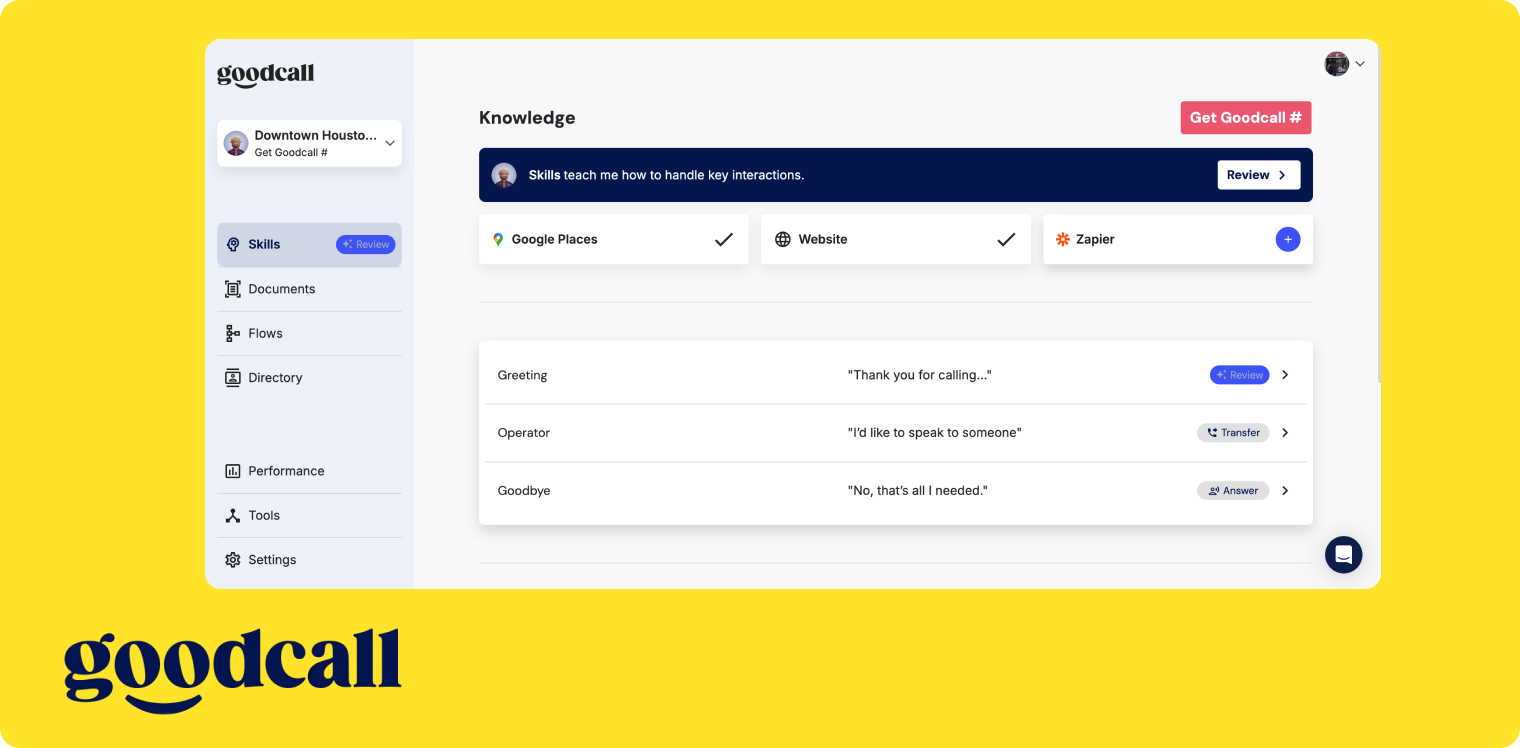
Goodcall was born back in 2017. The company has handled over 4.7 million calls since launch. Goodcall's ambition is a bit different from the others: it wants to eliminate the need for calls altogether. The AI pushes callers toward self-service — booking appointments online, sharing contact details, or getting instant answers without waiting on hold.
It's a standalone AI answering service (not a phone system), so it works alongside your existing phone setup through call forwarding.
Why Goodcall is a good fit for medical teams
Goodcall shines for practices that want to reduce call volume, not just answer it. The AI can guide callers to book online, fill out intake forms, or get answers to common questions — all without tying up your staff. For a busy medical office drowning in "What are your hours?" and "Do you take my insurance?" calls, that deflection is gold.
Goodcall is HIPAA compliant and offers encrypted data handling.
The lead capture feature is strong — you define which questions callers must answer, and the AI collects structured information during the call. Integrations are limited to Zapier and Google Voice, though, which means no direct Patient Management System sync without middleware.
Pricing is based on unique customers, not minutes or calls. That sounds appealing until you look at the numbers: $79/month gets you 100 unique customers, and every additional customer is $0.50. For a medical practice seeing dozens of unique patients calling each month, costs can scale quickly.
Goodcall Pricing
Goodcall offers three tiers based on unique monthly customers:
- Starter is $79/month per agent (100 unique customers).
- Growth is $129/month (250 unique customers).
- Scale is $249/month (500 unique customers).
Overages are charged at $0.50 per additional customer. All plans include unlimited minutes.
There's a 14-day free trial available.
Demo Video of Goodcall
RingCentral AIR
What is RingCentral AIR?
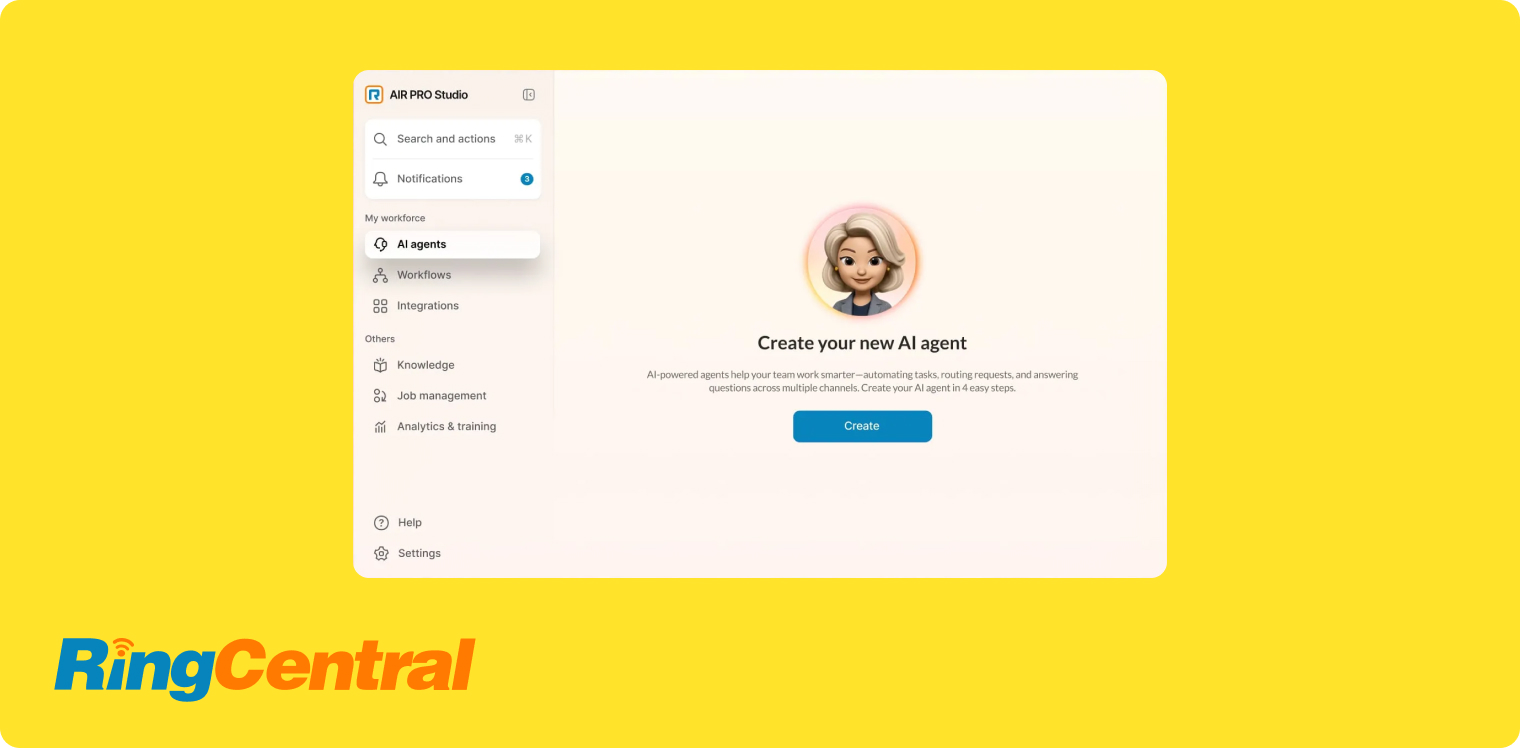
RingCentral has been a heavyweight in business communications since 1999. AIR (AI Receptionist) launched in November 2025 and is integrated directly into the RingCentral phone system — not available as a standalone product.
One catch: access to AIR is still gated behind their sales team. You can't just toggle it on from your dashboard.
Why RingCentral AIR is a good fit for medical teams
If your practice already runs on RingCentral, AIR is the path of least resistance. It's HIPAA compliant, supports appointment booking, answers FAQs trained on your website and uploaded documents, and can transfer calls to a human when the AI can't handle a question.
The multilingual support is best-in-class on this list: English (US, UK, Australian), French (Canadian and European), Spanish, Latin American Spanish, Italian, German, and Portuguese. For practices serving diverse patient populations, that range is difficult to beat.
AIR also provides dedicated reporting — call volume trends, transcript analysis, and insights into knowledge gaps where the AI couldn't answer questions. That feedback loop helps you continuously improve the AI's performance.
The downsides are classic RingCentral: the interface isn't the most intuitive, and the need for a sales call to activate AIR adds friction. The per-minute model ($39/month for 100 minutes, $0.50/minute overage) can get pricey for high-volume practices — and usage is billed in 30-second increments, so even short calls add up.
RingCentral AIR Pricing
AIR costs $39/month for 100 included minutes, on top of your existing RingCentral subscription.
Overages are $0.50 per minute, billed in 30-second increments. Additional minute bundles are available.
There's no free trial for AIR specifically. You'll need to go through a sales conversation to activate the feature.
Demo Video of RingCentral AIR
Nextiva Xbert
What is Nextiva Xbert?
Xbert is Nextiva's AI receptionist — and it goes further than most by supporting not just phone calls, but also text messages, web chat, and messaging apps.
It's a built-in feature of the Nextiva phone system, not a standalone product. But what makes Xbert particularly relevant for healthcare is its integration list — it connects with patient management systems like Core Practice, Opus Dental, and Ortho 2, which no other solution on this list offers.
Why Nextiva Xbert is a good fit for medical teams
Xbert is HIPAA compliant and purpose-built for the kind of multi-channel communication that modern medical offices need. The AI answers calls, responds to texts, and manages web chat inquiries — all from the same platform. For a dental practice or medical office where patients reach out through different channels, that consolidation matters.
The appointment scheduling integrations are solid: Google Calendar, Calendly, and Cal.com are built in. But the real differentiator is the ability to connect with healthcare-specific software.
Xbert sends SMS appointment confirmations, provides call transcripts and summaries, and includes a dedicated reporting dashboard with metrics on call volume, after-hours activity, and appointment handling.
The main drawback is cost. Xbert runs $99/month for 100 interactions (a call counts if it lasts 30+ seconds; a text counts after 3+ AI responses), plus you need a Nextiva subscription starting at $23/user/month. For a small practice, that total can climb past $150/month before overages. The entry-level plan also lacks call recording, which is a significant gap for practices that want to audit AI-handled calls.
Nextiva Xbert Pricing
Xbert costs $99/month per 100 interactions, with overages at $0.99 per additional interaction. This sits on top of a Nextiva phone subscription, which starts at $23/user/month billed monthly.
A conversation counts when a call lasts 30+ seconds or a text/chat receives 3+ AI responses.
There's no free trial for Xbert.
Demo Video of Nextiva Xbert
Conclusion
There's no single "best" AI medical answering service — the right choice depends on your practice's size, compliance needs, and how much change you're willing to absorb.
If HIPAA compliance is non-negotiable (and for most clinical practices, it should be), your options include Allo (on its Business plan), Quo Sona, Rosie, RingCentral AIR, and Nextiva Xbert. Among these, Nextiva Xbert stands out for its patient management integrations, while Rosie wins on simplicity and affordability.
If you want the most complete phone system at the lowest price, Allo gives you an AI receptionist included — with HIPAA compliance on the Business plan — at a price point that undercuts nearly every competitor. The mobile-first experience makes it especially practical for small, on-the-go teams.
Smith.ai is the right pick if you need a human in the loop and you're not handling PHI. Goodcall is worth exploring if your priority is reducing call volume altogether through self-service deflection.
The bottom line: figure out whether you need a standalone answering service or a full phone system. Then filter by HIPAA compliance. Then compare costs based on your actual call volume. That three-step process will get you to the right shortlist faster than any feature matrix.
FAQ about AI medical answering services
Are AI answering services HIPAA compliant?
Not all of them. HIPAA compliance requires specific safeguards — encrypted data handling, signed Business Associate Agreements, access controls, and audit trails. On this list, Allo (on its Business plan), Quo Sona, Rosie, RingCentral AIR, and Nextiva Xbert are HIPAA compliant. Smith.ai is not HIPAA compliant at the time of publishing. Always confirm a vendor's compliance documentation directly before routing patient calls through their service.
How much does an AI medical answering service cost?
Costs vary widely. Standalone AI answering services like Rosie start at $49/month with unlimited minutes, while Goodcall begins at $79/month per agent. Phone systems with built-in AI — like Allo ($18–$45/user/month) or RingCentral AIR ($39/month for 100 minutes) — require factoring in the base phone subscription too. Hybrid services like Smith.ai start at $95/month for 50 calls. For a typical small medical office, expect to budget between $50 and $200/month depending on call volume and features.
What are the best medical office answering services with AI?
It depends on what your practice needs most. For HIPAA-compliant AI answering with healthcare-specific integrations (patient management systems, dental software), Nextiva Xbert is the most purpose-built option. Rosie is a strong, affordable pick for smaller clinics that just need reliable message-taking and scheduling without switching phone providers. Quo Sona offers the most customizable call workflows among HIPAA-compliant options. And for wellness or non-clinical offices, Allo delivers a complete AI phone system at the lowest price per user on this list.