Best AI Answering Services for Restaurants in 2026
7 AI answering services compared for restaurants. Find the right fit for your call volume and budget.


Key Takeaways
• Slang AI is the best fit for restaurants that want a purpose-built solution because it's the only service designed exclusively for the restaurant and hospitality industry, with native integrations for OpenTable, SevenRooms, and Yelp. The trade-off: it's expensive, starting at $399/month per location and requires a phone system on top.
• Allo is a strong pick for restaurant owners who want one tool for everything because it combines a full phone system with an unlimited AI receptionist from $18/user/month (billed yearly) — no add-ons, no per-call charges. It doesn't integrate natively with reservation platforms, but its Zapier integration bridges that gap.
• Nextiva Xbert stands out for multi-location restaurants that need appointment scheduling and broad CRM support because it offers native integrations with Google Calendar, Calendly, and even Yelp (via manual activation), plus a dedicated reporting dashboard. Just know that pricing adds up quickly once you factor in the base subscription.
Introduction
Here's a reality most restaurant owners know too well: the phone rings during the Saturday night rush, the host is seating a four-top, the bartender is mid-pour, and nobody picks up. That call? Probably a reservation for six. Gone.
AI answering services promise to fix this. They pick up every call, answer basic questions, take messages, and — in the best cases — book reservations on the spot.
But here's the thing: the market has shifted. AI answering used to be a standalone product you'd bolt onto whatever phone system you already had. Now, the most interesting options are phone systems that come with AI answering built right in. That means one app, one bill, and one less integration headache.
In this comparison, we reviewed seven AI answering services that work for restaurants: one restaurant-specific specialist, three phone systems with built-in AI answering, and three standalone services. We looked at pricing, restaurant integrations, language support, ease of setup, and how each one handles the calls that matter most — reservations, directions, hours, and the classic "do you have outdoor seating?" question.
Whether you run a single neighborhood bistro or manage multiple locations, there's a solution here that fits. Let's dig in.
Slang AI
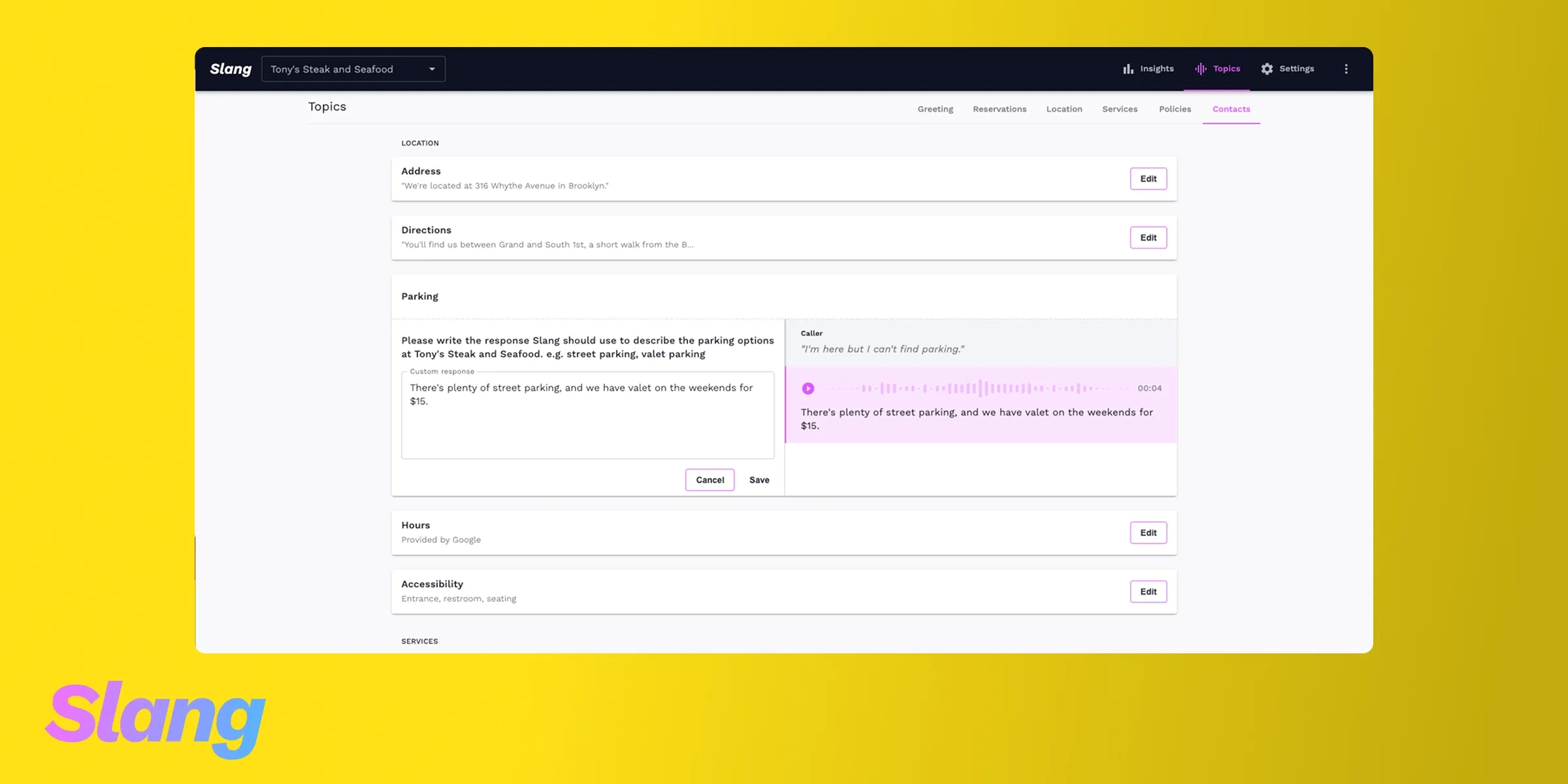
What is Slang AI?
Slang AI is the only AI answering service on this list built specifically for restaurants. Founded by Alex Sambvani and Gabriel Duncan — two Spotify alumni who saw an opportunity to bring AI-powered voice technology to the hospitality industry — Slang has carved out a niche that no generalist service has matched. Their entire product, from the onboarding flow to the integrations, is designed around how restaurants actually operate. If you're looking for a solution that "gets" the restaurant world out of the box, this is it.
Why Slang AI is a good fit for restaurants
The headline feature is reservation handling. Slang AI integrates natively with OpenTable, SevenRooms, Tripleseat, and Yelp — which means it can actually book tables, not just take messages about them. For restaurants that rely on these platforms, that's a game-changer. No Zapier workaround needed; it just works.
Slang also handles the usual restaurant call drivers well: hours, directions, menu questions, and private event inquiries. It supports both English and Spanish, covering a wide range of guest demographics.
Now, the downsides. Some G2 reviewers have flagged integration hiccups — the connections to reservation platforms don't always run smoothly. Others mention that the AI voices could sound more natural. And there's no mobile app, which is a real drawback for restaurant managers who spend their day on the floor, not behind a desk. You'll need to manage everything from a desktop browser.
Slang AI Pricing
Slang AI doesn't come cheap. The Core plan costs $399/month per location and the Premium plan runs $599/month per location (adding custom branding, performance insights, and bilingual support). Both plans include unlimited calls and minutes, so at least you won't be nickel-and-dimed on usage.
There's no free trial. You'll need to book a demo with their sales team to get started, which adds friction if you just want to test the waters.
For a single-location restaurant with high call volume, the cost may make sense. For smaller spots or multi-location groups, the per-location pricing adds up fast.
Demo Video of Slang AI
Allo
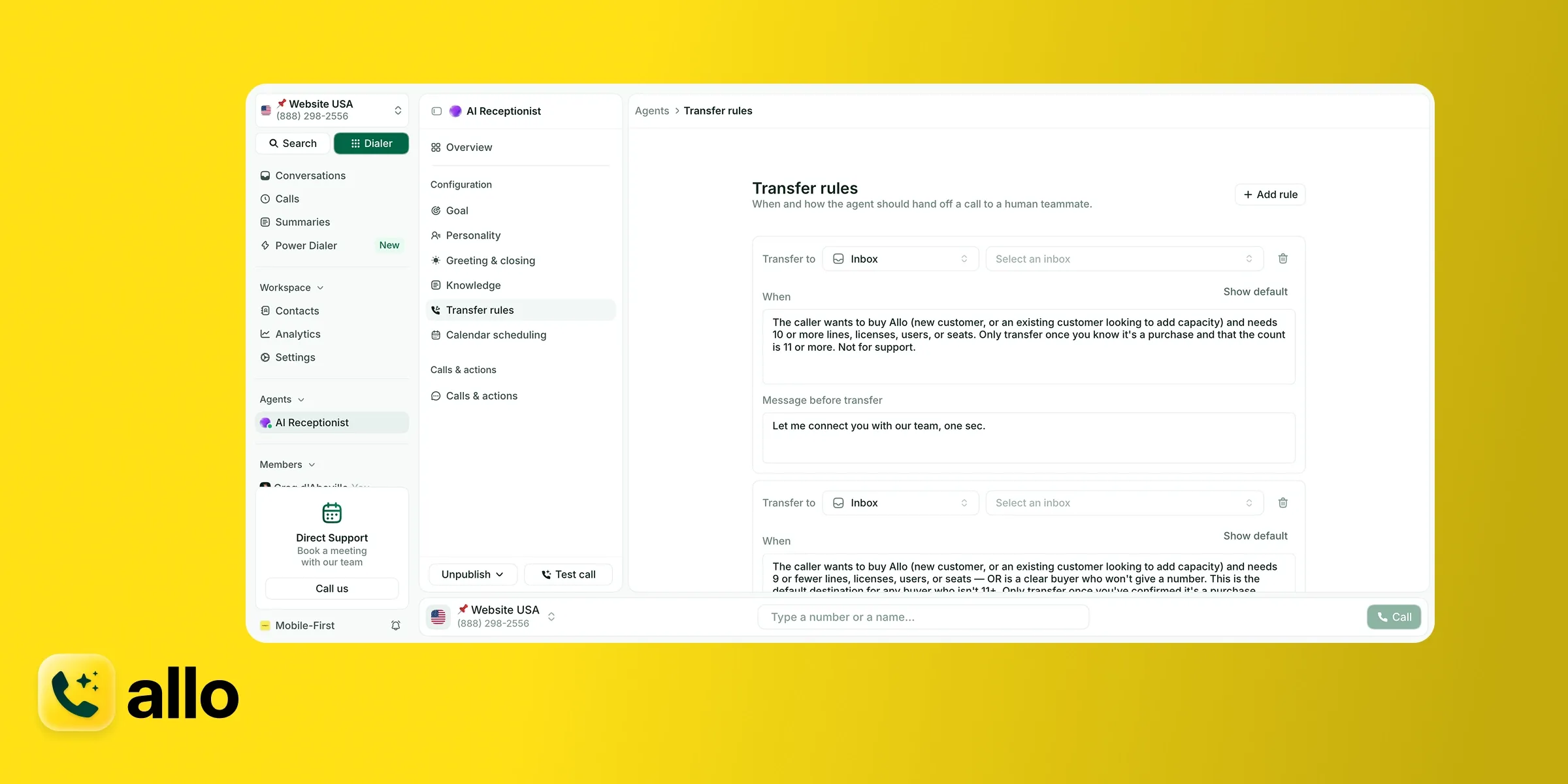
What is Allo?
Allo is a phone system built for small teams that includes an AI receptionist as a core feature — not an add-on. Founded in 2024, Allo was designed from the ground up for the AI era.
The idea: give small teams the same AI-powered phone capabilities that used to be reserved for companies with IT departments and enterprise budgets. It's mobile-first, which means you can manage everything — including your AI receptionist settings — directly from your phone.
Why Allo is a good fit for restaurants
Allo shines on two fronts that matter for restaurants: simplicity and price. The AI receptionist can be trained on your website and documents you upload — your menu, your event packages, your FAQ — so it handles common questions without you lifting a finger. Every call is recorded, transcribed, and summarized, which means you'll always know what callers asked about even when you weren't available.
The mobile-first design is a genuine advantage for restaurant owners and managers. You can customize your greeting, pick a tone of voice (friendly, professional, or enthusiastic), choose an answering style, and review call summaries — all from your iPhone or Android. No laptop required.
Allo doesn't integrate natively with reservation platforms like OpenTable or SevenRooms. That's worth acknowledging. However, it does connect with Zapier, which opens the door to over 1,000 apps — including most reservation and POS tools. It takes a few minutes to set up, but it works. Allo also supports English, French, and Spanish, which covers a lot of ground for restaurants in North America and Europe.
The main gap: Allo doesn't support appointment or reservation scheduling natively. If you need the AI to book a table during the call itself (without sending a link), you'll need to look at Slang AI or build a Zapier workflow.
Allo Pricing
This is where Allo stands out:
- The Solo plan costs $18/month for 1 user (billed yearly) and includes unlimited AI receptionist, one business number, unlimited national calls, call recording, SMS, and native CRM autofill.
- The Business plan runs $45/month per user ($32 billed yearly) with unlimited AI receptionist — no minute caps, no per-call fees — plus all integrations, power dialer, analytics, and the Allo MCP. The AI receptionist isn't an add-on; it's part of the package.
Both plans include pay-as-you-go international calling and one local or toll-free number (extra numbers are $5/month), backed by a 30-day money-back guarantee.
For a small restaurant with one or two users, you're looking at under $100/month for a full phone system plus unlimited AI answering. That's less than what most standalone AI services charge on their own.
Demo Video of Allo
Quo Sona
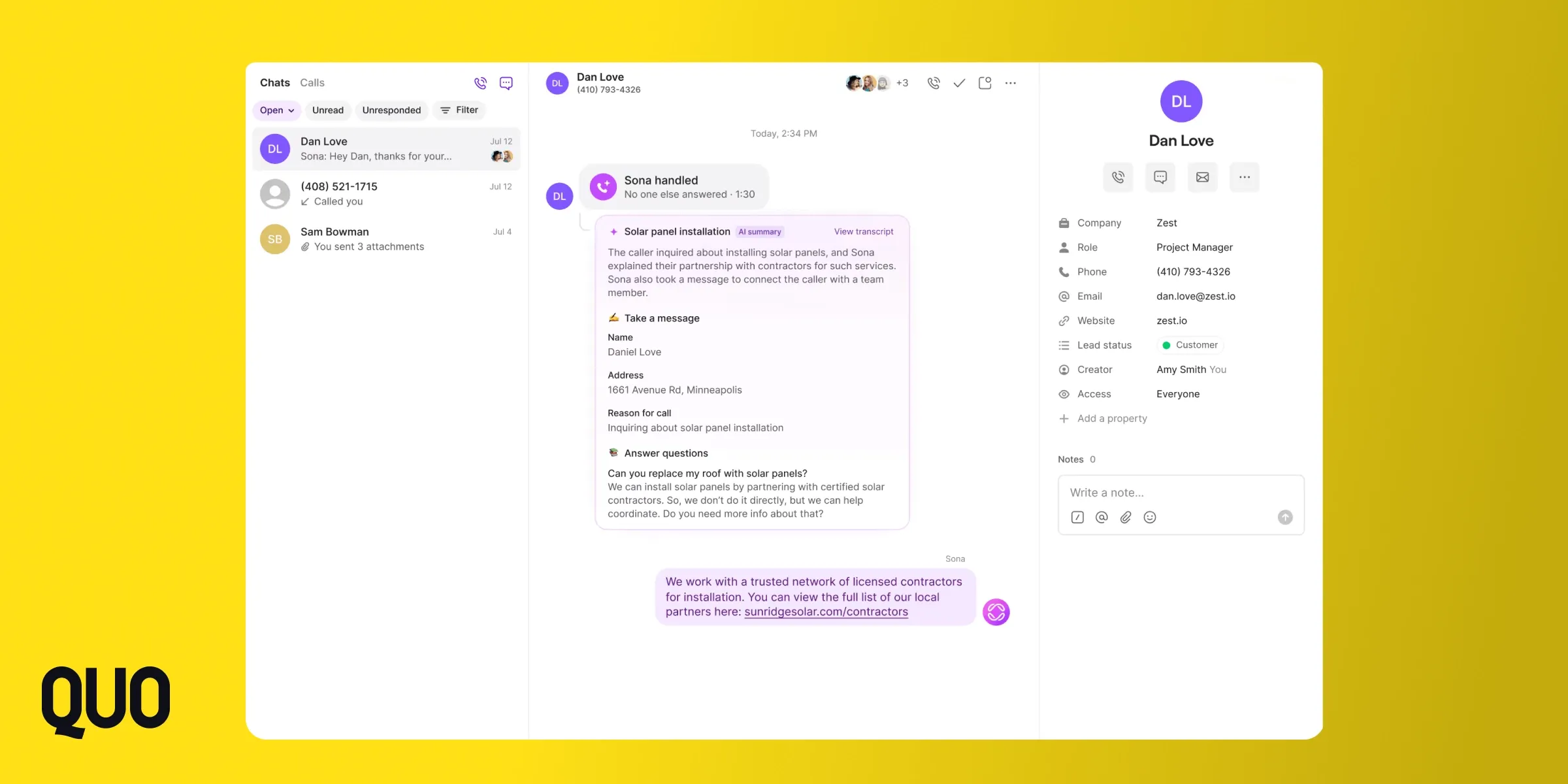
What is Quo Sona?
Quo (formerly OpenPhone) is a phone system that launched Sona, its AI answering service, in April 2025.
Founded in 2018 in Canada by Mahyar Raissi and Daryna Kulya, the company originally set out to solve a common problem: business owners running their operations from personal phone numbers. A YC alumni, Quo rebranded from OpenPhone in 2025 and has since positioned itself as a full-fledged business phone system with AI capabilities.
Why Quo Sona is a good fit for restaurants
Sona's standout feature is its customizable workflow builder. You can design exactly what happens at each step of a call: when to answer, when to transfer to a human, when to collect contact info, when to send to voicemail. For a restaurant, this means you could route reservation requests to a host while letting the AI handle questions about hours and parking.
Sona can also send SMS during calls — links, directions, forms — which is handy when someone needs your address or a link to your online reservation page. The voices sound natural, and you get AI call summaries and transcripts included, even on plans that wouldn't normally include those features.
The limitations: Sona only supports English, which is a dealbreaker for restaurants in multilingual neighborhoods. There's no free trial for Sona specifically (you'd need to subscribe to Quo first), and the pay-per-call model can get pricey. At $99/month for 250 calls, a busy restaurant could easily exceed that. Sona doesn't integrate natively with restaurant-specific tools, but Quo connects with Zapier and Make, so the workaround is there.
Quo Sona Pricing
Sona requires a Quo subscription as a baseline — plans start at around $19/user/month (billed monthly). F
rom there, Sona pricing is an add-on: 10 calls are free with any Quo plan, then it's $25/month for 40 calls, $49/month for 100 calls, $99/month for 250 calls, or $199/month for 600 calls.
There's no way to test Sona for free during Quo's trial period, which is a frustration. For a restaurant that fields hundreds of calls weekly, the combined cost of Quo plus Sona can climb quickly.
Demo Video of Quo Sona
Nextiva Xbert
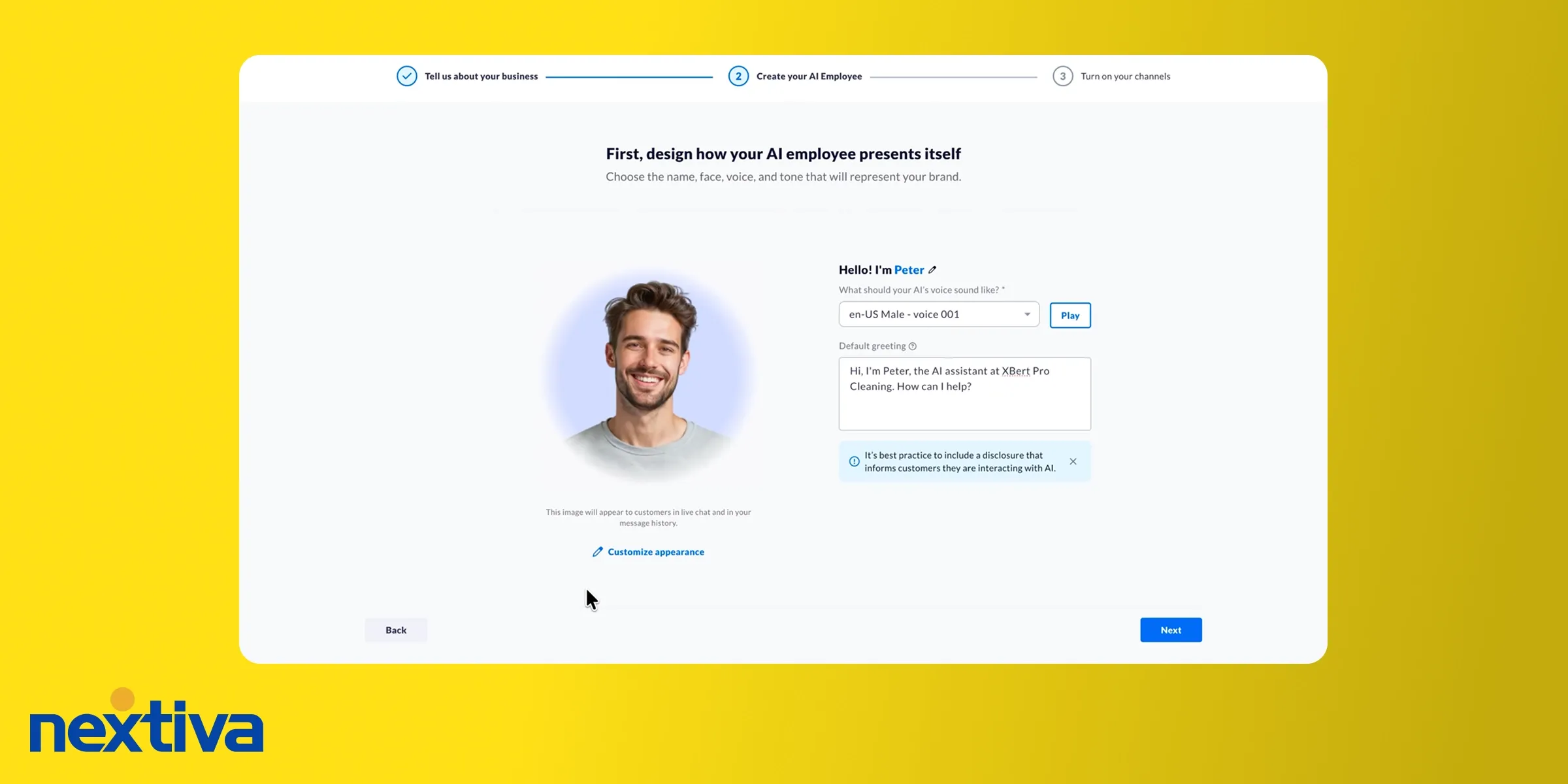
What is Nextiva Xbert?
Nextiva has been in the business communications game since 2008. Their AI receptionist, Xbert, handles phone calls, text messages, web chat, and messaging apps — making it one of the more versatile options on this list. Nextiva's positioning has always been about helping small businesses operate like Fortune 500 companies, and Xbert is their latest play to deliver on that promise.
Why Nextiva Xbert is a good fit for restaurants
Xbert checks several boxes that matter for restaurants. It can book appointments through integrations with Google Calendar, Calendly, and Cal.com — and it sends SMS confirmations afterward. For restaurants that take reservations through a calendar tool (as opposed to OpenTable or Resy), this works well.
Nextiva also offers integrations with Yelp and other restaurant-adjacent platforms. These integrations require manual activation on Nextiva's side (expect 2–4 days), but once live, they connect your AI receptionist directly to the platforms your customers already use. They're included for free.
Xbert can also be trained on your website and uploaded documents, so it'll answer questions about your menu, hours, and private dining options. The dedicated reporting dashboard is a nice bonus — you can see call volume, appointment stats, and after-hours call trends.
The downsides: Nextiva uses per-interaction pricing, which makes it harder to predict your costs. And it's limited to the US and Canada for local numbers.
Nextiva Xbert Pricing
Xbert costs $99/month for 100 interactions, with $0.99 per interaction after that. An "interaction" counts when a call lasts 30+ seconds or when a text/chat receives 3+ AI responses.
You'll also need a Nextiva subscription underneath — starting at $23/user/month billed monthly. So the real starting cost is more like $122/month before overages. For a busy restaurant that gets 200+ calls a month, the per-interaction fees add up.
Demo Video of Nextiva Xbert
RingCentral AIR
What is RingCentral AIR?
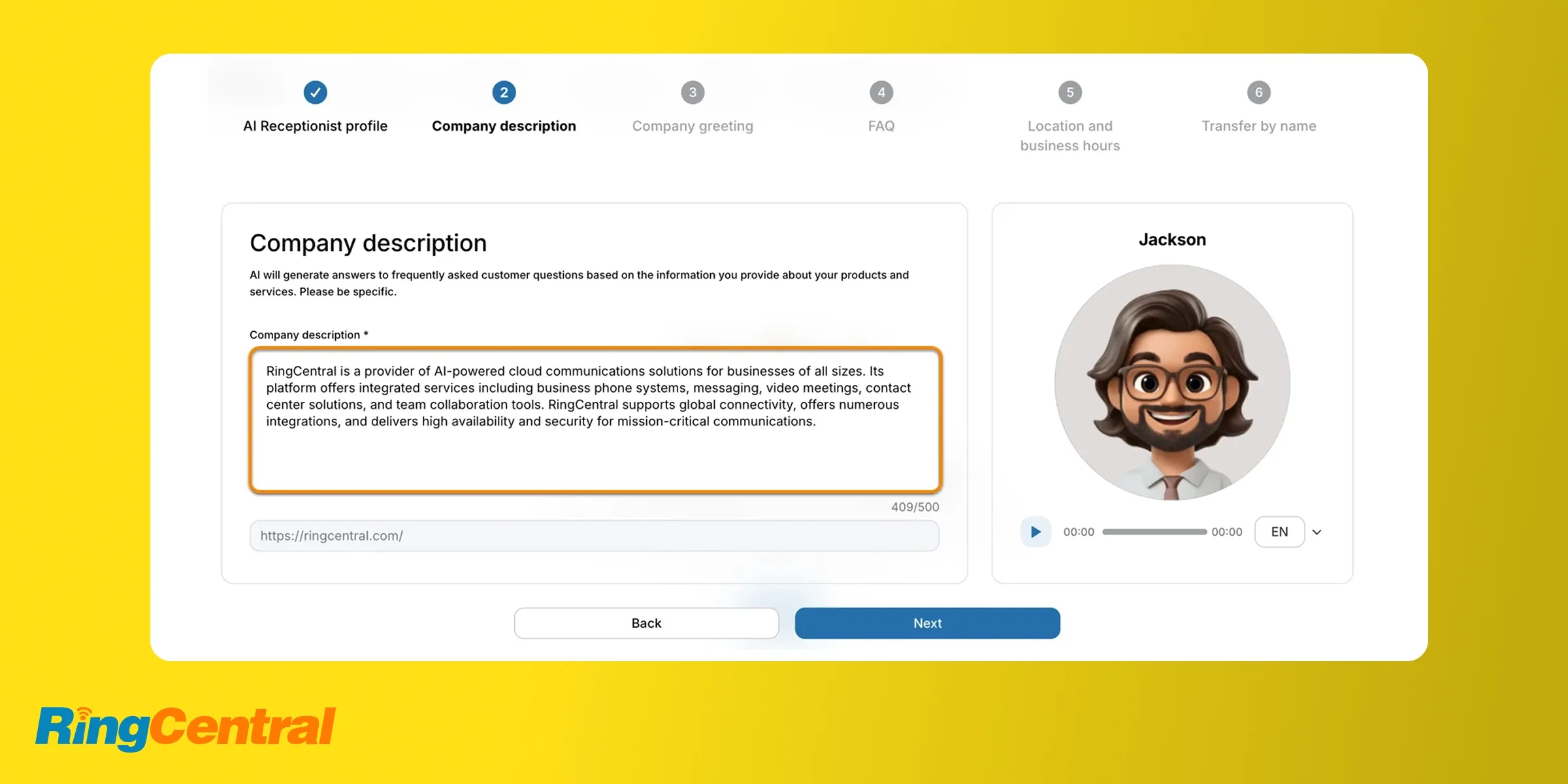
RingCentral has been a fixture in business communications since 1999 — long before AI answering was even a concept. Their AI Receptionist (AIR) launched in February 2025 and is still relatively new to the market. Access is gated behind a sales conversation, so you can't just sign up and start testing. That said, RingCentral's sheer scale and infrastructure mean AIR has some impressive capabilities under the hood.
Why RingCentral AIR is a good fit for restaurants
AIR covers the fundamentals well. It answers FAQs (trained on your website and uploaded docs), sends SMS for directions and important links, transfers to a human when it's stuck, and records plus transcribes every call. The reporting is solid too — you get metrics on call volume, trends, and knowledge gaps (i.e., questions the AI couldn't answer, which tells you what to add to your training materials).
The language support is the broadest on this list: English (US, UK, and Australian), French, Spanish, Latin American Spanish, Italian, German, and Portuguese. For restaurants in diverse urban areas, that's a legitimate advantage. RingCentral also supports over 100 countries, so it works for international restaurant groups.
AIR integrates directly with HubSpot, Zoho, Salesforce, and Google/Outlook calendars. No native restaurant integrations, but the ecosystem is wide enough that Zapier can fill the gap.
The deal-breaker for some: you can't self-serve. You have to go through a sales call to activate AIR, and RingCentral's UI has long been a source of complaints — it's functional but not fun. Pricing is also on the high side, especially once you factor in the base RingCentral subscription.
RingCentral AIR Pricing
AIR costs $39/month for 100 minutes, layered on top of your existing RingCentral subscription. Overages run $0.50 per minute, and call time is rounded up in 30-second increments — so a 31-second call gets billed as 60 seconds.
There's no free trial for AIR specifically. Combined with the mandatory sales call, testing this one requires a commitment upfront.
Demo Video of RingCentral AIR
Rosie
What is Rosie?
Rosie is a standalone AI answering service launched in 2024 by serial entrepreneur Jordan Gal. The premise is straightforward: small businesses lose leads when calls go to voicemail, so Rosie picks up instead, answers questions, and takes a message. It's a focused product that doesn't try to be a phone system — it does one thing and keeps it simple.
Why Rosie is a good fit for restaurants
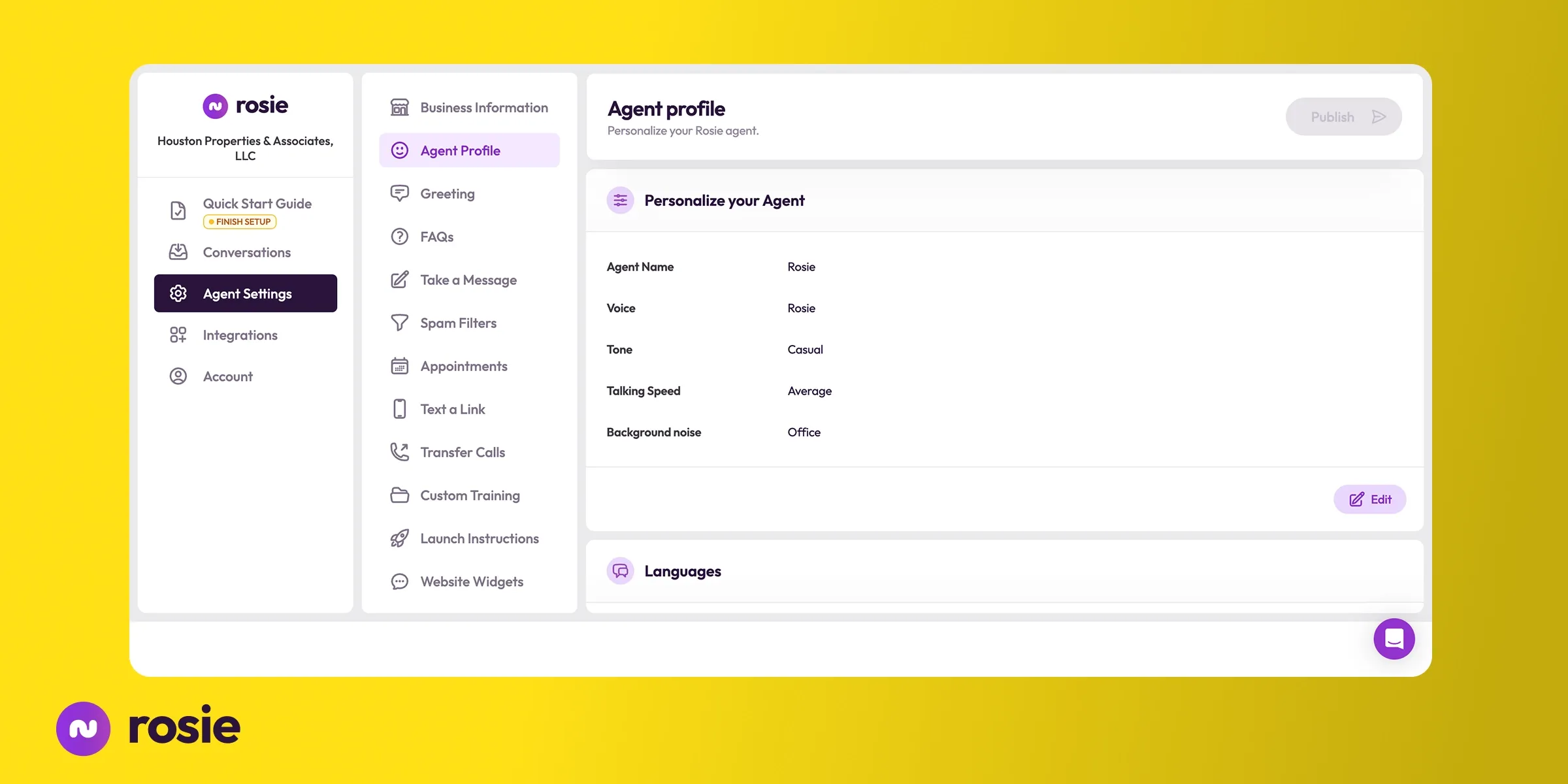
Rosie's strongest suit for restaurants is its ease of setup. It scans your website and Google My Business profile to train itself, which means it'll pull your hours, location, and basic info automatically. You can also create custom FAQs — "Do you have gluten-free options?" or "Is there a corkage fee?" — and customize the greeting. On the advanced plans, you can upload internal docs like pricing sheets or event menus.
Rosie sends instant notifications and AI-generated summaries for every call, so even during a slammed dinner service, you'll know exactly who called and what they needed. It also handles text messages, which is a nice touch.
The downside: the base Professional plan ($49/month) is quite limited. It doesn't include appointment scheduling, call transfers, or the ability to text links during calls. Those features unlock at the Scale plan ($149/month). And Rosie doesn't come with a phone system — you'll need to use it alongside your existing one.
On the integration front, Rosie connects with Google Calendar, Calendly, and Acuity for appointment booking, plus Zapier for everything else. No native restaurant integrations, but the Zapier connection opens the usual workarounds.
Rosie Pricing
Rosie offers three plans, all with unlimited minutes and message taking:
- The Professional plan is $49/month but lacks key features.
- The Scale plan at $149/month adds appointment links, call transfers, and SMS during calls.
- The Growth plan at $299/month includes training files for more complex setups.
There's a 7-day free trial, which is a plus.
Just keep in mind that you'll also need a separate phone system — so factor that cost in when comparing with bundled solutions like Allo or Quo.
Demo Video of Rosie
Goodcall
What is Goodcall?
Goodcall was founded in 2021 by Bob Summers, a tech veteran and former Google executive, with the goal of bringing AI agent technology to small businesses.
Rather than just answering calls and taking messages, Goodcall tries to resolve them on the spot — collecting lead info, answering FAQs, and steering callers toward self-service options. The philosophy is that the best call is the one that doesn't need a callback.
Why Goodcall is a good fit for restaurants
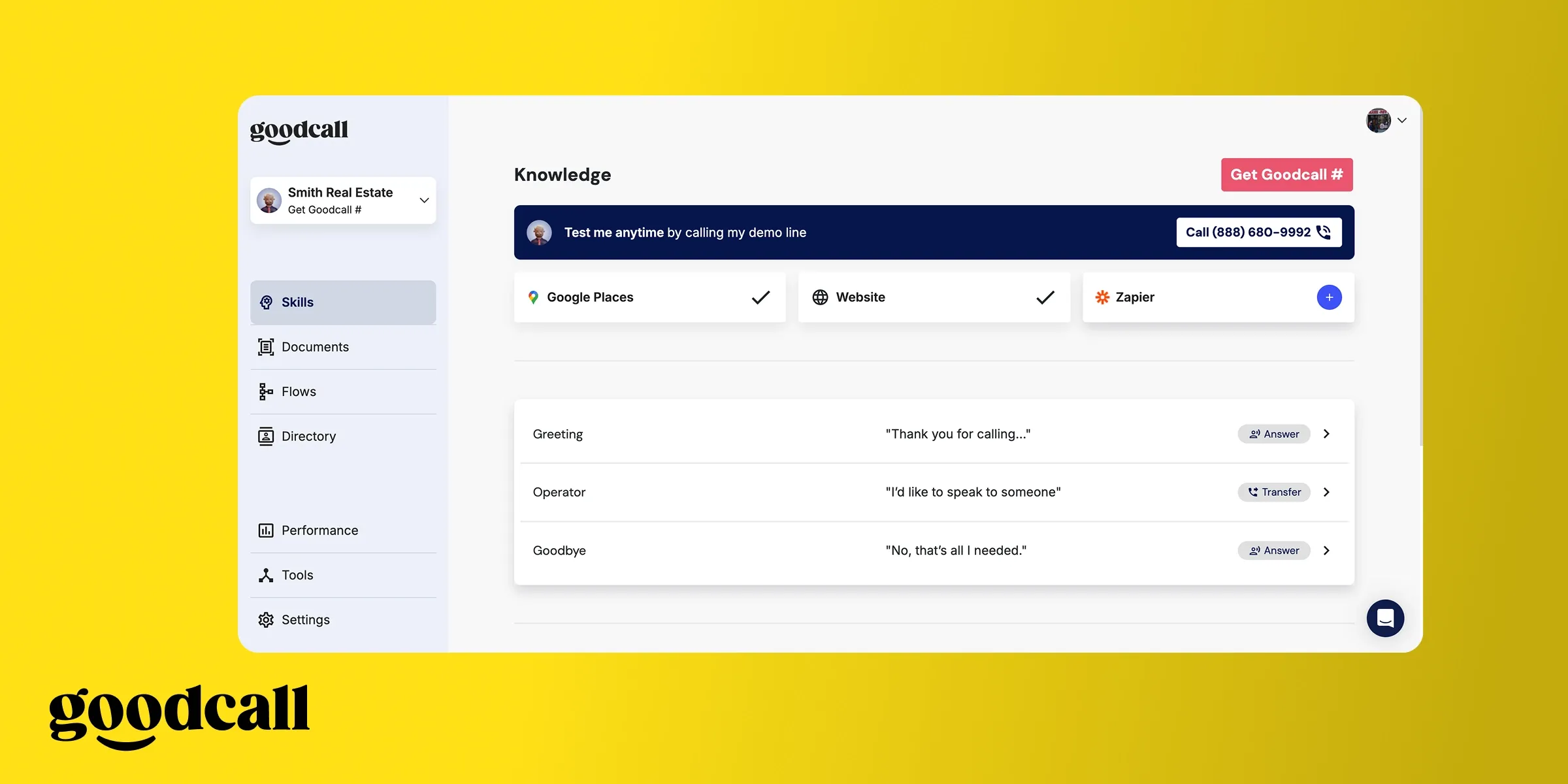
Goodcall's strength is lead capture. During a call, it can walk the caller through a customizable set of questions — name, party size, preferred date, dietary needs — and log everything without you being involved. For restaurants that want to reduce the volume of calls that require human follow-up, that's a real productivity gain.
It supports English, Spanish, and French, integrates with Zapier for connecting to other tools, and offers unlimited call minutes on all plans.
Where it falls short for restaurants: Goodcall doesn't integrate with any reservation or POS platforms natively. Its only direct integration beyond Zapier is Google Voice. There's no SMS support, so the AI can't text a caller your menu link or directions during the call. The voice options are limited, and — perhaps the biggest practical issue — there's no mobile app. You also need a separate phone system, since Goodcall doesn't provide one.
Goodcall Pricing
Goodcall's pricing is based on unique customers per month rather than minutes.
Two plans are available:
- The Starter plan costs $79/month per agent for 100 unique customers ($0.50 per customer after).
- Growth is $129/month for 250 customers, and Scale is $249/month for 500 customers.
There's a 14-day free trial. The "unique customer" model is interesting — if the same regular calls three times, it only counts once — but for a restaurant with a steady stream of new callers, the overages add up.
Demo Video of Goodcall
Conclusion
If one thing's clear from this comparison, it's that there's no one-size-fits-all AI answering service for restaurants. The right choice depends on your call volume, your tech setup, and how much you're willing to spend.
Slang AI is the obvious choice if you want a solution that was designed for restaurants from day one — native OpenTable and SevenRooms integrations are hard to beat. But at $399+/month per location, it's a premium pick.
Allo offers the best value for restaurant owners who want a complete phone system with built-in AI answering. Starting at $18/user/month (billed yearly) for unlimited AI receptionist, it's the most affordable all-in-one option, and the mobile-first design fits how restaurant teams actually work.
Quo Sona and Nextiva Xbert are solid mid-range options if you already use (or are open to) their phone systems. Sona has the edge on workflow customization; Xbert wins on integration breadth and appointment scheduling.
RingCentral AIR is best for larger or multi-location operations that already run on RingCentral and want to add AI answering without switching platforms.
Rosie and Goodcall work as add-ons to your existing phone system. Rosie is more affordable and easier to get started with; Goodcall is better suited for high-intent lead capture.
One final note: most of these services don't integrate natively with restaurant-specific tools like OpenTable or Toast. But nearly all of them support Zapier, which gets you there with a little extra setup. Don't let the lack of a native integration be a dealbreaker — the workaround works.
FAQ
How to pick the right AI answering service for a restaurant?
Start with three questions: Do you need a phone system too, or just the AI answering piece? What's your monthly call volume? And do you rely on a reservation platform like OpenTable or SevenRooms? If you want one tool that handles everything, look at all-in-one options like Allo or Quo. If you already have a phone system you're happy with, a standalone service like Rosie or Slang AI might be the better fit. Always check whether the service supports Zapier — it's the easiest way to connect your AI answering to the restaurant-specific tools most services don't integrate with natively.
What are the best AI answering services for restaurants?
The best AI answering service for your restaurant depends on what you need most. Slang AI is the only solution built specifically for the restaurant industry, with native integrations for OpenTable, SevenRooms, and Yelp. If you're looking for a more affordable option that bundles AI answering with a full phone system, Allo offers unlimited AI receptionist from $18/user/month (billed yearly). For restaurants already on an existing phone platform, Quo Sona, Nextiva Xbert, and RingCentral AIR all offer strong built-in AI answering capabilities.
How much does an AI answering service cost for a restaurant?
Prices vary widely. On the affordable end, Allo includes an unlimited AI receptionist starting at $18/month per user (billed yearly), which also gives you a full phone system. Rosie starts at $49/month for basic AI answering without a phone system. In the mid-range, Goodcall starts at $79/month per agent, Quo Sona at $25/month for 40 calls (plus a Quo subscription), and Nextiva Xbert at $99/month for 100 interactions (plus a Nextiva subscription). At the premium end, Slang AI costs $399–$599/month per location. Keep in mind that standalone services require a separate phone system, so factor that into your total cost.