6 Best AI Phone Answering Services for Plumbers
Six AI answering services for plumbers reviewed side by side—with real pricing breakdowns to help you stop missing calls.


Key Takeaways
• Allo is best for plumbers who want an all-in-one phone system with AI answering built in — from $18/user/month (billed yearly) with unlimited AI receptionist, it's the most affordable option that bundles everything together, and it's the only solution (alongside Quo Sona) that lets you manage your AI receptionist from your phone.
• Rosie is best for solo plumbers or very small crews who already have a phone system and just need a plug-and-play answering service — flat-rate pricing starting at $49/month with unlimited minutes keeps costs predictable, though you'll need the $149/month plan to unlock appointment links and call transfers.
• Goodcall is best for plumbing companies that want deep control over how calls are handled — its workflow builder lets you customize every step of the conversation, and it charges per unique customer rather than per minute, which suits businesses with repeat callers.
Introduction
You're under a house repairing a sewer line. Your phone buzzes. Then again. By the time you crawl out, you've missed three calls — one of which was a homeowner with a burst pipe willing to pay whatever it takes to get someone there tonight.
That's the daily reality for plumbers.
You can't answer the phone while you're working, but every missed call is a missed job.
An AI answering service picks up every call, captures the details, and even books appointments while you focus on the job in front of you. But choosing the right one isn't straightforward. Some are standalone services you layer on top of your existing phone setup. Others come built into a full phone system, which can simplify your stack and lower your total bill. Pricing models vary wildly. And if you spend your day in the field, being able to manage everything from your phone matters more than most vendors realize.
In this guide, we compare six AI answering services that work well for plumbing businesses: Allo, Rosie, Goodcall, Quo Sona, Nextiva Xbert, and RingCentral AIR.
We'll break down pricing, features, mobile access, and what makes each one a good (or not-so-good) fit for your crew.
| Solution | Starting Price | Best For | G2 Rating |
|---|---|---|---|
| Allo | $18/user/month Unlimited AI answering on every plan · billed yearly | Plumbing teams that want a phone system and AI answering in one affordable package. Best value | 4.7 / 5 |
| Rosie | $49/month Unlimited minutes, all plans | Solo plumbers or small crews who need a simple, affordable answering service on top of their existing phone. Solo-friendly | Not listed on G2 |
| Goodcall | $79/agent/month 100 unique customers included | Plumbing companies that want deep customization over call workflows and charge by unique callers, not minutes. Advanced workflows | Not listed on G2 |
| Quo Sona | $25/month add-on Requires Quo subscription ($23+/user) | Small plumbing teams already using Quo (formerly OpenPhone) who want to add AI answering without switching systems. Quo users | 4.7 / 5 |
| Nextiva Xbert | $99/100 interactions Requires Nextiva subscription ($23+/user) | Established plumbing businesses on Nextiva that want multi-channel AI support across calls, texts, and web chat. Multi-channel | 4.5 / 5 |
| RingCentral AIR | $39/100 minutes Requires RingCentral subscription | Plumbing companies already on RingCentral that want to add AI answering without bringing in a third-party tool. RingCentral users | 4.2 / 5 |
Important Criteria When Picking an AI Answering Service as a Plumber
Before diving into individual reviews, here's what matters most when you're choosing an AI answering service for a plumbing business.
- Pricing model and total cost. Some services charge flat monthly rates, others bill per minute, per call, or per unique customer. For plumbers — where call volumes spike unpredictably during storms or cold snaps — a flat rate or per-customer model is usually safer than per-minute billing. Also factor in whether you need a separate phone system subscription on top of the AI answering service, because that changes the real cost significantly.
- Mobile access. You're not sitting at a desk. You're in a crawl space or driving between jobs. If you can't configure your AI receptionist, check call summaries, or adjust settings from your phone, the service is going to collect dust. Not all products offer full mobile control — this is worth checking before you commit.
- Appointment scheduling. For non-emergency work, booking appointments during the call (or sending a scheduling link via text) saves hours of back-and-forth. Not every service offers this on every plan, so pay attention to tier restrictions.
- Third-party service vs. built-in phone system feature. This is one of the biggest decisions you'll face. A standalone AI answering service (like Rosie or Goodcall) plugs into your existing phone setup via call forwarding. It's flexible, but it means managing two separate tools. A phone system with AI built in (like Allo, Quo, Nextiva, or RingCentral) gives you everything in one place, often at a lower combined cost, but requires adopting a new phone system if you don't already use one.
Allo
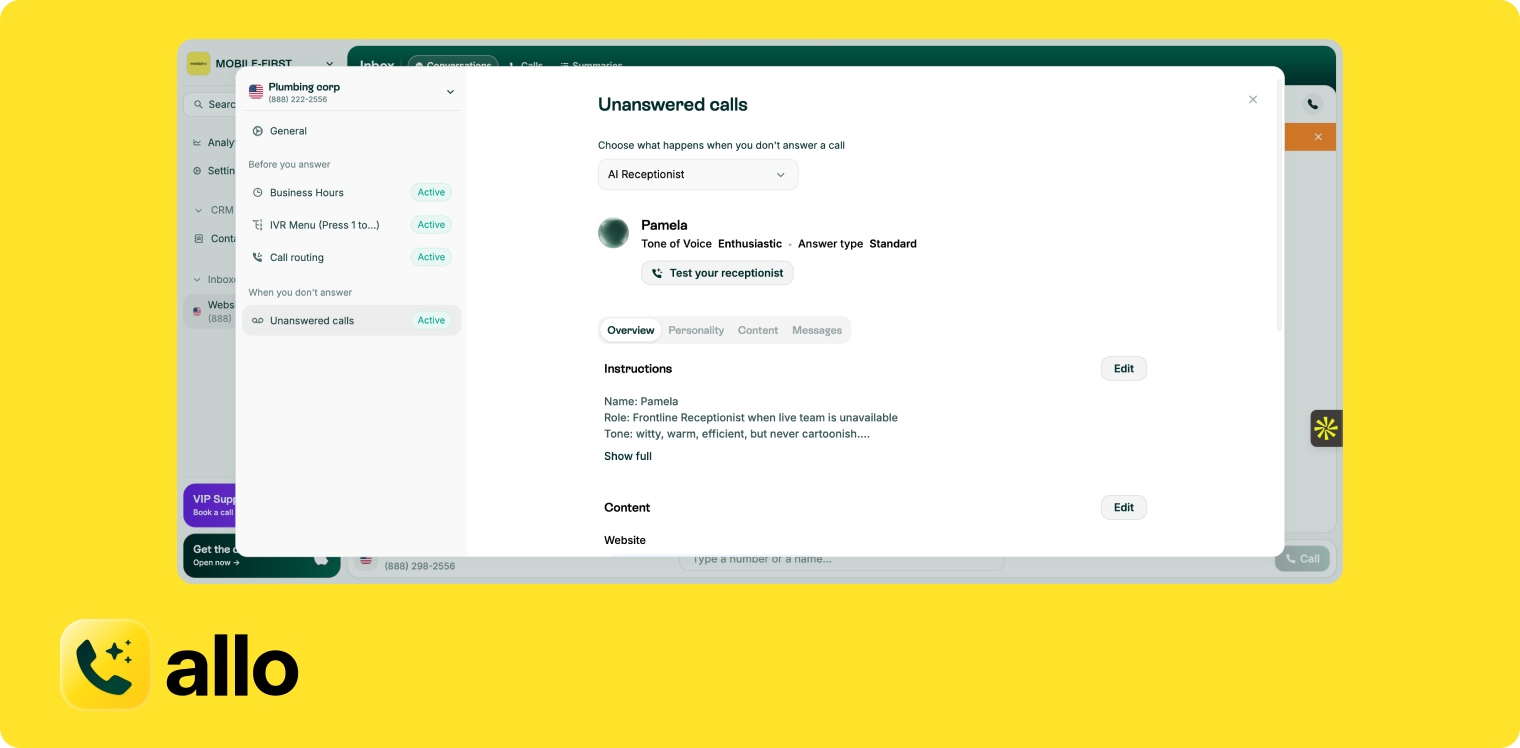
What is Allo?
Allo launched in 2024 with a straightforward mission: help small teams get more productive using AI. Unlike standalone answering services, Allo is a complete phone system with an AI receptionist baked in from the start — not tacked on as an afterthought.
That distinction matters. Instead of forwarding calls to a third-party service and toggling between apps, everything lives in one place: your business calls, CRM sync, call recordings, transcriptions, and AI answering. The whole platform was designed mobile-first, so it works just as well from your work truck as from a desktop.
Why Allo is a good fit for plumbers
The biggest advantage for plumbers? You get a professional phone system and an AI receptionist in a single subscription. No need to piece together a VoIP provider, a separate answering service, and a CRM connector: Allo handles incoming calls, records and transcribes them, generates summaries, and pushes everything to your CRM automatically through native integrations with HubSpot, Salesforce, Pipedrive, and others (plus Zapier for anything else).
The AI receptionist lets you customize your greeting, pick a tone of voice (friendly, professional, or enthusiastic), and choose how detailed the answers should be. You can train it on your website or upload documents (like a pricing sheet for common jobs) so callers get accurate information rather than generic responses.
Where Allo really stands apart: it's one of only two solutions in this comparison that lets you manage your AI receptionist directly from your phone (iPhone or Android). Check call summaries, adjust settings, or review recordings without needing a laptop. For a plumber, that kind of mobile access isn't a luxury — it's a necessity.
One thing to note: Allo doesn't work well for organizations that need multi-level IVR menus. But for most plumbing teams, the combination of simplicity, mobile access, and all-in-one value is hard to beat.
Allo Pricing
Allo keeps pricing simple:
- The Solo plan costs $18/month per user (billed yearly) and includes unlimited AI call answering, one business number, unlimited national calls, SMS, and CRM autofill.
- The Business plan is $45/month per user ($32 billed yearly) and adds all integrations, power dialer, analytics, and the Allo MCP on top of unlimited AI receptionist usage — no caps, no per-minute surprises.
The AI answering service is included in both plans, no add-on required. That's a big deal compared to solutions that charge a base subscription plus a separate AI fee on top.
Both plans include pay-as-you-go international calling and one local or toll-free number (additional numbers $5/month), backed by a 30-day money-back guarantee.
For a small plumbing crew of three, you're looking at $135/month total on the Business plan for unlimited AI answering plus a full phone system. Compare that to layering a $49–$149/month standalone answering service on top of your existing phone bill.
Demo Video of Allo
Rosie
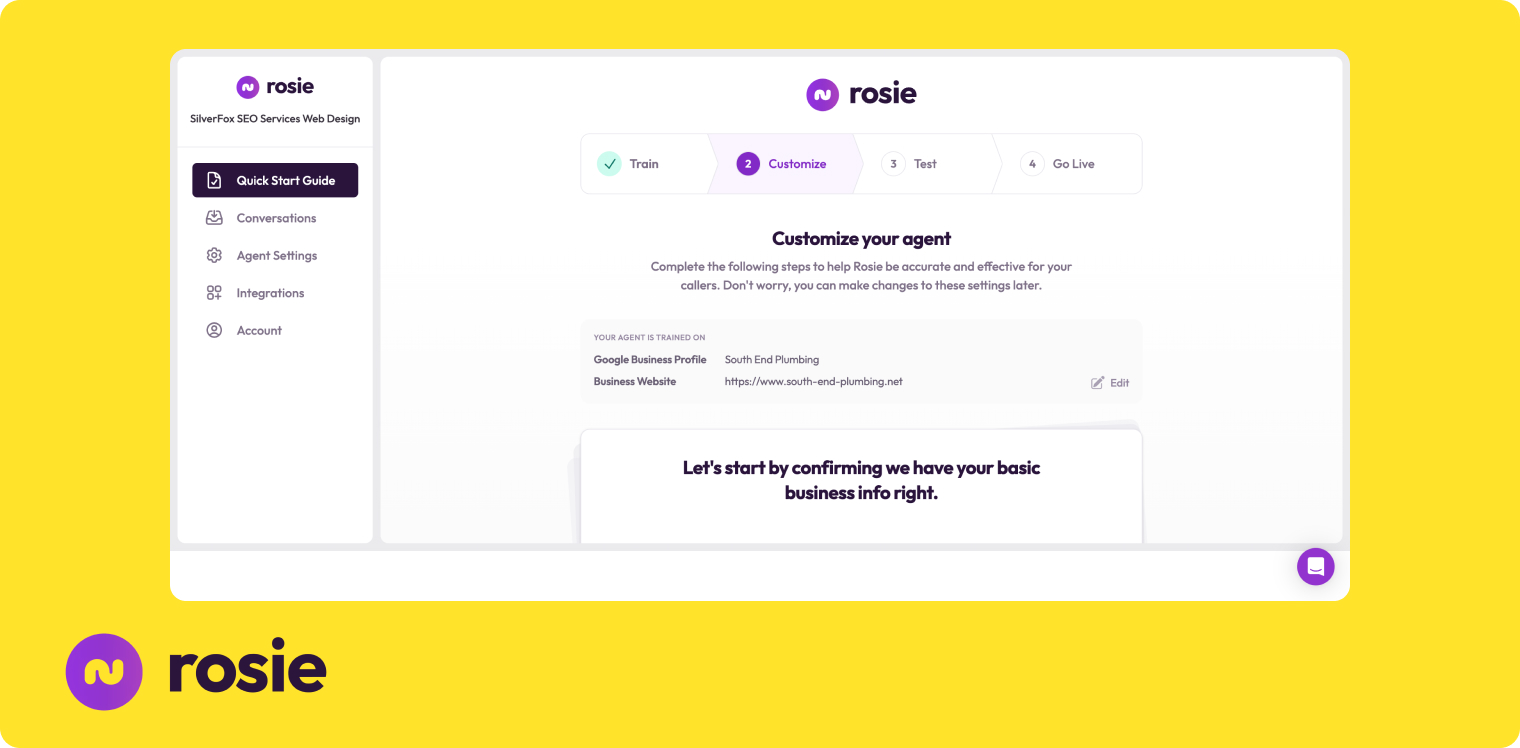
What is Rosie?
Rosie was founded in 2024, and it's quickly become one of the go-to AI answering services for home service businesses — plumbers included.
Unlike Allo or Quo, Rosie is a standalone answering service, not a phone system. You keep your current phone setup and forward calls to Rosie when you can't pick up. It then answers callers, handles common questions, takes messages, and notifies you instantly via text or email. Think of it as a virtual front desk that never takes a lunch break and never puts anyone on hold.
Why Rosie is a good fit for plumbers
Rosie shines for plumbers who already have a phone system they're happy with and just need something to catch the calls they miss. Setup is fast: Rosie scans your website and Google Business Profile to learn about your services, hours, and location. You can also add custom FAQs — like pricing for common jobs or your service area — so callers get useful information instead of a generic voicemail.
Every call comes with a recording, transcript, and AI-generated summary, with instant notifications so you know who called, what they needed, and how urgent it is. The Zapier integration lets you push call data to your CRM automatically. Rosie also supports English and Spanish and filters out robocalls and spam.
The trade-off? On the entry-level Professional plan ($49/month), you can't book appointments, transfer calls, or send text messages during calls. Those features unlock on the Scale plan at $149/month — a significant jump. And you can't configure or manage Rosie from a mobile app — it's dashboard-only — which is a friction point for plumbers who are rarely at a computer.
Rosie Pricing
Rosie offers three plans, all with unlimited minutes and message taking:
- The Professional plan starts at $49/month.
- The Scale plan is $149/month and adds appointment links, call transfers, and the ability to send texts during calls.
- The Growth plan at $299/month adds training files and custom agent training for businesses with more complex needs.
There's a 7-day free trial with all features available, so you can test the appointment scheduling and call transfer features before deciding whether the Scale plan is worth the extra investment.
Keep in mind: since Rosie doesn't include a phone system, you'll be paying your existing provider separately. For a solo plumber already paying $20–$30/month for a basic phone line, the real cost of Rosie is $69–$179/month depending on the plan.
Demo Video of Rosie
Goodcall
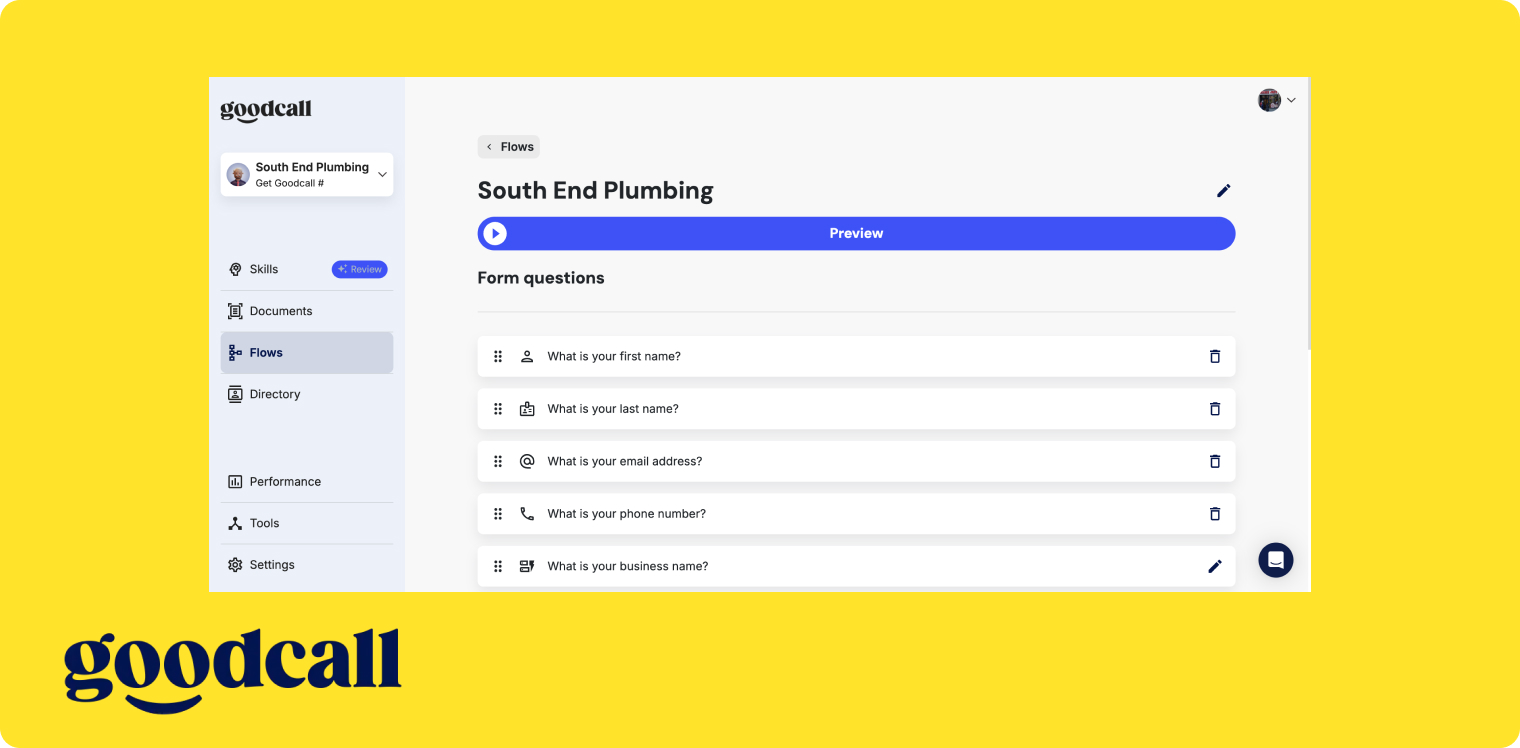
What is Goodcall?
Goodcall was started in 2021 by Bob Summers, a tech veteran and former Google employee, with the goal of bringing the power of AI agents to small businesses.
Where most AI answering services focus on taking messages and relaying them, Goodcall's ambition is bigger: it wants to eliminate unnecessary calls entirely by giving callers the information they need on the spot — or routing them to book an appointment, leave their details, or get a quick answer.
It's one of the more advanced AI answering platforms out there, especially when it comes to customization. If you like tinkering with how your calls are handled and want control over every step of the conversation, Goodcall gives you the tools to do that.
Why Goodcall is a good fit for plumbers
Goodcall's strongest card is its workflow builder. You can configure exactly what happens at each step of a call: what questions the AI asks, what information it collects, and where it routes the caller next. For a plumbing company, you can set it up to ask whether the call is an emergency, what type of service the caller needs, and their address — then send you a structured message with all the details.
The platform integrates with Google Voice and Zapier, pulls information from your Google Business Profile, and can collect lead information directly during calls using custom forms. That's useful if you want to qualify leads before calling back.
On the downside, Goodcall is a standalone service (no phone system included) and isn't configurable from a mobile app. It only integrates natively with Google Voice and Zapier — no direct CRM connections.
Goodcall Pricing
Goodcall's pricing is based on unique customers rather than minutes, which is an interesting model for plumbing businesses with repeat callers.
The Starter plan costs $79/month per agent (one agent = one phone number) and includes 100 unique customers per month.
Growth is $129/month for 250 unique customers, and Scale is $249/month for 500 unique customers. Each plan includes unlimited minutes and calls — you only pay extra ($0.50 per customer) if you exceed your unique customer cap.
There's a 14-day free trial with no credit card required.
The per-customer model can work well if you serve a lot of repeat clients — for instance, property managers who call regularly for different units. But if you get a high volume of one-time callers (which is common in residential plumbing), you could hit the 100-customer cap on the Starter plan quickly and rack up overage charges.
Demo Video of Goodcall
Quo Sona
What is Quo Sona?
Quo (formerly OpenPhone) is a phone system that was founded in 2018. Sona, their AI answering feature, launched in April 2025.
Like Allo, Quo is a full phone system — not just an answering service. Sona sits inside the Quo platform and handles calls when you're unavailable. The key difference from most competitors is Sona's visual workflow configuration screen, which lets you design multi-step call flows: when to send to voicemail, when to transfer, when to collect contact details, and when to send an SMS.
Why Quo Sona is a good fit for plumbers
Sona's standout feature is its workflow builder. You can map out exactly what happens during a call: greet the caller, ask if it's an emergency, collect their address, offer to send a scheduling link via text, or transfer to a specific team member. For plumbers who want more control over call routing than a basic answering service provides, this is a genuine advantage.
The AI voices sound natural, and Sona generates call summaries and transcripts for every call it handles. It can also send SMS messages during calls to share links, directions, or appointment confirmations, which is a practical touch for service businesses.
Like Allo, Sona is fully configurable from the Quo mobile app on both iPhone and Android. That's a real plus for field workers.
The downsides? Sona only supports English, which limits its usefulness if you serve Spanish-speaking communities. There's no free trial specifically for Sona — you have to subscribe to Quo first, and while Quo offers a free trial, Sona isn't available during it. You get 10 free Sona calls with your Quo subscription, but after that, it's a paid add-on. The pricing model is per-call, not flat rate, so costs can climb during your busiest months.
Quo Sona Pricing
To use Sona, you first need a Quo subscription, which starts at $23/user/month billed monthly.
Sona is then added on top. Every Quo plan includes 10 free Sona calls. Beyond that, the add-on tiers are: $25/month for 40 calls, $49/month for 100 calls, $99/month for 250 calls, and $199/month for 600 calls.
There's no way to test Sona for free — the Quo free trial doesn't include access to it.
For a solo plumber on the basic Quo plan, the real monthly cost is $23 (phone) + $25–$49 (Sona) = $48–$72/month for phone plus AI answering with 40–100 calls. That's competitive, but the per-call model means you need to estimate your volume carefully. If you regularly exceed your tier, you're either paying overage fees or upgrading to a higher plan mid-month.
Demo Video of Quo Sona
Nextiva Xbert
What is Nextiva Xbert?
Nextiva has been in the business phone game since 2008. Xbert is their AI receptionist, and it goes beyond phone calls — it also handles text messages, web chat, and messaging apps, making it one of the more versatile options here. For plumbing businesses that get inquiries through multiple channels, that breadth can be genuinely useful.
Why Nextiva Xbert is a good fit for plumbers
Xbert's multi-channel approach is its headline feature. It handles phone calls, text messages, web chat, and messaging platforms from a single AI. For plumbers who get booking requests through their website and phone, this consolidates everything.
On the phone side, Xbert answers FAQs (trained on your website, Google Business Profile, or documents), books appointments through Google Calendar, Calendly, and Cal.com, and sends SMS confirmations. It transfers calls to a human when needed. The reporting dashboard tracks call volume, trends, and knowledge gaps — handy for refining training over time. For CRMs, Xbert connects to Zoho natively, with Salesforce, HubSpot, and Pipedrive available through manual activation (2–4 days).
The catches: The AI receptionist isn't configurable from a mobile app. And the pricing model — $99 per 100 interactions — can get pricey. An "interaction" counts when a call lasts 30+ seconds or a text/chat gets three or more AI responses, so even short calls eat into your allocation.
Nextiva Xbert Pricing
Xbert costs $99/month for 100 interactions, with additional interactions charged at $0.99 each.
But you also need a Nextiva phone subscription, which starts at $23/user/month billed monthly. So a solo plumber is looking at $23 + $99 = $122/month minimum for phone plus AI answering.
There's no free trial for Xbert. The interaction-based pricing can be hard to predict — a busy week of burst pipes and flooding could blow through 100 interactions fast, pushing your monthly bill well past $200. For plumbing companies with high call volumes, the math gets expensive quickly compared to flat-rate alternatives.
Demo Video of Nextiva Xbert
RingCentral AIR
What is RingCentral AIR?
RingCentral has been around since 1999 — it's one of the veterans of business communications.
AIR (AI Receptionist) launched in February 2025, making it the newest product on this list. Access is still gated through their sales team, so you can't just sign up and start using it — you'll need to go through a sales call to get it activated.
RingCentral AIR sits inside the broader RingCentral phone system, so it's aimed primarily at businesses that already use RingCentral for their communications. If you're not on RingCentral yet, adopting AIR means switching your entire phone system — which is a bigger commitment than just adding a standalone answering service.
Why RingCentral AIR is a good fit for plumbers
If you're already a RingCentral customer, AIR is a natural add-on. It handles FAQ answering (trained on your website and documents), books appointments through Google and Outlook calendars, sends SMS confirmations and directions, and transfers to a human when needed. Call recordings and transcripts are included, along with a reporting dashboard that tracks volume, trends, and knowledge gaps.
RingCentral AIR supports English (US, UK, Australian), French, Spanish, Italian, German, and Portuguese — the widest language support in this comparison. It also integrates directly with HubSpot, Zoho, and Salesforce for lead capture.
The downsides are significant, though. Per-minute pricing with 30-second rounding increments gets expensive. No mobile app configuration. You need a sales call just to get access — no free trial or self-serve setup. And RingCentral's interface has a reputation for being complex, which can frustrate small teams without IT support.
RingCentral AIR Pricing
AIR costs $39/month for 100 minutes, on top of your existing RingCentral subscription. Overage is charged at $0.50 per minute, billed in 30-second increments. Additional minute bundles are available.
RingCentral's base phone plans aren't cheap either, so the total cost adds up. A plumber receiving 15–20 AI-answered calls per day during a busy stretch could easily blow through 100 minutes in a week.
Demo Video of RingCentral AIR
Conclusion
Choosing an AI answering service as a plumber comes down to three questions:
- Do you want a standalone service or a full phone system with AI built in?
- What pricing model fits your call volume?
- And can you manage it from your phone — because you're definitely not behind a desk all day.
If you want everything in one place at the lowest total cost, Allo bundles a phone system and unlimited AI answering from $18/user/month (billed yearly), with full mobile control. Quo Sona offers a similar all-in-one approach with a more powerful workflow builder, but costs more once you factor in the base subscription plus per-call AI fees, and it only supports English.
If you'd rather keep your current phone and just add an answering layer, Rosie is the simplest option at $49/month with unlimited minutes — just know you'll need the $149/month plan for appointment booking and call transfers. Goodcall gives you deeper customization and charges by unique customer rather than by minute, which suits businesses with repeat callers.
For plumbers already locked into a larger phone system, Nextiva Xbert and RingCentral AIR add AI answering without requiring a system switch — but both come with per-interaction or per-minute billing that can spike during your busiest months, and neither offers mobile configuration.
The right choice depends on your setup, your budget, and how much control you want. But the wrong choice? That's easy — it's not having anything at all, and letting every missed call walk straight to your competitor.
FAQ about AI phone answering services for plumbers
What is the best AI answering service for plumbers?
There's no single best option — it depends on what you need. For plumbers who want the simplest, most cost-effective all-in-one solution, Allo is hard to beat: you get a phone system and unlimited AI answering from $18/user/month (billed yearly), fully manageable from your phone. If you already have a phone setup and just want to add answering, Rosie's flat-rate pricing ($49/month, unlimited minutes) makes it easy to budget for, though you'll need the higher-tier plan for appointment scheduling. For more advanced call customization, Goodcall's workflow builder gives you granular control, and its per-customer pricing model works well for plumbing companies with a lot of repeat callers. If you're already on Quo, Nextiva, or RingCentral, their built-in AI answering features (Sona, Xbert, and AIR respectively) keep everything in one place — just watch out for per-call or per-minute fees that can add up fast during peak season.
How much does an AI answering service cost for a plumbing company?
It depends on the type of service and your call volume. Standalone AI answering services like Rosie start at $49/month with unlimited minutes, while Goodcall starts at $79/month per agent with 100 unique customers included. Phone systems with built-in AI answering, like Allo, start at $18/user/month (billed yearly) with unlimited AI receptionist included. Systems like Quo, Nextiva, and RingCentral charge a base phone subscription plus AI answering fees on top, typically ranging from $25–$99/month depending on usage. For a solo plumber, expect to spend anywhere from $18 to $150/month for a functional setup. For a team of three, budget $135–$400/month depending on the solution and plan tier.