
Key Takeaways
- Mojo is best for solo real estate agents and small teams focused on high-volume cold calling in the US/Canada — its triple-line dialer on copper infrastructure was built specifically for real estate prospecting, and it comes with built-in lead data for FSBOs, expireds, and neighborhood farming.
- Allo is best for solo agents and small teams that want AI transcription, summaries, and an AI receptionist built into every plan at the lowest entry price on this list — its single-line power dialer starts at $45/user/month with no seat minimum, though it lacks Mojo's built-in real estate lead data.
- Kixie is best for real estate teams of 5–20 reps who use HubSpot, Salesforce, or Pipedrive and want a modern parallel dialer (up to 10 lines) with local presence, AI spam protection, and a clean interface, without the legacy feel.
- PhoneBurner is best for agents and teams who prefer a disciplined, one-call-at-a-time approach with built-in lead management and strong Salesforce/HubSpot integrations ; ideal if you value conversation quality over raw dial volume.
Introduction
Let's be honest: cold calling in real estate can feel like a grind.
Dialing expired listings, FSBOs, and circle-prospecting leads for hours, only to hear voicemail after voicemail. It takes persistence, a good script, and thick skin.
But half the battle is having the right tools. A great dialer won't teach you how to handle objections (that's on you and your coach), but it will make sure you're spending your time talking to people instead of punching in phone numbers.
That's what this guide covers: the tools side of the equation.
We compared seven dialers that real estate professionals actually use, and we evaluated each one on the four criteria that matter most when you're picking a dialer for prospecting: ease of use, pricing transparency, CRM integration depth, and AI features that save you time after the call.
Whether you're a solo agent farming expireds or a team leader managing 10 reps, you'll find a clear recommendation below. Let's get into it.
| Solution | Dialer type | Best for | Min monthly cost |
|---|---|---|---|
| Allo | Progressive dialerSingle line by design, no parallel dialing. | Solo agents and small teams that want AI transcription and summaries built into every plan at the lowest entry price.AI included | $45/mo$32/mo billed yearly. No seat minimum. |
| Mojo | All typesSingle-line or triple-line dialing up to 3 lines. | Solo agents and small teams doing high-volume cold calling on US/CA real estate leads.Real estate specialist | $99/moSingle-line + $10 access fee. Month-to-month. |
| JustCall | All typesPower, predictive and parallel dialing up to 10 lines. | Budget-conscious teams of 2+ who want a parallel dialer, AI transcription, and affordable pricing.Best value | $138/moPro plan, 2 seats. $98/mo billed yearly. |
| PhoneBurner | Progressive dialerNo parallel dialing, one call at a time. | Agents and teams who prefer quality-focused, single-line dialing with built-in lead management.Quality over volume | $165/moStandard plan, 1 user. |
| CloudTalk | Progressive dialerParallel dialing sold as a $39/user/mo add-on. | Teams working across multiple markets or states that need local numbers and parallel dialing.Multi-market coverage | $207/moExpert plan, 3 seats. $147/mo billed yearly. |
| Aircall | Progressive dialerBasic power dialer, no parallel dialing. | Mid-sized real estate teams that need a trusted brand with strong integrations and wide geo coverage.Trusted brand | $210/moProfessional plan, 3 seats. $150/mo billed yearly. |
| Kixie | All typesSingle-line and multi-line dialing up to 10 lines. | Teams of 5–20 reps who want parallel dialing with deep CRM integration and a modern UI.Modern & flexible | Not publicHistorically ~$35–$95/user/mo. |
Mojo, Best for High-Volume Real Estate Prospecting
What is Mojo?
Mojo has been around since 2007, which makes it one of the oldest dialers in this comparison. Built by a team in New Hampshire, it was designed from day one for real estate agents, mortgage brokers, and insurance professionals ; not as a general-purpose phone system that later pivoted to sales.
What makes Mojo unusual is its infrastructure. Instead of running on VoIP like most modern dialers, Mojo uses a copper-line system.
The practical benefit? Fewer dropped calls and faster connections. For agents who spend 2–3 hours a day on the phone, that reliability adds up. Mojo also offers a built-in lead data store (the "Leadstore") covering FSBOs, expired listings, pre-foreclosures, and neighborhood farming data across the US and Canada — so you can prospect without needing a separate data provider.
Why Mojo is a good fit for real estate cold calling
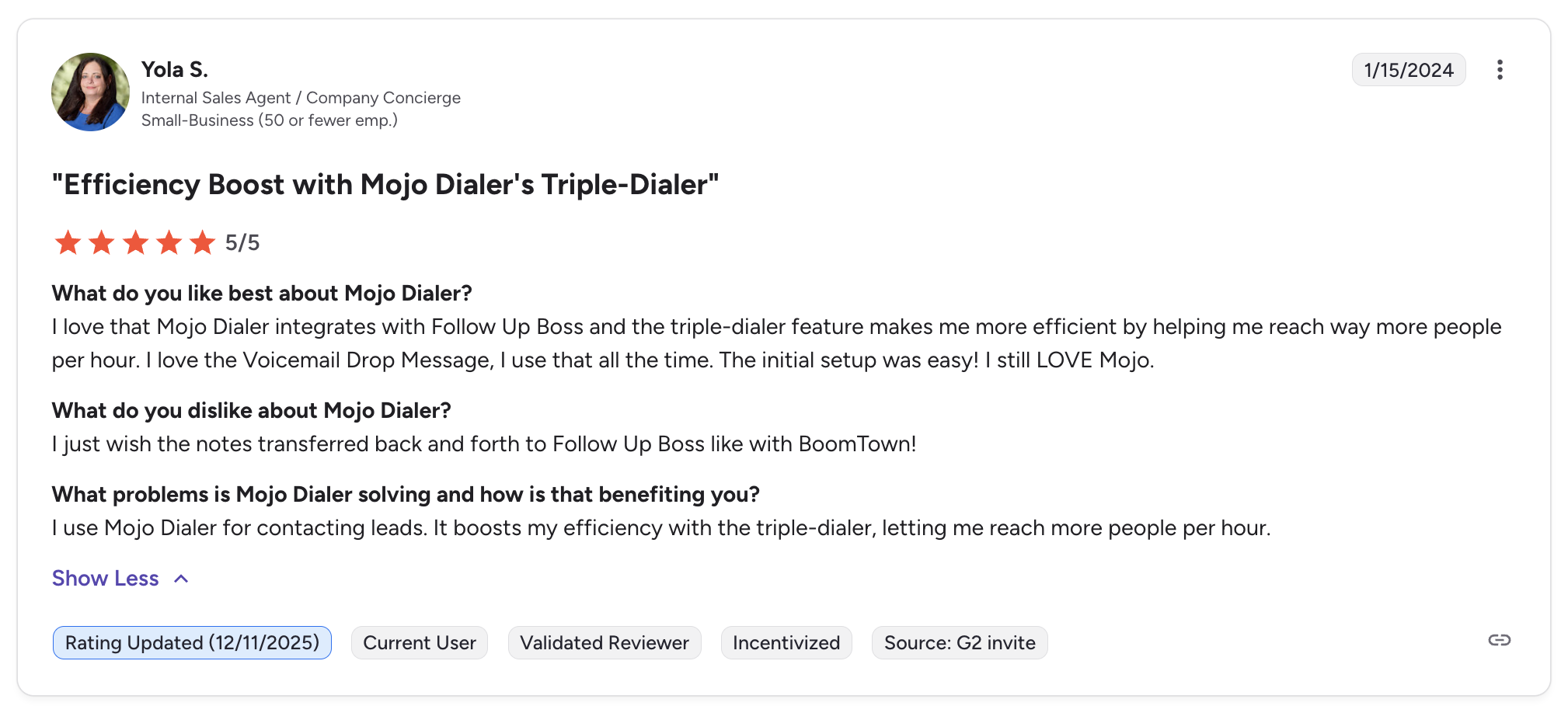
Mojo's strongest selling point is raw speed. The triple-line dialer lets you call up to three prospects simultaneously and connects you to whoever picks up first. That means up to 300 dials per hour, which is hard to beat if your strategy revolves around volume — think circle prospecting or working expired listings at scale.
The built-in Leadstore is a real differentiator for real estate. You can pull FSBO, expired, and pre-foreclosure data directly inside the platform without toggling between tools. The prospecting dashboard tracks your dialing time, call count, and appointments set, so you can measure activity without a separate analytics tool.
Where Mojo falls short: it doesn't offer AI features. Calls can be recorded, but there's no transcription, no automated summaries, and no coaching tools. The interface also feels dated compared to newer competitors. And if you work markets outside the US and Canada, Mojo won't help: its data, compliance, and calling infrastructure are limited to North America. There's also no local presence feature, which can hurt your answer rates if you're calling into area codes that don't match your own number.
Mojo pricing
Mojo uses an à la carte pricing model. Every user needs a base license, then you add dialer licenses and optional features on top:
- Agent Access License: $10/user/month (required for everyone)
- Single Line Dialer: $89/user/month (or $99 for single-user accounts)
- Triple Line Dialer: $139/user/month (or $149 for single-user accounts)
Common add-ons include Mojo Voice ($30/user/month), Call Recording ($25/user/month), and Caller ID ($10/user/month). A realistic solo agent setup with the triple-line dialer, voice, recording, and caller ID runs around $214/month. Data products like Neighborhood Search, Skip Tracer, and Expired Data cost $25–$50/month extra each. No annual contracts — everything is month-to-month.
Demo video of Mojo
Allo, Best for Solo Agents Who Want AI Built In
What is Allo?
Allo is a business phone system that launched in 2024, built for small teams and individual salespeople rather than call centers. It's mobile-first — an agent can run a prospecting session from their phone between showings as easily as from a desk — and every plan bundles AI: transcription in 36 languages, an AI receptionist that picks up when you can't, call summaries, and drafted follow-ups.
Where Mojo brings its own real estate lead database, Allo takes the opposite approach: it stays lean and plugs into the CRM or list you already work from. It won't hand you FSBO or expired data, but if you bring your own leads, it turns them into a call session without any extra tooling.
Why Allo is a good fit for real estate cold calling
The pitch for agents is simple: the lowest cost of entry on this list, with AI that other tools charge extra for. The power dialer sits on the Business plan at $45/user/month ($32 billed yearly) with no seat minimum — so a solo agent pays $45, against $99 for Mojo and $138–$210 once the other tools' seat minimums apply. Import a list from a CSV, the API, your CRM, or even an AI assistant like Claude through Allo's MCP connection, then work it one call at a time, pausing whenever a lead turns into a live showing.
Because AI ships in every plan, the post-call admin agents dread — logging the call, writing the summary, drafting the follow-up text — happens automatically. Native integrations cover HubSpot, Pipedrive, Salesforce, and more, so activity flows into whatever system you run your pipeline in.
The honest limits for real estate specifically: Allo's dialer is single-line, so it won't match Mojo's or Kixie's raw dials-per-hour on a big expired-listing push. There's no built-in lead data and no real-estate-specific CRM connection like Follow Up Boss, and as a 2024 product it's newer than everything else here. It fits agents who value a clean, AI-assisted workflow and a low monthly bill over maximum dial volume.
Allo pricing
- Solo: $18/month for one user (billed yearly) — one business number, unlimited national calls, call recording, SMS, AI transcripts and summaries, unlimited AI Receptionist, core CRM integrations.
- Business: $45/user/month ($32 billed yearly) — adds the power dialer, all integrations, collaborative inbox and notes, custom AI summary templates, AI call tags, Allo MCP, analytics, and team leaderboards.
Both plans include a local or toll-free number with pay-as-you-go international rates. There's a 7-day free trial, and you can cancel from settings anytime.
Demo video of Allo
Kixie, Best for CRM-Connected Real Estate Teams
What is Kixie?
Kixie launched in 2013 out of Santa Monica with a clear focus: make power dialing work seamlessly inside the CRMs that sales teams already use. Unlike Mojo, which brings its own lead management system, Kixie is designed to live inside your existing workflow — whether that's HubSpot, Salesforce, Pipedrive, or Zoho.
The product runs as a Chrome extension, which means your reps can launch calls directly from their CRM without switching tabs. It's a more modern approach to dialing that prioritizes integration depth over a standalone experience. For real estate teams that have already invested in a CRM and want to add outbound calling on top, Kixie feels like a natural fit rather than a separate tool to learn.
Why Kixie is a good fit for real estate cold calling
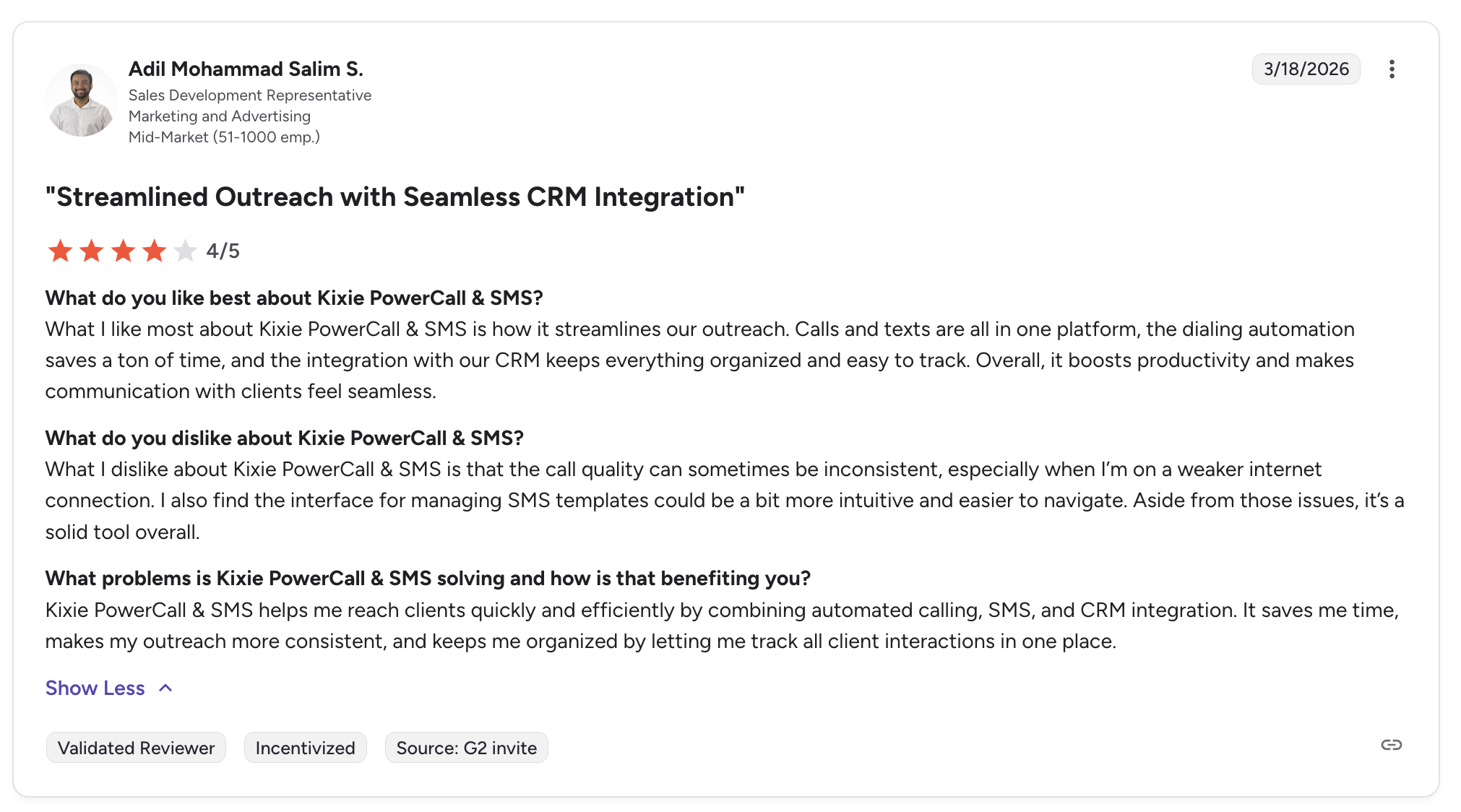
Kixie's parallel dialer can handle up to 10 simultaneous lines, which puts it among the most aggressive options in this list. But what sets it apart for real estate teams is how tightly it connects to your CRM. You can import leads directly from your CRM into the dialer, and when a call ends, Kixie automatically creates tasks — like scheduling a callback if a prospect mentions they're out of the office.
Local presence is another win. Kixie supports local numbers in 65+ countries, though real estate teams will mostly care about US coverage. The dialer automatically rotates numbers if you call the same person multiple times in a day, and AI spam protection disables numbers that get flagged — both of which help keep your answer rates healthy over time.
The downsides? Kixie relies on a Chrome extension, so you're locked into Google Chrome. Users on G2 report occasional glitches and outages. And since Kixie no longer publishes pricing publicly, you'll need to talk to their sales team to get a quote, which can slow things down if you're just exploring options.
Kixie pricing
Kixie doesn't publish current pricing on its website. Based on historical data retrieved via the Waybackl Machine (when pricing was still public in 2023), the plans ranged from approximately $35 to $95/user/month, billed quarterly:
- Professional Plan: Click-to-call, SMS templates, voicemail drop, live call coaching. Unlimited US/CA minutes.
- Single-Line PowerDialer: Adds a single-line power dialer.
- Multi-Line PowerDialer: Adds parallel dialing with up to 10 lines.
CRM integrations are included in all plans. Kixie offers a 7-day free trial. Contact their sales team for current rates.
Demo video of Kixie
PhoneBurner, Best for Agents Who Prioritize Conversation Quality
What is PhoneBurner?
PhoneBurner is a US-based dialer that's been around since 2008. The company takes an intentionally different approach to outbound calling: no parallel dialing. Their philosophy is that reps should focus on one lead at a time, which they believe leads to better conversations and higher conversion rates. They even brand their compliance approach as "Responsible Communications®."
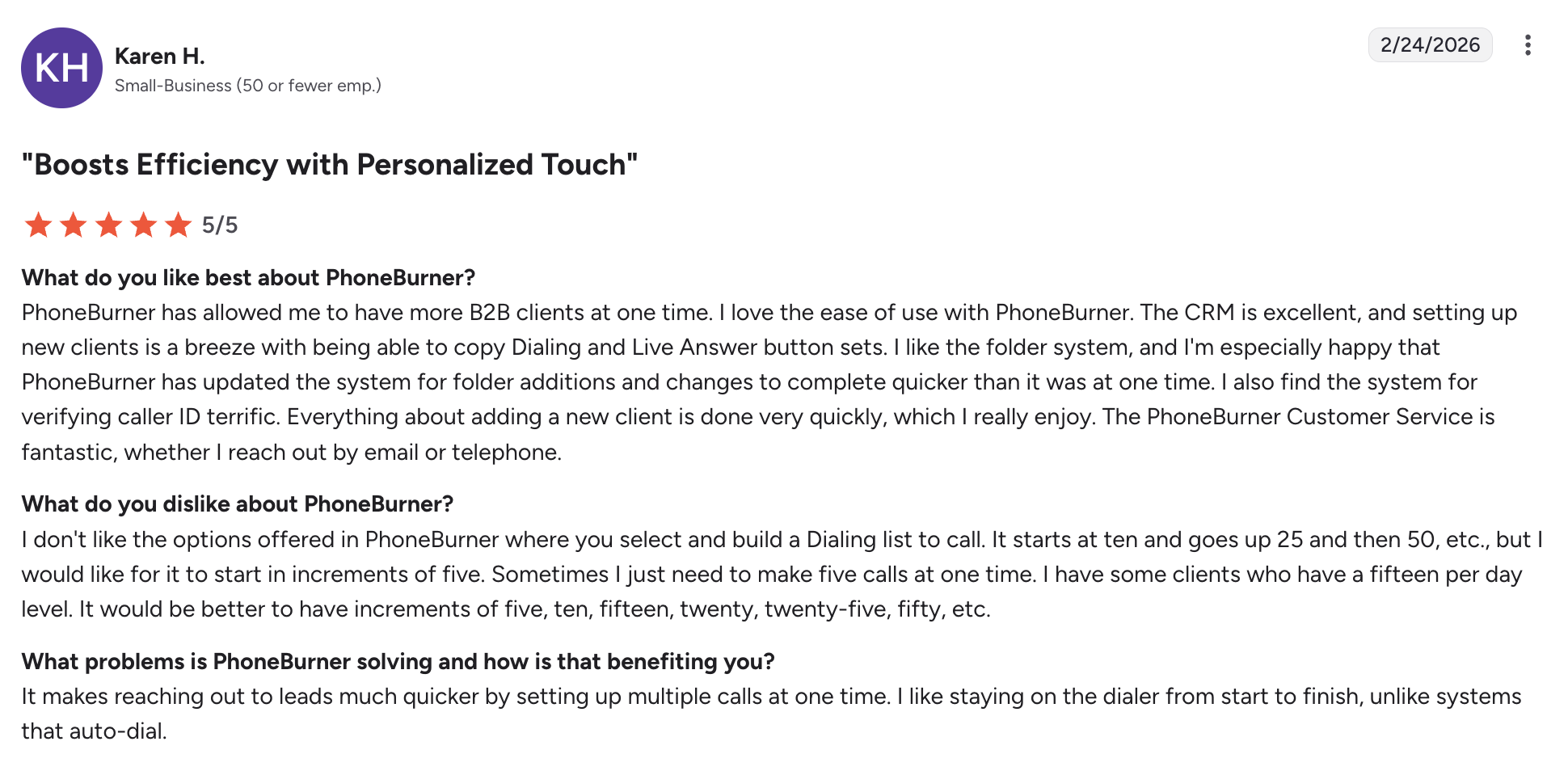
This makes PhoneBurner a polarizing choice. If you're the type of agent who wants to blast through 300 dials an hour, this isn't your tool. But if you believe that real estate is a relationship business and every conversation deserves full attention, PhoneBurner's single-line approach might resonate with how you already work.
Why PhoneBurner is a good fit for real estate cold calling
PhoneBurner's strength is in the details that support a one-at-a-time calling workflow. Voicemail drop lets you leave pre-recorded messages instantly. Local presence matches your prospect's area code automatically, which helps answer rates (specially useful in real estate where you're often calling into unfamiliar zip codes). The platform also includes an "Armor" feature that monitors your numbers and disables any that get flagged as spam.
PhoneBurner comes with its own lightweight CRM, which is handy for solo agents who don't want to pay for a separate system. For teams already using Salesforce, HubSpot, or Zoho, native integrations keep everything in sync. Automated lead distribution across your reps is a nice touch for team leaders managing multiple agents.
The limitations: PhoneBurner only works for dialing US and Canadian numbers, so it's not an option if you work in international markets. Users report a steep learning curve, and there's no way to filter between mobile numbers and office lines — meaning you'll inevitably spend time calling landlines that have lower pick up rates. The starting price of $165/user/month also makes it one of the pricier options here.
PhoneBurner Pricing
- Standard: $165/user/month — Unlimited calling, call analytics. Requires a hardware phone.
- Professional: $195/user/month — Adds live call monitoring and coaching.
- Premium: $215/user/month — Adds call transcription, text messages, and unlimited call recording storage.
All plans include unlimited dialing in the US/Canada. If you want call transcription (useful for reviewing conversations after prospecting sessions), you'll need the Premium plan at $215/user/month.
Demo video of PhoneBurner
Aircall, Best for Mid-Sized Teams That Want a Trusted Brand
What is Aircall?
Aircall started in Paris in 2014 with a mission to replace clunky, hardware-dependent phone systems with something cloud-native and easy to set up. The company quickly realized that CRM integrations were the key differentiator, and it built one of the deepest integration ecosystems in the market.
Unlike Mojo or Kixie, Aircall isn't a pure power dialer. It's a full business phone system that includes a power dialer feature on its higher-tier plan. This makes it a better fit for real estate teams that need both inbound and outbound calling capabilities — think brokerages where agents take incoming buyer inquiries and also run outbound prospecting campaigns.
Why Aircall is a good fit for real estate cold calling
Aircall's main draw is reliability and breadth. It covers 38 countries with local numbers, the integration library is extensive, and the brand carries weight — choosing Aircall feels like a safe decision, especially for team leaders who need to justify the purchase to a broker or office manager.
The AI features are solid too: call transcription, summaries, sentiment analysis, call scoring, and live coaching are all available (though currently only in English and French). For team leaders who want to coach agents based on actual call data rather than gut feeling, this is valuable.
The trade-off is that Aircall's power dialer is intentionally basic. There's no parallel dialing: Aircall has publicly stated they believe in a more ethical approach to outbound calling. You can't import numbers directly from your CRM into the dialer, and there's no local presence feature. For agents who need pure dialing speed, Aircall will feel limiting. The 3-license minimum also means solo agents are priced out unless they're willing to pay for seats they don't need.
Aircall pricing
- Essentials: $40/user/month — Local number, unlimited US/CA calls, IVR, call recording, SMS.
- Professional: $70/user/month — Adds power dialer, voicemail drop, advanced analytics, unlimited call recordings.
The power dialer is only available on the Professional plan. Minimum 3 licenses required. Aircall offers a 7-day free trial.
You can find more details in our detailed analysis of Aircall's pricing.
Demo video of Aircall
CloudTalk, Best for Teams Working Multiple Markets
What is CloudTalk?
CloudTalk was founded in 2016 by Martin Malych and Viktor Vanek in Slovakia. It's grown to serve over 4,000 customers across 100 countries, positioning itself as a phone system built for teams that operate internationally or across multiple regions. While many of its customers are in sales and support, the platform's geo coverage makes it particularly interesting for real estate teams that work across state lines or in multiple metro areas.
CloudTalk's approach is to combine a full-featured phone system with aggressive dialing capabilities. The power dialer supports parallel dialing with up to 10 simultaneous lines, and the platform offers local numbers in 160+ countries — far more than any other tool on this list.
Why CloudTalk is a good fit for real estate cold calling
If your real estate business covers multiple markets — say you're prospecting in both Miami and Atlanta, or you run a team that covers several states — CloudTalk's local presence feature is a standout. The platform automatically switches to a local number matching your prospect's area, which directly impacts answer rates. This is a real advantage over tools like Mojo that don't offer local presence at all.
The AI toolkit is respectable: call transcripts, summaries, topic extraction, sentiment analysis, and talk-to-listen ratio tracking. For team leaders, the sentiment analysis and ratio metrics can help identify which agents need coaching on listening skills — a common gap in real estate cold calling.
On the downside, some users report call quality issues, and customer support response times can be slow. The power dialer and most useful features require the Expert plan at $69/user/month with a 3-license minimum — so the entry-level $27/user/month price isn't what you'll actually pay. The mobile app also has a poor App Store rating (2.4/5), which matters if your agents prospect on the go.
CloudTalk pricing
- Lite: $27/user/month — Unlimited domestic calls, local numbers in 160+ countries. No integrations or advanced features.
- Essential: $39/user/month — Adds business hours, IVR, ring groups, CRM integrations.
- Expert: $69/user/month — Adds power dialer, parallel dialing, live monitoring, advanced reporting, WhatsApp. 3-license minimum.
For real estate prospecting, you'll need the Expert plan to access the power dialer and CRM integrations. 14-day free trial available, no credit card required.
Demo video of CloudTalk
JustCall, Best for Budget-Conscious Real Estate Teams
What is JustCall?
JustCall was founded in 2016 by India-based company SaaS Labs. The original idea was straightforward: build a phone system that automates the repetitive tasks salespeople hate — logging calls, updating CRM records, writing follow-up notes. Over time, JustCall expanded into a full sales and support platform with a parallel dialer, AI features, and integrations with most major CRMs.
JustCall targets both sales and support teams, which gives it a broader feature set than pure dialers like Mojo. For real estate teams, this means you get calling capabilities alongside SMS messaging, WhatsApp support, and an AI answering service (useful if your business handles both outbound prospecting and inbound buyer inquiries).
Why JustCall is a good fit for real estate cold calling
JustCall hits a sweet spot between features and affordability. The parallel dialer supports up to 10 simultaneous calls, putting it on par with Kixie and CloudTalk. Voicemail drop is included, and you can import contacts directly from your CRM or a CSV file — handy when you're working a list of expired listings from a third-party data provider.
The AI features are growing: call transcription is included in all plans, and the AI add-on ($9/user/month) adds summaries, sentiment analysis, topic extraction, and automated CRM logging. For agents who want AI to handle their post-call admin without paying enterprise prices, this is appealing. JustCall also integrates with Follow Up Boss, which is a common CRM in real estate — a connection that many competitors lack.
The weaknesses: AI features beyond transcription are billed as an add-on, the platform can be glitchy according to user reviews, and some users report problems with assigned numbers getting flagged as spam. The 2-seat minimum on the Pro plan means solo agents are paying for an extra license.
JustCall pricing
- Team: $39/user/month — Unlimited US/CA calls, AI transcription, local number, SMS/WhatsApp, CRM integrations. 2-seat minimum.
- Pro: $69/user/month — Adds power dialer, bulk SMS, Salesforce integration, roles and permissions, reporting. 2-seat minimum.
- Pro Plus: $109/user/month — Adds real-time agent assist, sentiment analysis, call scoring.
The power dialer requires the Pro plan at $69/user/month. AI add-ons (summaries, sentiment, CRM logging) cost $9/user/month extra. 14-day free trial available.
Demo video of JustCall
Conclusion
The right dialer depends on how you prospect:
- If you're a solo agent or small team grinding through expireds and FSBOs in the US, Mojo's triple-line dialer and built-in real estate data are hard to beat for raw volume.
- If you want AI transcription and summaries baked into every plan without paying extra — and you don't need Mojo's built-in lead data — Allo is the cheapest entry at $45/user/month with no seat minimum.
- If your team already runs on a CRM like HubSpot or Salesforce and you want a modern dialer that lives inside it, Kixie offers the deepest integration with aggressive parallel dialing. PhoneBurner is the pick for agents who'd rather have better conversations than more dials.
- For mid-sized teams that need both inbound and outbound capabilities with a recognized brand, Aircall is a solid choice (just don't expect power-dialer fireworks).
- CloudTalk wins for teams that work across multiple markets and need local numbers everywhere.
- And JustCall delivers the best balance of features and price for budget-conscious teams that still want AI and parallel dialing.
Whichever tool you choose, remember: the dialer is only half the equation.
Pair it with solid scripts, consistent follow-up, and real coaching, and the calls will take care of themselves.
Frequently asked questions about real estate dialers
What's the best dialer for real estate?
It depends on your prospecting style. For high-volume cold calling with built-in real estate lead data, Mojo is the go-to — its triple-line dialer and copper infrastructure were designed specifically for agents. For teams that want modern CRM integration and parallel dialing, Kixie or JustCall are stronger picks. If you value conversation quality over dial volume, PhoneBurner's single-line approach fits better. And for solo agents who want AI transcription and summaries built in at the lowest price, Allo starts at $45/user/month with no seat minimum — though you'll bring your own leads rather than Mojo's built-in data.
How much does a power dialer cost?
Expect to pay between $45 and $215/user/month depending on the tool and plan tier. Allo is the lowest entry point at $45/user/month with no seat minimum. Mojo's single-line dialer starts at $99/user/month (plus a $10 access fee), while a fully loaded setup runs over $200/month. CloudTalk and JustCall offer power dialers starting at $69/user/month. PhoneBurner is the priciest at $165–$215/user/month. Keep in mind that the entry-level price on most websites doesn't include the power dialer — you usually need a mid-tier or higher plan.
What are the different kinds of dialers?
There are three main types: A preview dialer shows you the contact's information before placing the call, giving you time to prepare — good for high-value conversations. A power dialer (or auto dialer) automatically calls the next number on your list as soon as the previous call ends, eliminating manual dialing while keeping one conversation at a time. A parallel dialer (sometimes called a multi-line dialer) dials multiple numbers simultaneously and connects you to whichever prospect picks up first — maximizing volume but requiring quick transitions. Mojo's triple-line and Kixie's 10-line dialers are parallel dialers. Allo and PhoneBurner are single-line power dialers. Most other tools in this guide offer some combination of these modes.