Best Phone Systems for Attio (2026)
In this article, we review the top phone systems that integrate with Attio. Discover which VoIP tools sync calls automatically to your CRM in 2026.


Key Takeaways
- Attio does not offer a native dialer, so you'll need to use a third-party phone system if you want to call from Attio.
- Allo is best for small sales teams that want a mobile-first phone system with AI built in from day one. At $45/user/month on the Business plan, you get a deep Attio integration, automatic call transcription, and an AI receptionist — all without juggling add-ons.
- Aircall is best for growing mid-sized teams that need a recognized, reliable brand and advanced sales features like a power dialer and call monitoring. It’s a proven choice if you have at least three reps and a bigger budget.
- RingCentral is best for larger organizations that need enterprise-grade reliability, a massive integration ecosystem, and global coverage across 100+ countries. Just be prepared for more complexity and a higher price tag.
Introduction
If you’re running your sales team on Attio, you already know it’s one of the cleanest, most flexible CRMs on the market.
But here’s the catch: Attio doesn’t have a native calling feature. To make calls and have them automatically synced back to your Attio contacts and deals, you need a VoIP phone system that integrates directly with it.
That’s where it gets tricky. Not every business phone system supports Attio. Popular tools like Dialpad and Nextiva, for example, don’t offer a native Attio integration — which means you’d have to rely on workarounds or manual data entry. That’s the last thing a sales team needs.
The good news? A handful of strong options do connect natively with Attio. In this article, we reviewed five of the best: Allo, Aircall, Quo, RingCentral, and Ringover. For each, we explain how the Attio integration actually works, what it costs, and which teams it’s best suited for — so you can make the right call for your business.
Allo, Best for Small Sales Teams
What is Allo?
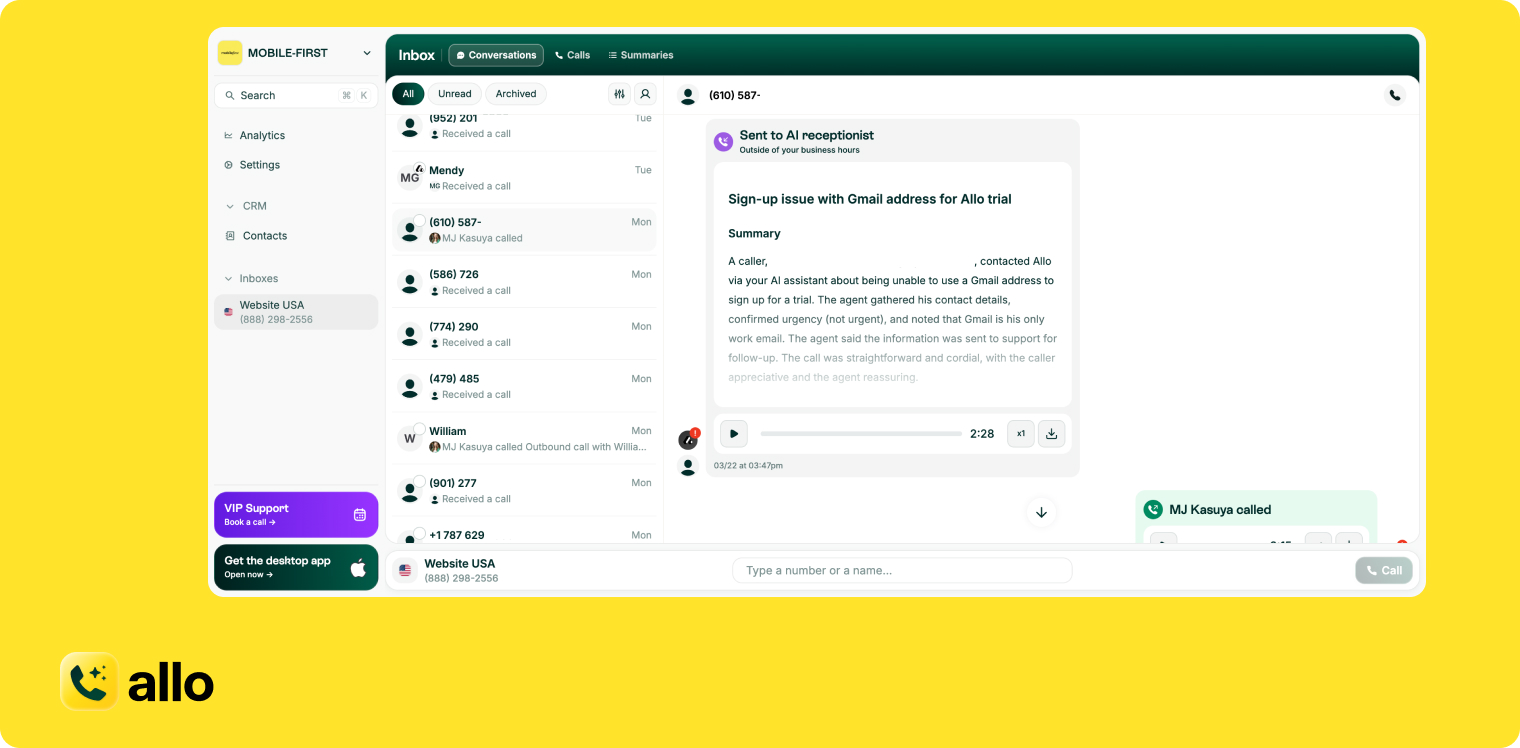
Allo is an AI-first, mobile-native phone system built specifically for small sales teams. Founded in 2024 by Jérémy Goillot — formerly of the unicorn startup Spendesk — Allo was designed from scratch for the AI era, not retrofitted with AI features the way many legacy VoIP tools have been. Its core mission is clear: help salespeople spend less time on admin and more time actually selling.
What sets Allo apart from the beginning is its philosophy. Every plan includes AI features with no add-ons required — call transcription, call summaries, an AI receptionist, and even the ability to draft follow-up emails. The mobile app is built to be the primary experience, not an afterthought, which matters a lot for sales reps who are always on the move.
Why Allo Works Well with Attio
Allo’s Attio integration is designed to eliminate the manual work that kills sales team productivity. When a call ends, Allo automatically syncs the recording, transcript, and AI-generated summary directly to the corresponding Attio contact or deal — no copy-pasting, no forgetting to log the call.
The integration also updates contact records in real time, so your Attio data stays accurate without anyone having to touch it. For small teams where everyone wears multiple hats, this kind of automation is genuinely valuable. You can step off a call and move straight to the next task, knowing your CRM is already up to date.
One area where Allo currently doesn’t cover every use case: it doesn’t have a power dialer. If your team runs high-volume outbound campaigns with sequential dialing, that’s a gap to be aware of. But for teams focused on quality conversations rather than raw call volume, the integration hits everything you’d want. You can even set up webhook-driven workflows using Attio’s automation features in combination with Allo’s call data.
For a step-by-step guide on setting up the integration, Allo published a dedicated walkthrough on their blog: How to get started with the Attio integration.
Demo video of Allo
Allo Pricing
Allo keeps pricing simple — two plans, no add-ons, no surprises.
- Starter: $25/month for one user. Includes unlimited calls, a local phone number, AI summaries, and IVR. This plan does not include CRM integrations.
- Business: $45/user/month. This is the plan you need for Attio. It includes the full integration suite, unlimited AI answering service, SMS, and international calls.
A 7-day free trial is available on both plans.
Aircall, Best for Mid-Sized Sales Teams
What is Aircall?
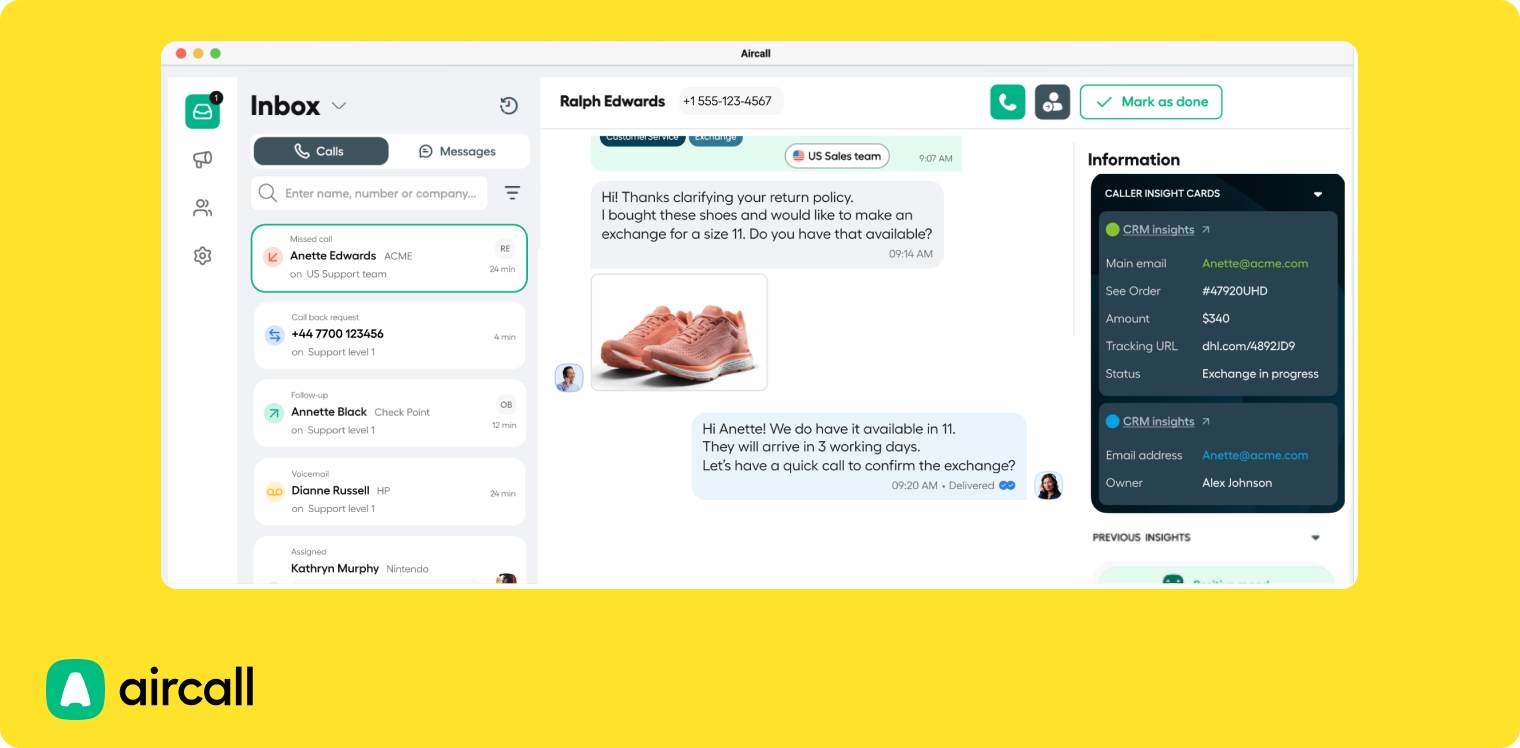
Aircall was born in Paris in 2014 with a simple ambition: replace clunky hardware-based phone systems with something cloud-first and CRM-friendly.
Today, Aircall is particularly strong for medium-sized and larger teams that need advanced sales features alongside solid analytics and reporting. This article we wrote earlier gives a good overview of how the tool compares to the broader market if you want a deeper comparison.
Key standout features include unlimited US/Canada calling and SMS, AI transcription and summaries, call monitoring (listen, whisper, and barge), and a power dialer on higher-tier plans.
One thing to be aware of: Aircall’s AI features currently support only English and French, which can be a limitation for international teams.
Why Aircall Works Well with Attio
Aircall offers a native Attio integration that covers the fundamentals well. Calls are logged automatically in Attio, and recording and transcription data flow through to the relevant contact records without manual entry. For sales managers who want visibility into what’s happening across the team’s calls — and want that data organized cleanly in their CRM — Aircall delivers.
Where it stands out over some competitors is in the depth of its analytics. Aircall gives you dashboards and reporting that let you spot patterns across calls, monitor individual rep performance, and identify coaching opportunities — all of which can be paired with Attio data for a fuller picture of your pipeline health.
The tradeoff is cost and complexity. Aircall requires a minimum of three licenses, which means even a two-person team pays for three seats. And the AI features — beyond basic transcription — come as paid add-ons: the AI Voice Agent runs $0.49 per minute, and Analytics+ costs $15/user/month on top of the base plan. For small teams, that adds up quickly.
Demo Video of Aircall
Aircall Pricing
- Essentials: $40/license/month. Includes a local number, unlimited calls within the US and Canada, IVR, call recording, and SMS/MMS. Minimum 3 licenses.
- Professional: $70/license/month. Adds advanced analytics, power dialer, voicemail drop, and unlimited call recordings. Minimum 3 licenses.
The Attio integration is available on both plans. A 7-day free trial is available.
Quo, Best for Small Teams Wanting a Lightweight CRM Combo
What is Quo?
Quo — formerly known as OpenPhone — was founded in 2018 in Canada by Mahyar Raissi and Daryna Kulya. The pair saw firsthand how business owners were juggling personal phone numbers to run their companies, and set out to fix that with a clean, modern business phone system. The company went through Y Combinator and has grown into one of the more popular choices for small businesses and startups. Quo’s alternatives page covers how it stacks up if you’re weighing your options.
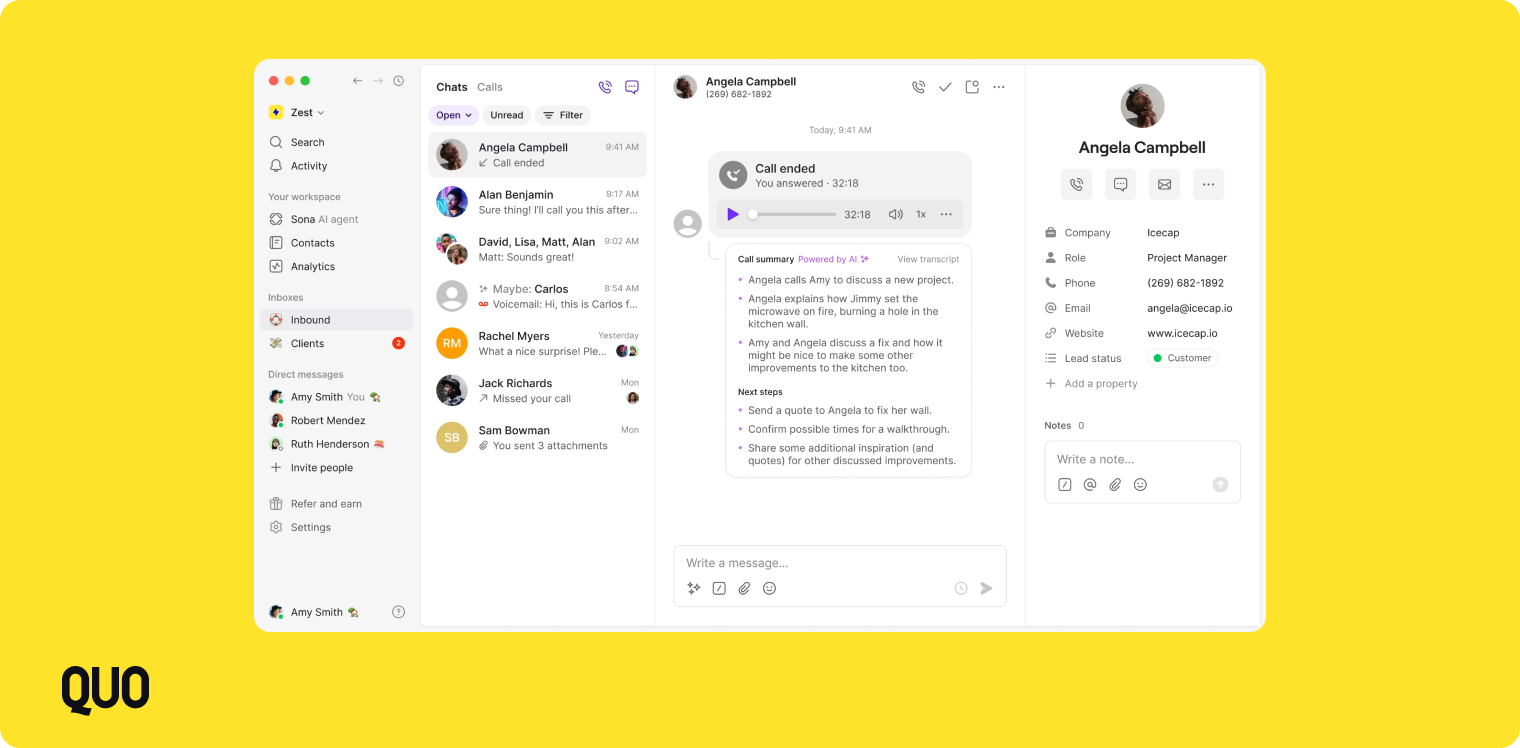
What makes Quo distinctive is its built-in lightweight CRM alongside the phone system — shared inboxes with threading and tagging, internal team chat, group calls, and caller ID features that help teams stay organized without necessarily needing a separate CRM tool. That said, it does offer a native Attio integration for teams that want the full CRM experience.
Quo’s AI features include an answering service (branded as Sona), call transcripts, summaries, and voicemail transcription — supporting 34 languages for transcription and summaries, which is broader than some competitors.
Why Quo Works Well with Attio
Quo’s Attio integration enables automatic call logging, contact syncing, and activity tracking in Attio. For teams that want a simple, no-fuss setup, Quo’s integration is straightforward to activate. Calls, voicemails, and messages can flow into Attio records, keeping the CRM up to date without manual data entry.
Where Quo earns praise from users is its clean UI and easy onboarding. The learning curve is minimal, and teams tend to get up and running quickly. The support team also gets consistently positive reviews, which matters when you’re setting up a new integration.
One notable constraint: Quo has a strict policy against cold calling, and they can restrict accounts they suspect of breaking this rule. If outbound prospecting is a core part of your workflow, it’s worth reviewing their terms carefully before committing. The mandatory SMS registration process can also take some time to get approved.
Demo Video of Quo
Quo Pricing
- Starter: $19/user/month. Includes a local number, unlimited calling and messaging to US and Canadian numbers, voicemail transcription, and 10 calls handled by Sona (their AI agent).
- Business: $33/user/month. This is the plan that includes Attio integration, along with AI call summaries and transcripts, group calling, call transfers, and analytics.
- Scale: $47/user/month. Adds dedicated onboarding support and priority support.
A 7-day free trial is available.
RingCentral, Best for Larger Teams Needing Scale
What is RingCentral?
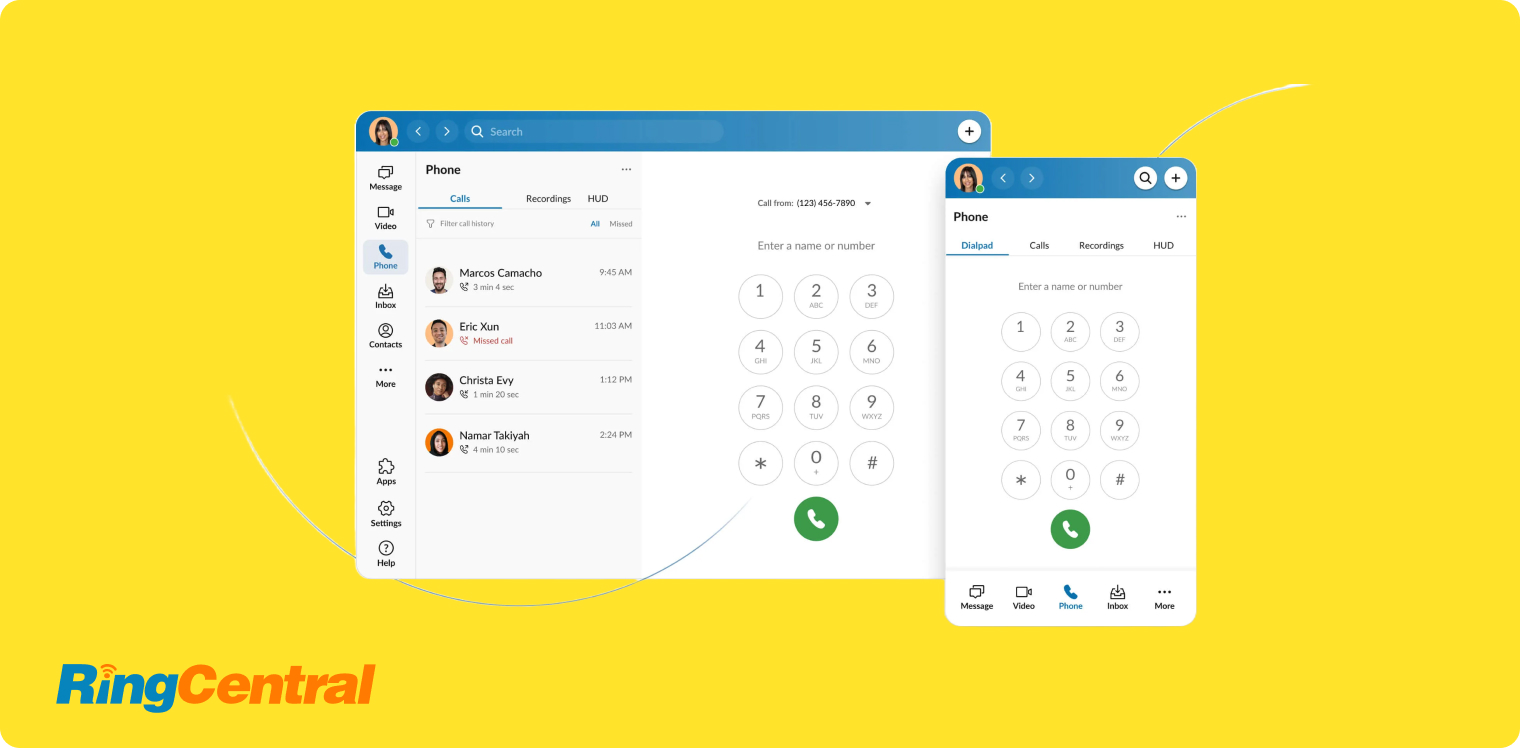
RingCentral has been around since 1999, which in the VoIP world makes it practically ancient. That longevity comes with real advantages: a massive and well-tested integration ecosystem of 500+ native integrations, reliable infrastructure built over decades, and global coverage across 100+ countries. The company targets US and Canadian businesses primarily but serves organizations of all sizes worldwide. If you’re looking at more ways to manage costs, the RingCentral pricing guide and RingCentral alternatives page are useful resources.
RingCentral has invested seriously in AI in recent years. Their AI assistant (AVA) lets you ask questions using your call data, and the platform includes call recording with AI summaries, a draft email generator, AI receptionist, and SMS translation. They also support voice, video, text messaging, Instagram, and WhatsApp — making it genuinely useful for teams that need an all-in-one communications platform.
That said, RingCentral is complex software. It can feel overwhelming for smaller teams, and if you’re an SMB, you may find that premium support is harder to reach than you’d like. Their Trustpilot score of 2.1/5 reflects frustrations from users — particularly around cancellation practices and contract terms.
Why RingCentral Works Well with Attio
RingCentral’s Attio integration gives sales teams automatic call logging, recording sync, and activity tracking inside Attio. For large teams that are already managing high call volumes across multiple reps and territories, the combination of RingCentral’s reliability with Attio’s relationship intelligence is genuinely powerful.
The depth of RingCentral’s integration ecosystem also means you can build more complex workflows. If your team uses other sales tools alongside Attio — Google Workspace, Notion, or Teams— RingCentral likely integrates with all of them. That makes it a practical choice for organizations that need a single phone system to serve multiple departments with different tools.
Where RingCentral shows its age is in the complexity of setup and the cost structure. CRM integrations (including Attio) require the Advanced plan minimum, and AI features like the AI Receptionist and Conversation Intelligence are billed as add-ons. For a team of 10+ users, the total monthly cost can climb quickly once you factor in those extras.
Demo Video of RingCentral
RingCentral Pricing
- Core: $30/user/month. Includes unlimited domestic calling, call recordings, and meetings. Attio integration is NOT included at this tier.
- Advanced: $35/user/month. This is the minimum plan that includes CRM integrations like Attio, plus reporting.
- Ultra: $45/user/month. Adds unlimited storage, webinars, and device analytics.
Notable add-ons: AI Receptionist starts at $39/month for 100 minutes; Conversation Intelligence costs $60/user/month.
Ringover, Best for Sales and Staffing Teams in Europe
What is Ringover?
Ringover is a Paris-born VoIP platform with roots going back to 2005. The first version of what we know as Ringover launched in 2015, and by 2018 the team had refocused the product around CCaaS — cloud contact center as a service. Today, Ringover operates from offices in Paris, London, Barcelona, and Atlanta, with coverage across 65 countries. The company has found a particular niche with staffing agencies and sales teams in Europe and the UK. Alternatively, if you’re evaluating other options, the Ringover alternatives page is a solid starting point.
Ringover’s AI capabilities have expanded significantly. The platform offers call transcripts and summaries (included in all plans), keyword-based call tagging through a feature called Call Moments, an AI website chatbot, an AI answering service (AIRO), and a coaching tool called Empower that runs AI call simulations and provides real-time conversation guidance for reps. That’s a strong AI stack, though AIRO and Empower are both billed as add-ons.
Why Ringover Works Well with Attio
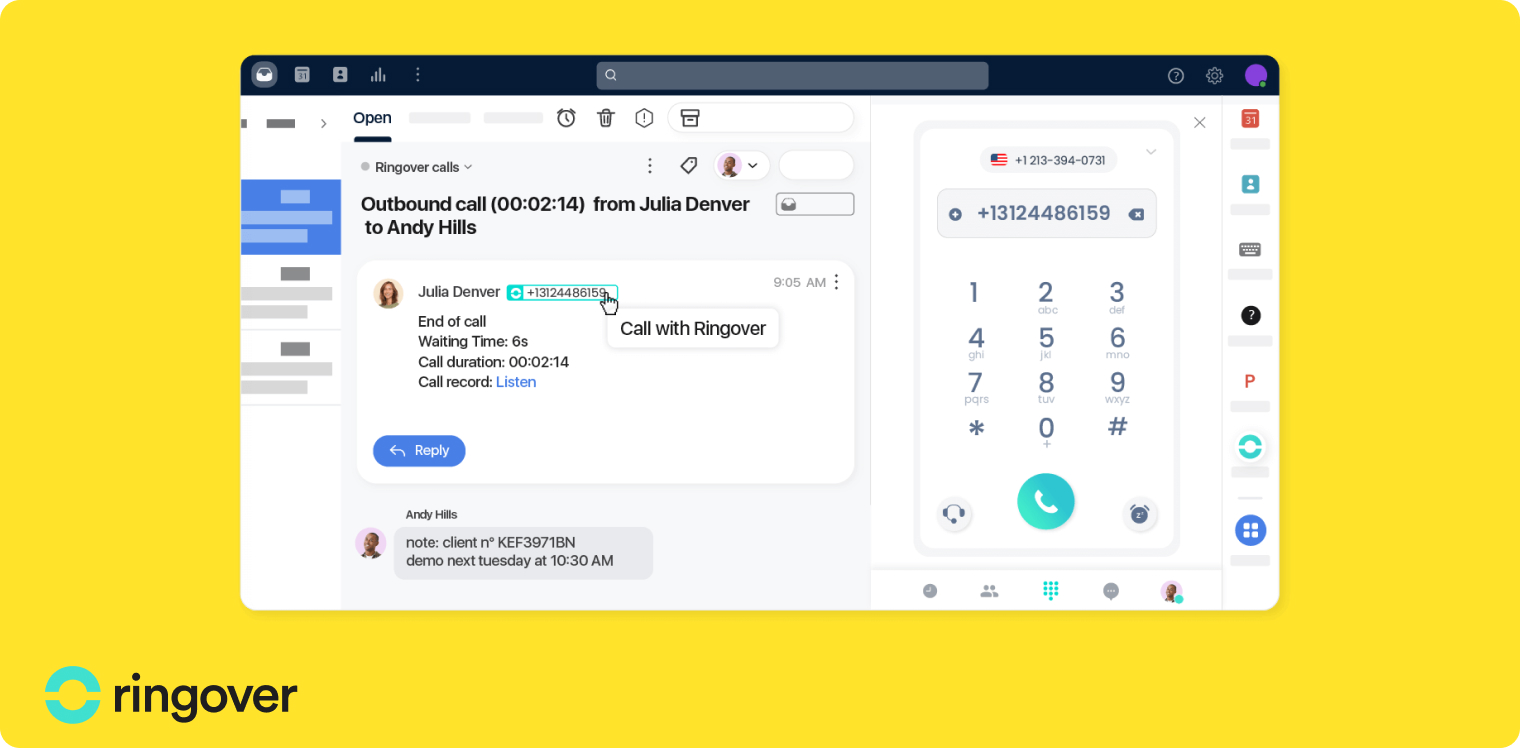
Ringover integrates natively with Attio, automatically logging call recordings, transcriptions, and call summaries to the right contact or deal in your CRM. For sales teams that make high volumes of calls and want every interaction captured without lifting a finger, the integration removes the manual effort completely.
Ringover is also one of the few phone systems that integrates with Attio while also supporting multichannel outreach — voice, text, video calling, Instagram, Messenger, WhatsApp, and email can all be managed within the platform. If your team needs to reach prospects across multiple channels and sync all that activity to Attio, Ringover handles it in a way that more voice-only tools can’t.
The main watch-out with Ringover is call quality. A meaningful number of reviews mention audio issues, and several G2 users note that the company was slow to acknowledge problems. Support responsiveness is also a recurring concern in reviews, which is worth factoring in if you’re a small team without an IT person to troubleshoot issues internally. Subscription renewal terms have also tripped up some customers, so read the contract carefully before signing.
Demo Video of Ringover
Ringover Pricing
- Smart: $29/user/month. Includes unlimited calls to 90 destinations, IVR, call logs and recordings, click-to-call, call and voicemail transcription, and AI call summaries. The Attio integration is available on this plan.
- Business: $54/user/month. Adds advanced IVR, two integrations, advanced analytics, and call coaching features (double listening, whispering).
- Advanced: Custom pricing. Adds call campaigns, power dialer, call scripts, voicemail drop, and three integrations.
Notable add-ons: AIRO AI answering service ($0.99/min pay-as-you-go or from $98/month for 200 minutes); Empower AI coach ($39/user/month).
Conclusion
Attio is a powerful CRM — but to get the most out of it, you need a phone system that actually connects with it. The five tools we reviewed all offer native Attio integrations, but they’re built for different situations.
Allo is the strongest pick for small sales teams. The pricing is transparent, AI is baked into every plan, and the mobile-first experience is genuinely better than most competitors. If you’ve got a lean team that lives in Attio and wants calls to sync automatically without complexity, start here.
Aircall steps up for growing teams that need more advanced features — a power dialer, deeper analytics, and the reassurance of a well-established brand — and can justify the higher per-seat cost.
Quo is a smart choice for very small teams or solo operators who want something easy and affordable, as long as cold calling isn’t central to their workflow.
RingCentral is best reserved for larger organizations that need enterprise-grade reliability, global reach, and the ability to connect a phone system to a complex tech stack.
And Ringover earns a spot for European sales and staffing teams who want multichannel communication alongside their Attio CRM sync.
Whichever tool you choose, the key is making sure every call is automatically logged in Attio — so your team spends time selling, not updating records.
FAQ About Attio Phone Systems
Can you make calls through Attio?
Not natively. Attio is a CRM and doesn’t include a built-in calling feature. To make and receive calls that sync to Attio, you’ll need to connect a third-party VoIP system like Allo, Aircall, or Quo. These tools integrate directly with Attio to log calls, recordings, and transcriptions automatically.
Which VoIP providers integrate with Attio?
Several VoIP providers offer native Attio integrations, including Allo, Aircall, Quo, RingCentral, Ringover, and JustCall. Notably, some major VoIP tools — including Dialpad and Nextiva — do not currently offer a native Attio integration, so if Attio is your CRM, you’ll want to confirm integration support before committing to any phone system.