
Key Takeaways
• Allo is best for small sales teams because it offers a native Intercom integration with two-way contact sync, click-to-dial, and AI-powered call summaries — all included at $45/user/month with no add-ons.
• Aircall is best for mid-sized support teams because it's a mature product that integrates well with Intercom — though you'll need at least 3 licenses to get started.
• Dialpad is best for call centers that need team management options and can afford a more expensive option.
Introduction
You're using Intercom to manage customer conversations. But when it's time to pick up the phone, things get messy. You switch apps, lose context, and forget to log the call.
Sound familiar?
If you're looking for the best intercom phone integration, you're in the right place. In this article, we compare five phone systems that connect natively with Intercom: Allo, Aircall, JustCall, Dialpad, and Ringover.
For each one, we'll cover what the tool does, how its Intercom integration actually works, what it costs, and where you can see a demo. Whether you're a small sales team or a growing support org, you'll find the option that fits your workflow, team size, and budget.
But first — why look for a separate phone system at all when Intercom already has a built-in calling feature?
Why Use a Phone System That Integrates With Intercom?
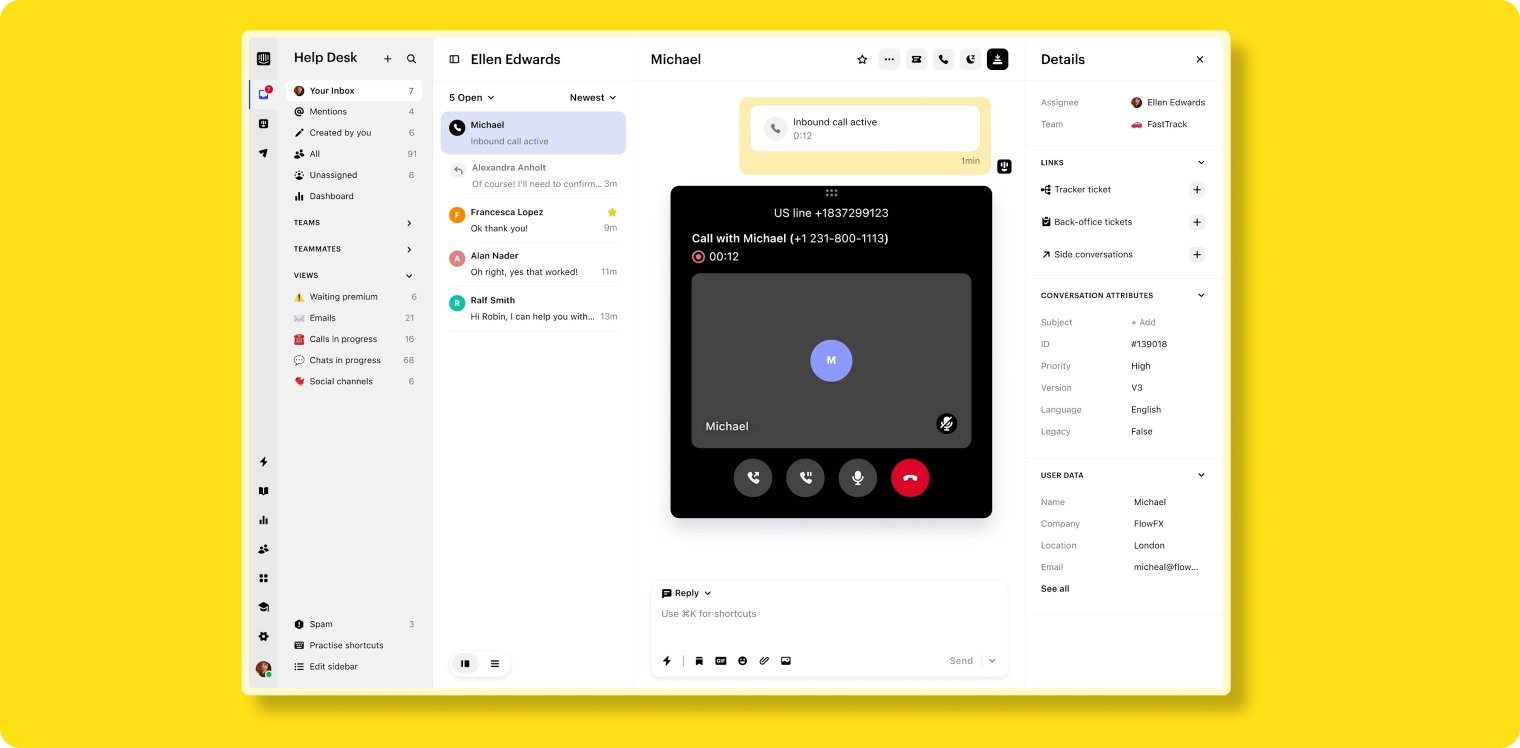
Intercom does offer a native calling option called Intercom Phone. It includes useful features like video calls and screen sharing. But for most teams, it falls short as a daily phone system.
Here's why:
- Per-call billing adds up fast. Intercom charges on a per-call basis — and the minutes billed include time customers spend navigating your IVR, sitting in wait queues, and on hold. That's money spent before your agent even picks up. (See their pricing)
- Recordings and transcripts cost extra. On top of what you're already paying per call, Intercom charges separately for call recordings and transcripts. Most dedicated phone systems include these at no additional cost.
- You can't choose your phone number. Intercom assigns a number for you. If you need a specific local number to build trust with prospects in a given market, you're out of luck.
- It's not a full phone system. There's no AI answering service, no CRM integration, and no local phone numbers in most countries. If your team works outside of Intercom — sales, operations, finance — they can't use it.
- It runs on Twilio, not their own infrastructure. Intercom doesn't control call quality directly. And Twilio, while reliable, isn't perfect.
A dedicated phone system with a native Intercom integration solves these problems.
You get click-to-dial directly from Intercom, automatic call logging with transcripts in your conversation history, customer context displayed when calls come in, and contact sync that keeps your data accurate across both tools — without the per-minute billing surprises.
Now, let's review the best options.
Allo, Best for Small Sales Teams
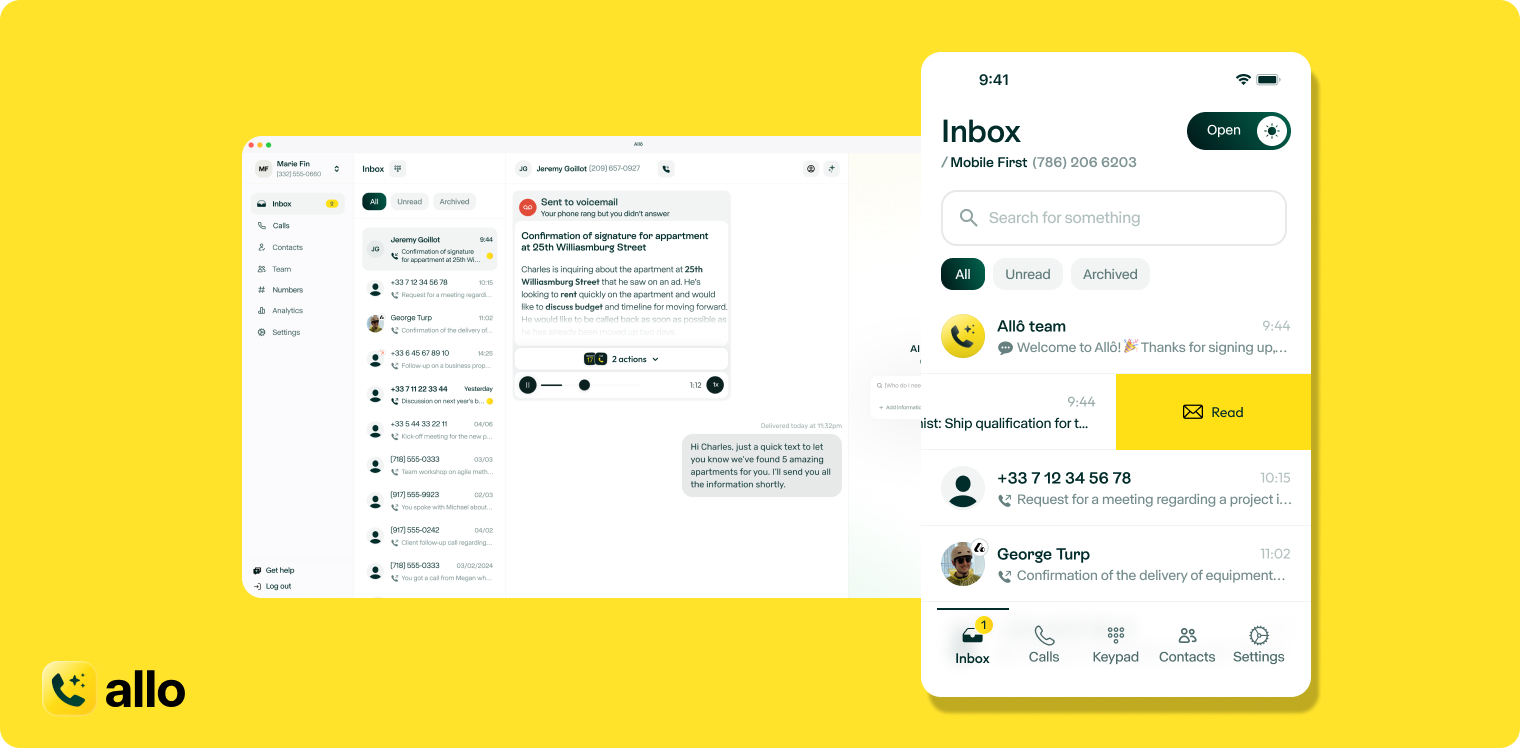
What is Allo?
Allo is an AI phone system launched in 2024 by Jérémy Goillot, an ex-employee of French unicorn Spendesk. Headquartered in Miami with offices in Argentina and France, Allo was built from the ground up with AI and mobile-first at its core.
The platform is designed specifically for small teams and salespeople who need a phone system that's simple to set up, works great on mobile, and integrates deeply with the tools they already use. With 18 native integrations (including Intercom), transparent pricing at $45/user/month, and an AI receptionist included in every Business plan, Allo removes the complexity that typically comes with business phone systems.
Why Allo works well with Intercom
Allo's Intercom integration stands out for its simplicity and depth. The click-to-dial feature lets your team call contacts directly from Intercom without switching to a separate app — saving time on every single interaction.
What makes it particularly useful is the two-way contact sync. Contacts created or updated in either tool stay accurate in both, so your team never wastes time on duplicate records or outdated phone numbers. When a customer calls you, Allo's caller ID pulls data directly from Intercom, giving your team instant context before they even pick up.
Every call gets recorded, transcribed, and summarized by AI, and all of that syncs back to Intercom automatically. No manual note-taking, no forgotten follow-ups.
Where it could improve: Allo's integration is available only on the Business plan ($45/user/month). If you're a solo user on the Starter plan ($25/month), you won't have access to the Intercom connection.
Allo pricing
Allo's Intercom integration is available on the Business plan at $45/user/month. This includes unlimited calls, a local phone number, AI summaries, AI receptionist, SMS, and international calls.
There's also a Starter plan at $25/month for solo users, but integrations aren't included on that tier.
You'll get a 7-day free trial on either plan, and there are no add-ons or hidden fees.
Allo video demo
See Allo in action:
Aircall, Best for Mid-Sized Support Teams
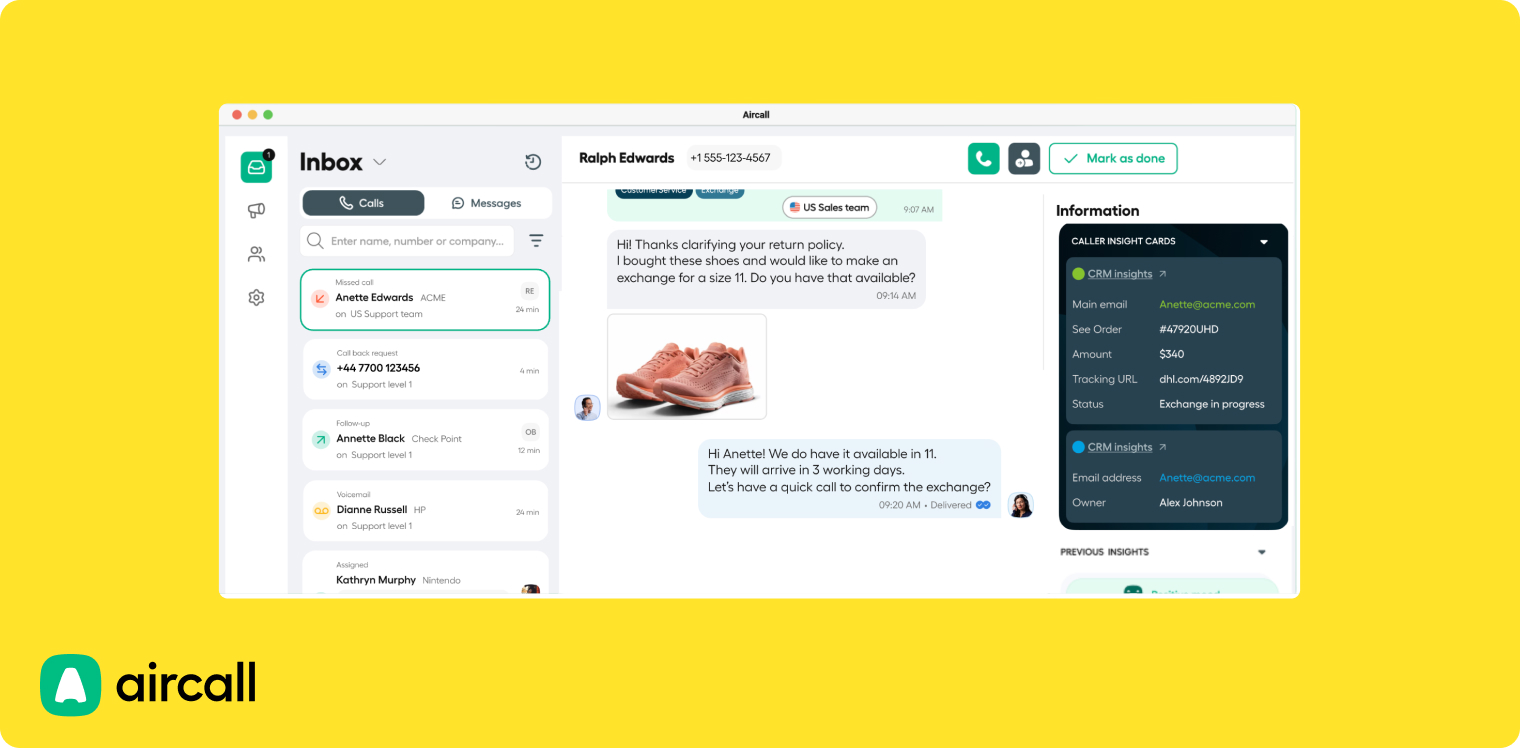
What is Aircall?
Aircall started in Paris back in 2014 with a clear mission: challenge traditional phone systems that relied on clunky hardware and complex setups.
Today, the platform caters primarily to medium-sized and large companies, with strong integrations across Salesforce, HubSpot, Zendesk, and of course, Intercom. The platform supports voice, SMS, and WhatsApp, with AI features including call transcription, summaries, and sentiment analysis.
Why Aircall works well with Intercom
Aircall's Intercom integration is one of the more mature options available.
Every call, voicemail, and SMS gets automatically logged inside Intercom conversations, complete with essential call data like contact information, notes, tags, and call recordings. Your agents don't need to manually document anything, it's all there.
When inbound calls come in, Aircall surfaces an insight card directly in the Aircall phone app. This card pulls essential information on contacts and prior conversations from Intercom, so your agents know exactly who they're talking to before they say hello.
Aircall's Contact Sync feature creates new contacts in Intercom automatically after a call connects. And with "Aircall Now," agents can start a call directly from within the Intercom chat, no need to open a separate window or app.
Where it could improve: Aircall requires a minimum of 3 licenses, which means the cheapest you'll pay is $120/month. AI features are limited to English and French, and several capabilities like WhatsApp messaging and advanced analytics come as paid add-ons.
Aircall pricing
The Intercom integration is available on all Aircall plans.
The Essentials plan starts at $40/user/month and includes a local number, unlimited calls within the US and Canada, IVR, call recording, and SMS/MMS.
The Professional plan at $70/user/month adds advanced analytics, power dialer, and voicemail drop. Keep in mind the 3-license minimum: you're looking at $120/month at the very least.
There's a 7-day free trial available.
Aircall Demo
See Aircall's Intercom integration in action:
https://fast.wistia.net/embed/iframe/275nhkarfp
JustCall, Best for SMS-Heavy Teams
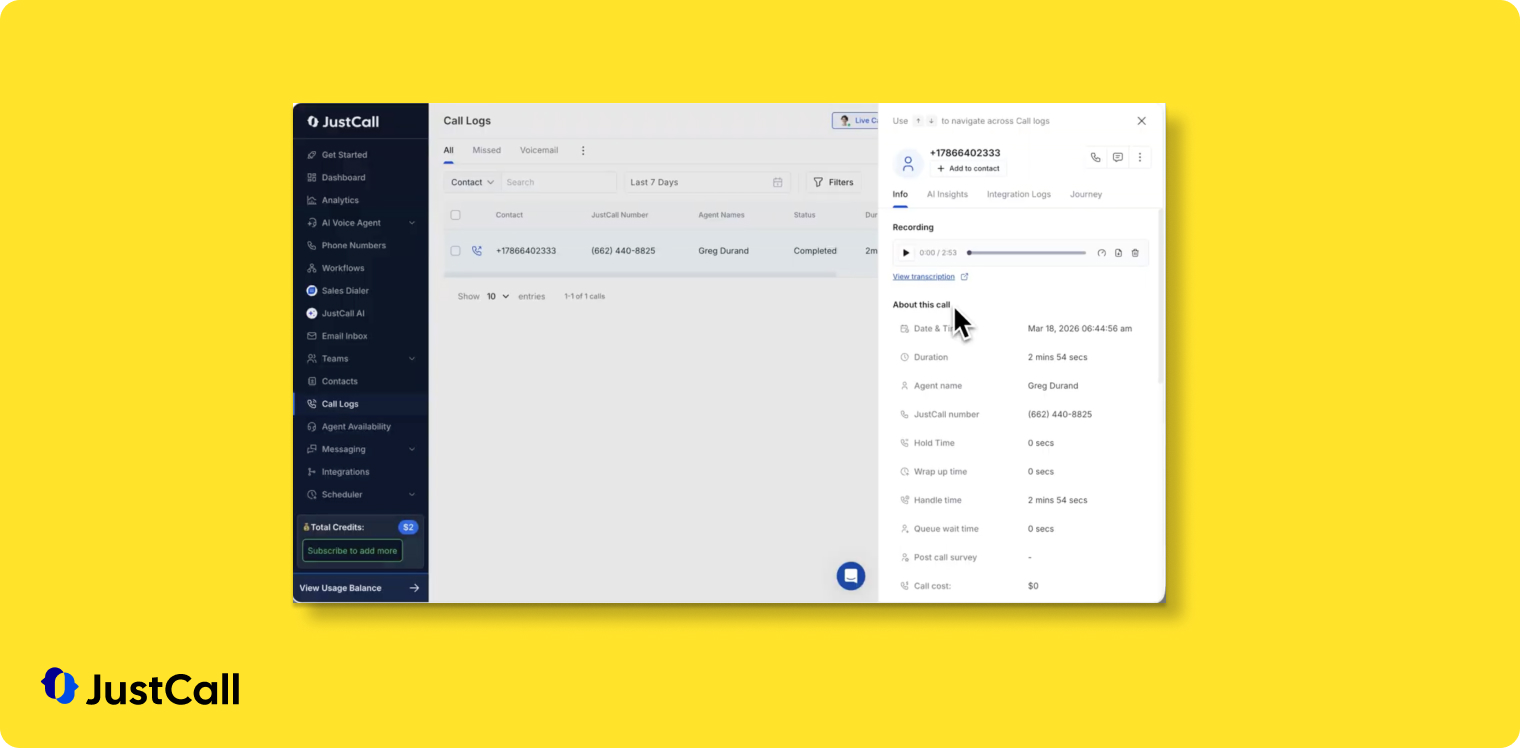
What is JustCall?
JustCall was founded in 2016 by India-based SaaS Lab with a straightforward goal: help sales and support teams stop wasting time on repetitive tasks like manually logging calls and updating their CRM.
Since then, it's grown into a full unified communications platform supporting voice, SMS, WhatsApp, and email. JustCall operates in over 70 countries and offers a strong set of native integrations with tools like HubSpot, Salesforce, Pipedrive, and Intercom. The platform targets both sales teams and call centers, with a power dialer feature and AI capabilities including call transcription, sentiment analysis, and an outbound AI voice agent.
Why JustCall works well with Intercom
JustCall's Intercom integration shines when it comes to activity tracking. Every inbound call, outbound call, text message, and voicemail is automatically recorded as an event on the contact's Intercom profile. Each event log includes call duration and a link to the recording when available, so your team has a complete history without lifting a finger.
The standout feature for Intercom users is SMS handling. Incoming text messages from JustCall appear directly in the Intercom Inbox app, where agents can read and reply without switching tools. For support teams that handle a mix of phone and text interactions, this keeps everything in one place.
JustCall also offers two-way contact sync: contacts created or updated in JustCall appear in Intercom, and vice versa. This prevents duplicate records and keeps phone numbers, names, and emails accurate across both systems. Click-to-dial is included as well, letting agents initiate calls directly from Intercom.
Where it could improve: AI features beyond basic transcription require paid add-ons ($9/user/month for AI Review Assist or $99/month for the AI Voice Agent). Some users also report occasional platform glitches and assigned numbers provided by Justcall getting flagged as spam.
JustCall pricing
The Intercom integration is available starting from the Team plan at $39/user/month (minimum 2 licenses). This includes unlimited US/Canada calls, AI transcription, a local number, SMS, WhatsApp messaging, and CRM integrations.
The Pro plan at $69/user/month adds power dialer, bulk SMS, and Salesforce integration.
The Pro Plus plan at $109/user/month includes real-time agent assist and call scoring.
There's a 14-day free trial available.
JustCall demo video
See JustCall's Intercom integration in action:
Dialpad, Best for Contact Centers
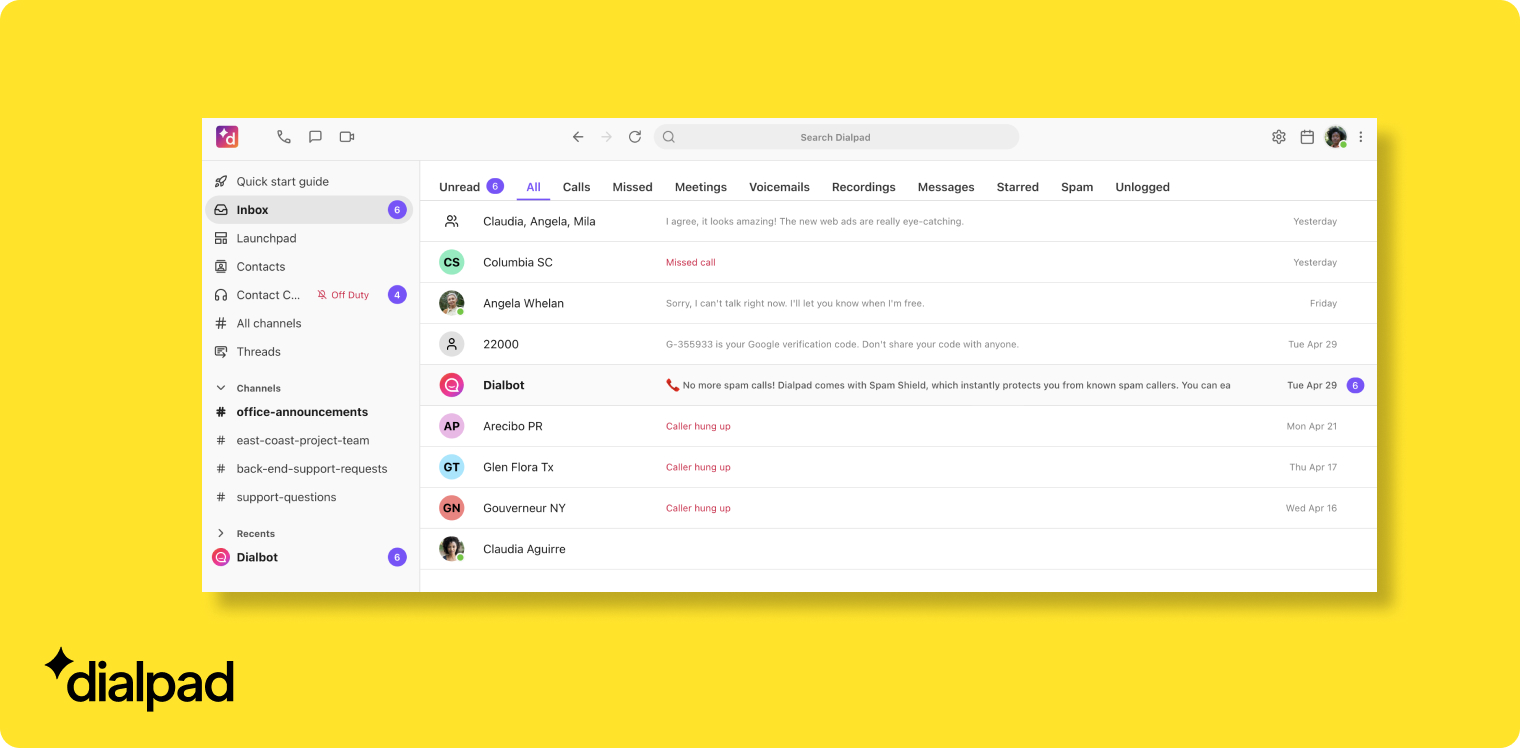
What is Dialpad?
Dialpad was founded in 2011 by Craig Walker (the same person who built GrandCentral, which Google acquired and turned into Google Voice). Walker started Dialpad as an entrepreneur in residence at Google, and half of the company's first 30 hires came from Google as well. That Google DNA shows in the product's AI capabilities: Dialpad has been developing its own AI model since 2018, and AI features like call summaries, live coaching, and call scoring are included in every plan at no extra cost.
The platform maintains three distinct products — Connect (for general business), Support (for support teams), and Sell (for sales teams). The Intercom integration is available only on the Support and Sell products.
Why Dialpad works well with Intercom
Dialpad's Intercom integration focuses on two key features: click-to-dial and the "Call Me" card. Click-to-dial works as you'd expect — your team can initiate calls directly from Intercom without juggling a separate app.
The "Call Me" card is a clever addition. It lets customers enter their phone number directly in the Intercom chat conversation through a simple form. Once they submit it, the call connects immediately. For support teams, this turns a text-based conversation into a voice call in seconds, which can speed up resolution times for complex issues.
Where it could improve: Dialpad’s pricing is steep; the Sell product starts at $49 per user/month, while the Support entry plan is priced at $95 per user/month.
Dialpad pricing
The Intercom integration is available on Dialpad's Sell and Support products.
- Dialpad Support is available from $95 per user/month (Essentials plans) and includes the Intercom integration, automatic call distribution, call and screen recording, and supervision features such as whispering and barge-in.
- Dialpad Sell starts at $49 per user/month and comes with the Intercom integration, recordings and transcriptions and a local number.
Dialpad demo video
See Dialpad's Intercom integration in action:
https://fast.wistia.net/embed/iframe/ysgk4uo8ov
Ringover, Best for Staffing and Prospecting Teams
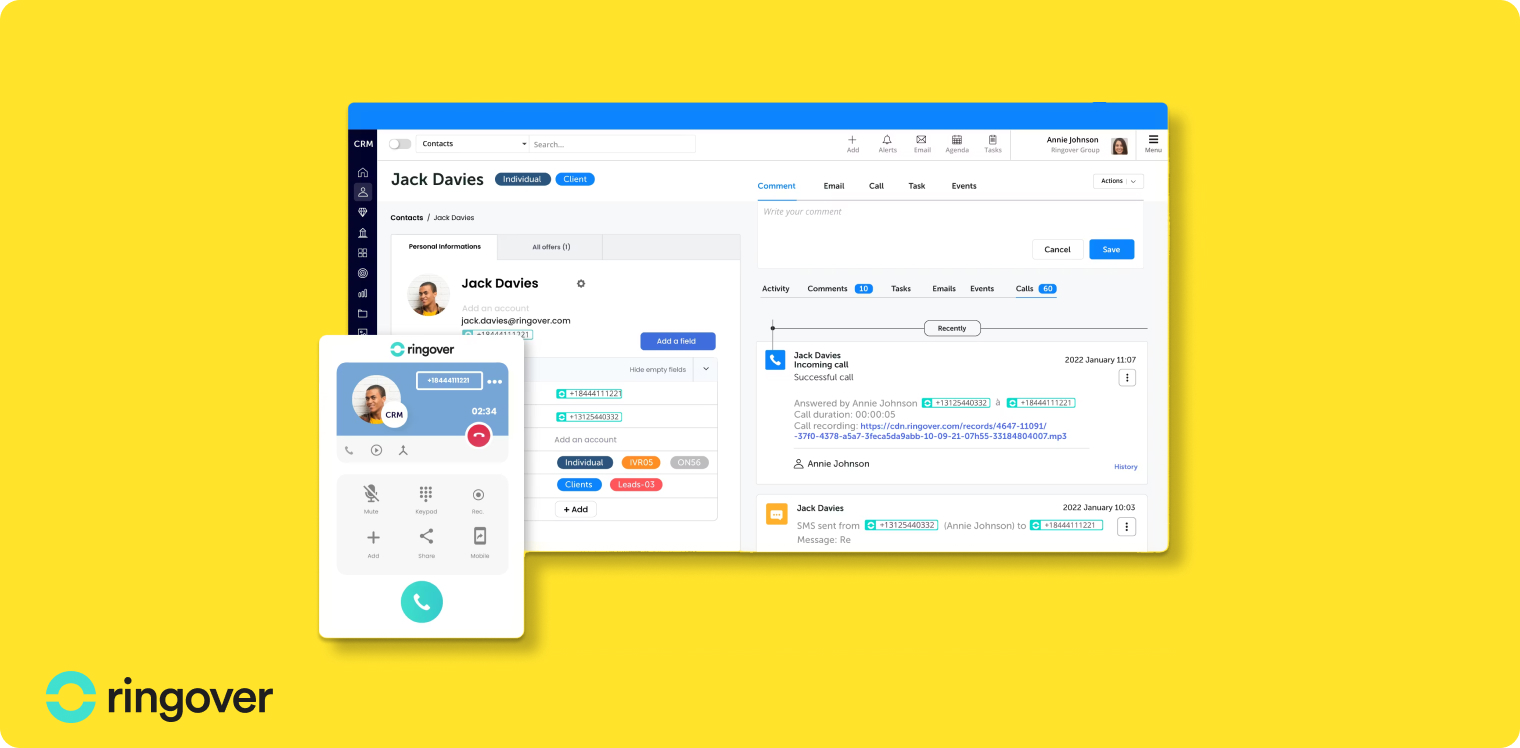
What is Ringover?
Ringover has been around since 2005, when co-founders Jean-Samuel Najnudel and Renaud Charvet started building telecom services for small businesses in Paris. The first version of the Ringover product launched in 2015, and by 2018, the company had pivoted toward cloud contact center solutions.
Today, Ringover operates offices in Paris, London, Barcelona, and Atlanta, and targets staffing and sales teams specifically. The platform supports 88 native integrations and offers features like power dialer, voicemail drop, nearest number matching, and an AI coaching tool.
Why Ringover works well with Intercom
Ringover's Intercom integration covers the essentials for teams that want their call activity visible inside Intercom. Click-to-dial is included, so your agents can initiate calls from within Intercom conversations.
The integration also automatically retrieves a contact's interaction history each time you make or receive a call, giving your team context without digging through records. After every call, call logs and call recordings are automatically saved to the Intercom contact profile — keeping your conversation history complete.
Where it could improve: the integration is limited to the Business plan and above. Some users have flagged issues with call quality, and Ringover's support response times have drawn criticism on review platforms. Be aware of subscription renewal clauses too, some users have reported unexpected auto-renewals.
Ringover pricing
The Intercom integration is available starting from the Business plan at $57/user/month.
The entry-level Talk plan at $24/user/month includes unlimited calls to 90 destinations and basic features, but doesn't include CRM or Intercom integrations.
The Business plan adds advanced IVR, smart routing, call queues, integrations, and coaching features.
An Advanced plan with custom pricing includes power dialer, call campaigns, and voicemail drop.
Note that the AI answering service (AIRO) is charged separately at $0.99/minute or from $99/month.
Ringover demo
See Ringover's Intercom integration in action:
Conclusion
Choosing the right intercom phone integration comes down to what your team actually needs day-to-day:
- If you're a small sales team that wants deep Intercom syncing, AI call summaries, and transparent pricing with no add-ons, Allo is your best bet at $45/user/month.
- For mid-sized support teams that need robust call logging and the ability to start calls from within the Intercom chat, Aircall delivers, though the 3-license minimum and add-on costs add up.
- JustCall stands out for SMS-heavy teams who want to reply to texts directly inside the Intercom Inbox.
- Dialpad brings strong AI features and a userful callback option but at a higher price point.
- Ringover works well for staffing and prospecting teams who need features like power dialer and nearest-number matching alongside their Intercom setup.
The bottom line? Don't settle for Intercom's built-in phone with its per-call billing and limited features. A dedicated phone system that integrates natively saves your team time, keeps your data clean, and gives you the calling features you actually need.
Frequently Asked Questions About Intercom Phone Integration
Is Intercom Phone any good?
Intercom Phone is useful if you need a quick, native calling option without adding another tool. It includes features like video calls and screen sharing, which are handy for support teams. However, there are significant drawbacks: per-call billing (including IVR and hold time), extra charges for recordings and transcripts, no choice of phone number, and limited phone system features like AI answering services, CRM integrations, or local numbers. For teams that make a high volume of calls or need their phone system to work across departments beyond Intercom, a dedicated phone system with a native integration is typically the better choice.
Which phone systems integrate natively with Intercom?
Several phone systems offer native Intercom integrations, including Allo, Aircall, JustCall, Dialpad, and Ringover. Each provides at minimum click-to-dial functionality from within Intercom, with varying levels of call logging, contact sync, and SMS handling depending on the provider.
What is the best phone system that integrates with Intercom?
It depends on your team's size and priorities. For small sales teams, Allo offers the best combination of deep Intercom syncing (two-way contact sync, caller ID with Intercom data, AI call summaries) at a straightforward price of $45/user/month with no add-ons. For larger support teams, Aircall's mature integration with automatic call logging and in-chat calling is hard to beat. And if your team needs strong contact center management options, Dialpad is the best choice.