Best AI Answering Services for HVAC (2026 selection)
Six AI answering services for HVAC teams, compared on cost, mobile access, and what actually matters on a busy day.


Key Takeaways
• Allo is the best pick for small HVAC teams that want a complete phone system with unlimited AI answering built in — no add-ons, no per-call fees, and full mobile control, with a $18/month starting price for solo users.
• Rosie is ideal for solo HVAC contractors or very small shops on a tight budget who already have a phone system and want simple, affordable AI call coverage starting at $49/month with unlimited minutes.
• Quo Sona is worth a look for HVAC businesses that need advanced call workflows and automated SMS — but watch the per-call pricing, which can add up fast during peak season.
Introduction
Here's a number that should keep every HVAC business owner up at night: home service companies miss roughly 27% of their inbound calls. That's more than one in four potential jobs walking out the door before you even know they called.
And HVAC isn't like other trades. When someone's AC quits during a heat wave or their furnace stops in a cold snap, they're not going to call back tomorrow.
Hiring a full-time receptionist to answer phones around the clock isn't realistic for most HVAC teams.
That's where AI answering services come in. These tools pick up your calls 24/7, answer common questions, capture lead information, and even book appointments — without putting anyone on hold or sending them to voicemail.
In this comparison, we'll walk through six AI answering services — Allo, Quo Sona, Rosie, Nextiva Xbert, Goodcall, and RingCentral AIR — and break down what each one actually costs, how it works on mobile, and whether it fits the way HVAC teams operate day to day.
| Solution | Starting Price | Best For | G2 Rating |
|---|---|---|---|
| Allo | $18/user/mo Billed yearly · unlimited AI answering on every plan | Small HVAC teams that want a phone system and AI receptionist in one package, with full mobile control.Best value | 4.7 / 5 |
| Quo Sona | $19/user/mo, 10 calls included | HVAC businesses that need advanced call workflows and automated SMS, and are comfortable with per-call pricing.Advanced workflows | 4.7 / 5 |
| Rosie | $49/mo Unlimited minutes included | Solo contractors or very small HVAC shops who already have a phone line and want affordable, no-surprises AI coverage.Budget-friendly | Not listed on G2 |
| Nextiva Xbert | $114/mo for 100 interactions Nextiva subscription + Xbert add-on | Mid-size HVAC companies already on Nextiva that want integrated scheduling and multi-channel support.Multi-channel | 4.5 / 5 |
| Goodcall | $79/mo per agent Unlimited minutes, capped unique customers | Small HVAC businesses focused on reducing inbound call volume by deflecting routine questions to AI.Call deflection | Not listed on G2 |
| RingCentral AIR | $69/mo for 100 minutes RingCentral subscription + AIR add-on | Existing RingCentral users who want to add AI answering without switching phone systems.Enterprise-ready | 4.2 / 5 |
Key Decision Criteria for HVAC Teams
Before diving in, here's what matters most when picking an AI answering service for an HVAC company:
- Cost structure. Some services charge per call, some per minute, some offer unlimited plans. For HVAC companies that see huge call spikes during heat waves and cold snaps, the difference between a flat rate and per-call billing can be hundreds of dollars a month.
- Mobile access. Your techs are on rooftops, not at desks. If you can't configure and monitor your AI receptionist from your phone, you're stuck waiting until you're back at the office to make changes.
- Standalone service vs. bundled phone system. Some AI answering tools are add-ons to a full phone system. Others are standalone services you layer on top of your existing setup. Both approaches work — but they come with different trade-offs in cost and complexity.
- Call routing and transfers. HVAC emergencies need to reach the right person fast. The ability to transfer urgent calls to an on-call tech is a dealbreaker for most contractors.
- Scheduling integrations. If your AI receptionist can book appointments directly in your calendar, that's one less callback your team needs to make.
Allo
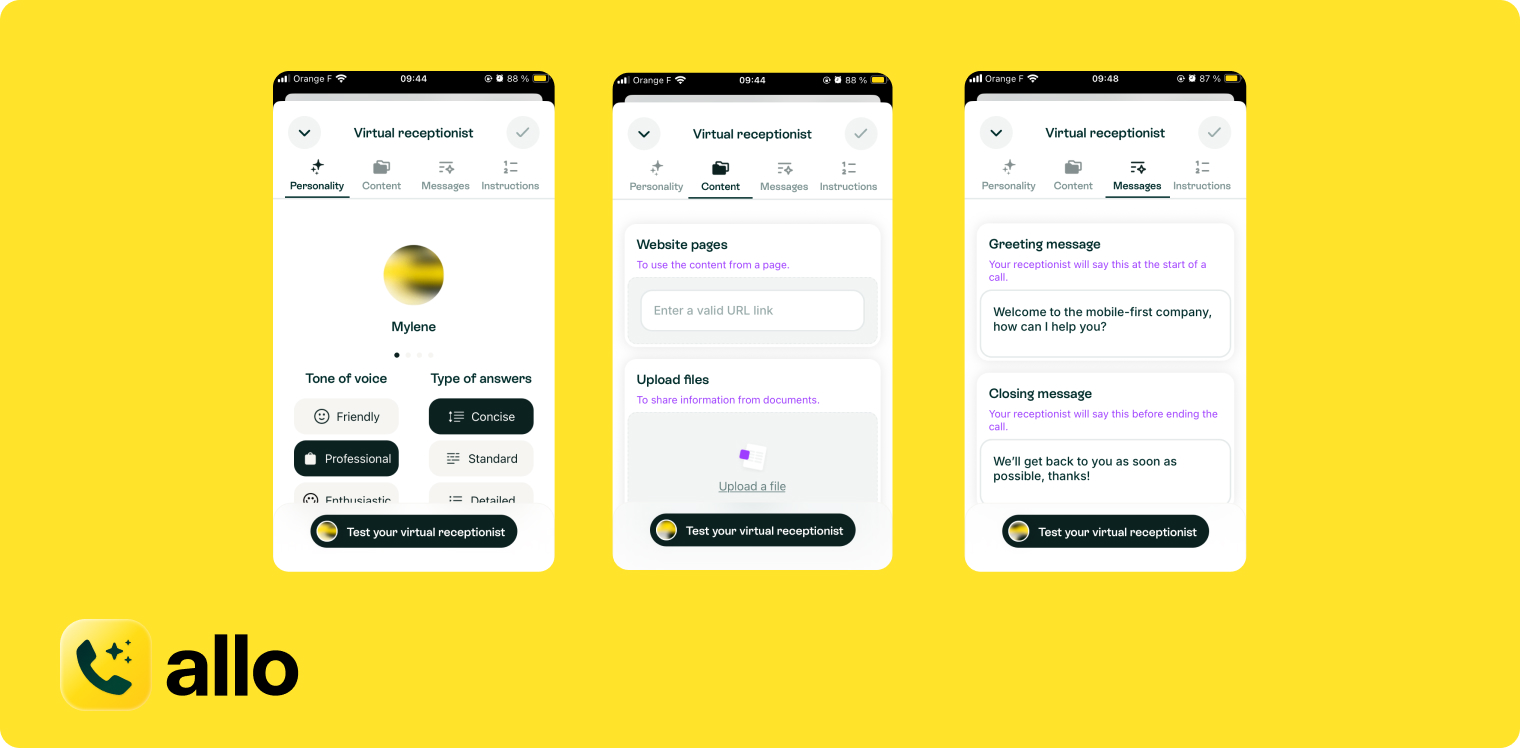
What is Allo?
Allo is an AI-native phone system launched in 2024. The founding idea was straightforward: give small teams a phone system that's built around AI from day one.
What sets Allo apart is that the AI receptionist isn't a separate product or add-on. It's woven into the phone system itself.
You get call recording, transcription, CRM syncing, and AI answering all under one roof. And because it was designed mobile-first, the entire experience (including configuring your AI receptionist) works directly from your phone. For HVAC techs spending their days on job sites, that's a meaningful advantage over competitors that require a desktop to make changes.
Why Allo is a good fit for HVAC teams
The biggest draw for HVAC businesses is cost predictability. AI answering is unlimited on every plan. When a summer heat wave triples your call volume overnight, your bill stays the same. That alone makes Allo worth a hard look.
Setup is fast, too. You can train the AI on your website or upload documents about your services, pricing, and service areas. It handles greetings, answers common questions ("Do you service Carrier units?" or "What's your after-hours rate?"), and captures caller information. It can also transfer calls to human employees.
The mobile-first design is genuinely useful for HVAC operations. You can adjust your AI receptionist's behavior, review call summaries, and check transcripts right from your iPhone or Android.
On the integration side, Allo connects with HubSpot, Pipedrive, and other CRMs natively, plus Zapier for everything else. If you're tracking leads and jobs in a CRM, call data flows there automatically. It also let your callers book appointments into your cal.com, Google Calendar or Calendly calendars.
Where Allo falls short today: it doesn't yet support complex call routing flows. So it might too basic for larger orgs.
For a small HVAC team that just needs calls answered, leads captured, and summaries sent, these gaps are minor. For larger operations with multi-step intake processes, it's worth noting.
Allo Pricing
Allo keeps pricing simple with two plans:
- Solo: $18/month for 1 user (billed yearly). Includes unlimited AI receptionist, one business number, unlimited national calls, call recording, SMS, native CRM autofill, and AI summaries & transcripts.
- Business: $45/month per user ($32 billed yearly). Everything in Solo plus all integrations, power dialer, analytics, custom AI summary templates, AI call tags, and the Allo MCP.
No add-ons required — unlimited AI receptionist is included on both plans. Both come with pay-as-you-go international calling and one local or toll-free number (additional numbers are $5/month). Allo backs it with a 30-day money-back guarantee.
Because Allo is a full phone system, there's nothing else to buy. Your phone number, call handling, and AI answering are all included. For a 3-person HVAC team on the Business plan, you're looking at $135/month total — phone system and AI receptionist included.
Demo Video of Allo
Quo Sona
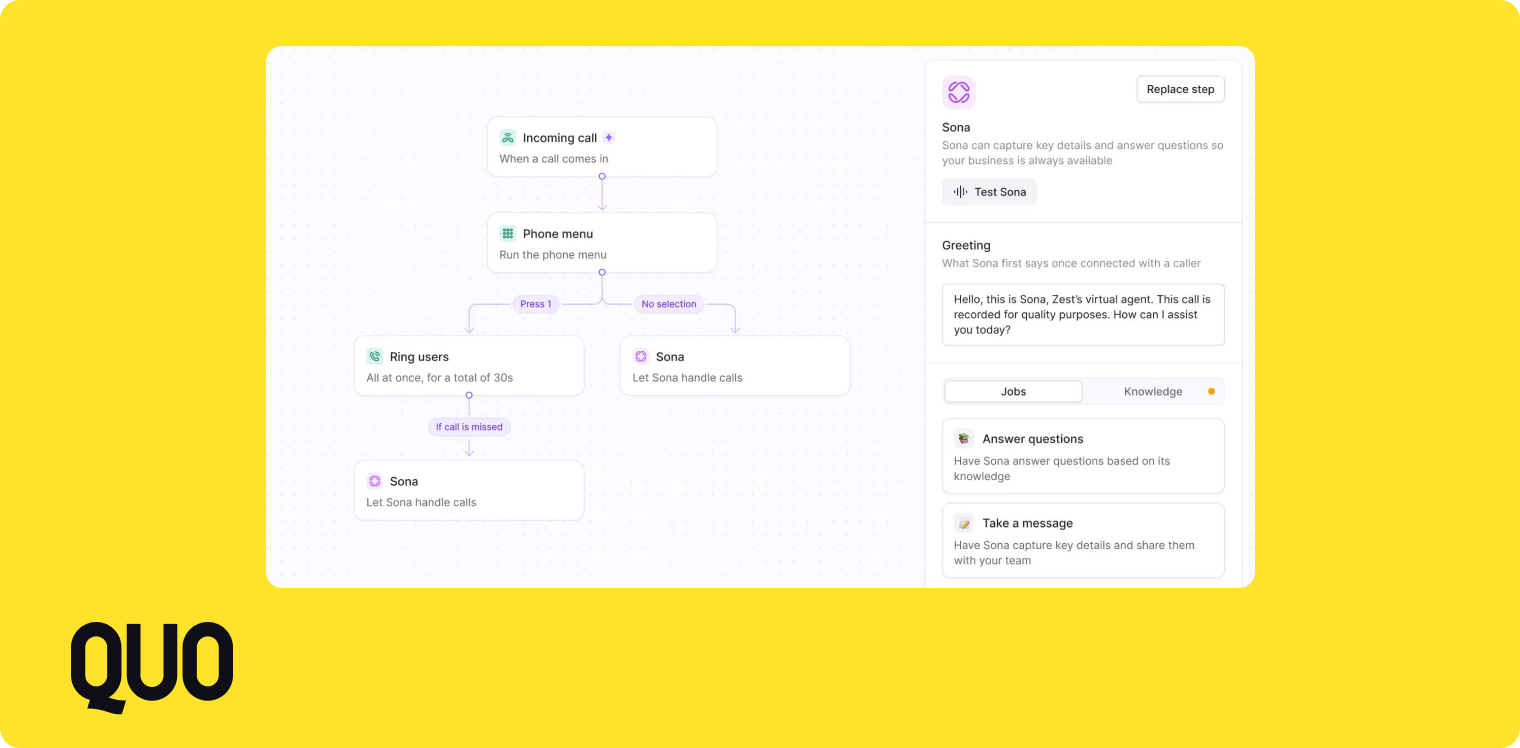
What is Quo Sona?
Quo (formerly OpenPhone) has been building phone tools for small businesses since 2018. Sona, their AI answering feature, launched in April 2025.
Like Allo, Quo is a full phone system with AI answering built in. The difference is in how Sona handles calls. It offers a visual workflow configuration screen where you can define what happens at each step: answer a question, collect contact details, send an SMS, transfer the call, or route to voicemail. For HVAC businesses with specific intake processes — like asking callers whether it's a heating or cooling issue before routing — that flexibility is a real plus.
Why Quo Sona is a good fit for HVAC teams
Sona's strongest selling point for HVAC is its automated SMS capability. While on a call, Sona can text the caller a link to your scheduling page, send directions to your office, or share a form they need to fill out. If your HVAC business uses online booking, this alone can save a lot of back-and-forth.
The workflow builder gives you more control over call logic than most competitors. You can set up branching paths — emergency calls get transferred to your on-call tech, routine maintenance questions get answered by the AI, and everything else goes to a specific voicemail box. It's a step up from the simpler "answer and take a message" approach.
Call summaries and transcripts are included for all Sona-handled calls, even on Quo's lower-tier plans. That's a nice touch for HVAC managers who want visibility into what their AI receptionist is saying.
The catch? Pricing. All plans include by default 10 calls handled by Sona. Then its 40 calls for $25/month, 100 calls for $49/month, and so on up to 600 calls for $199/month. During peak HVAC season, call volume can spike dramatically. A team handling 300 calls a month through Sona would pay $99/month for the AI add-on alone — on top of their Quo phone subscription. And there's no free trial for Sona, so you'll need to commit to a Quo plan before you can test it. Sona also only supports English at this time.
Quo Sona Pricing
Sona requires a Quo phone subscription (starting at $19/user/month, billed monthly) plus a separate add-on:
- 10 calls/month: Included free with any Quo plan
- 40 calls/month: $25/month
- 100 calls/month: $49/month
- 250 calls/month: $99/month
- 600 calls/month: $199/month
There's no free trial for Sona specifically. Quo offers a trial for the phone system, but you can't test the AI receptionist during that period.
Demo Video of Quo Sona
Rosie
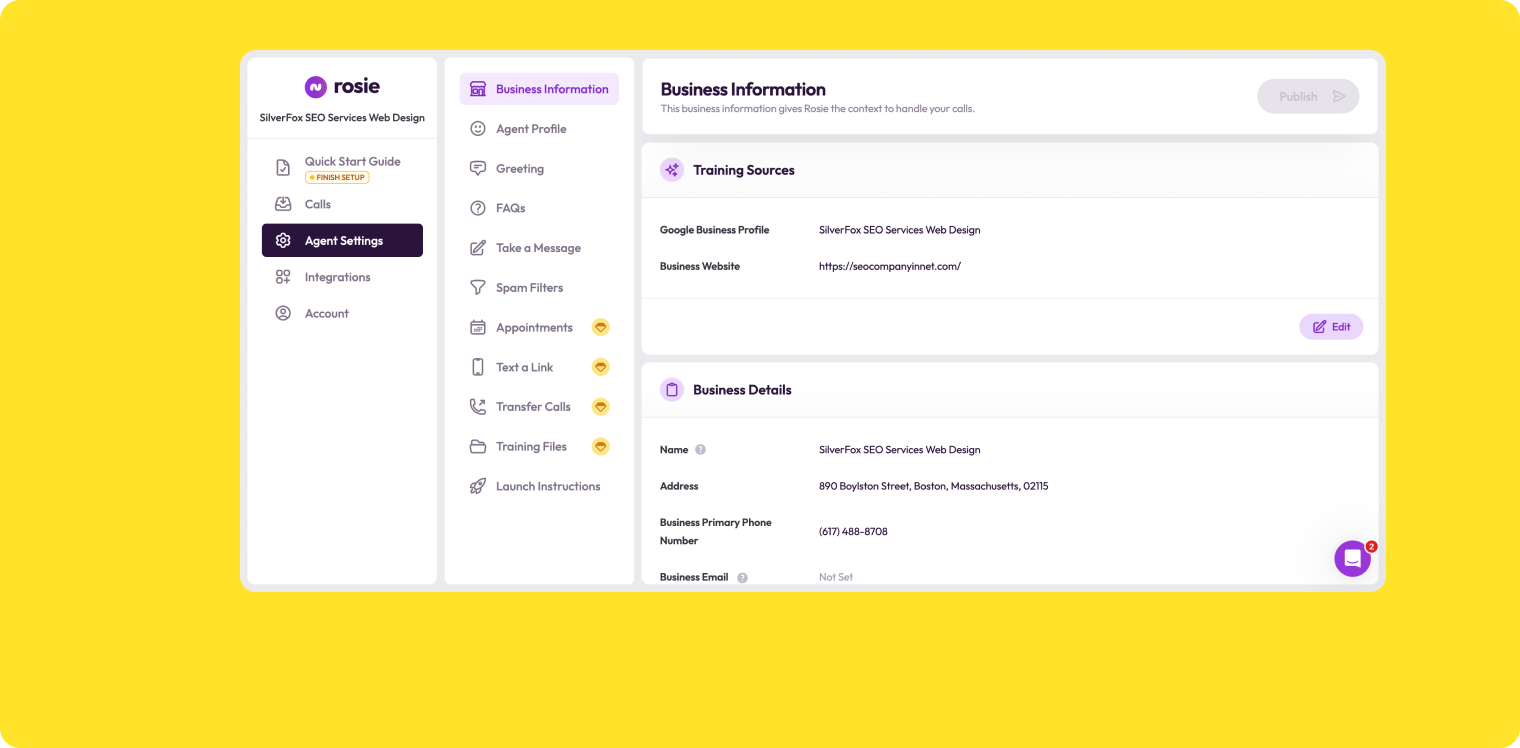
What is Rosie?
Rosie was launched in 2024 by Jordan Gal, a serial entrepreneur who spotted a gap in the market: small businesses were losing too many leads to voicemail, but most AI answering services were either too expensive or too complex for a one- or two-person operation.
Rosie is a standalone AI answering service — it doesn't include a phone system. You connect it to your existing phone line, and it picks up when you can't. It answers caller questions, takes messages, and sends you instant notifications with AI-generated summaries. Think of it as a smarter voicemail replacement, designed specifically for small businesses that can't afford to miss calls but also can't afford a receptionist.
Why Rosie is a good fit for HVAC teams
For solo HVAC contractors or small shops with two or three techs, Rosie hits a sweet spot. It's affordable ($49/month on the base plan), includes unlimited minutes, and doesn't require you to change your phone system. If you're happy with your current phone setup and just need something to catch calls while you're on a job site, Rosie does exactly that.
Setup is quick. Rosie scans your website and Google My Business profile to train itself, so it can answer basic questions about your services, hours, and service area right away. You can also create custom FAQs — handy for HVAC-specific questions like "Do you work on ductless mini-splits?" or "What brands do you service?"
The downside is that Rosie's base plan is limited. On the Professional tier ($49/month), you can't book appointments, transfer calls, or send text links during a conversation. Those features unlock at the Scale plan ($149/month), which starts to close the gap with competitors. For an HVAC contractor who just needs someone to pick up and take a message, the base plan works. But if you want your AI to actually schedule a service call or route emergencies to your personal cell, you'll need to spend more.
Rosie is only available in the US and Canada.
Rosie Pricing
All Rosie plans include unlimited minutes and message-taking:
- Professional: $49/month. Answers calls, takes messages, sends notifications.
- Scale: $149/month. Adds appointment links, call transfers, and in-call texting.
- Growth: $299/month. Adds custom training files for more detailed AI responses.
Rosie offers a 7-day free trial. No phone system is included — you'll need your own.
Demo Video of Rosie
Nextiva Xbert
What is Nextiva Xbert?
Nextiva has been in the business communications game since 2008. Xbert is their AI receptionist product, designed to handle calls, texts, web chats, and messaging apps from a single platform.
Xbert goes beyond just answering phone calls. It's a multi-channel AI assistant that can respond to customers across text messages, web chat, and other messaging platforms — all from the same configuration. For HVAC businesses that get inquiries through multiple channels, that breadth is appealing. It also supports appointment booking through Google Calendar, Calendly, and Cal.com, which means callers can get scheduled without anyone from your team being involved.
Why Nextiva Xbert is a good fit for HVAC teams
Xbert's standout feature for HVAC is appointment scheduling. If your business runs on scheduled service windows, having the AI book directly into Google Calendar or Calendly cuts out a major step. The AI can also send SMS confirmations after booking, which reduces no-shows.
It supports English, Spanish, French, and Portuguese — a genuine advantage for HVAC companies serving multilingual communities. And the dedicated reporting dashboard gives you metrics on call volume, appointment bookings, and after-hours call trends. If you're trying to figure out when you need more coverage or which questions your AI can't answer yet, that data is valuable.
The integration list is solid too. CRM connections with Salesforce, HubSpot, and Pipedrive are available, though some require a manual activation on Nextiva's side that takes two to four business days.
Where Xbert struggles for smaller HVAC teams: cost and complexity. It requires a Nextiva phone subscription (starting at $23/user/month), and the AI receptionist is charged on top at $99/month per 100 interactions. If you exceed that, overage is $0.99 per interaction. There's also no free trial, and the AI receptionist can't be managed from a mobile app — a real limitation for teams in the field.
Nextiva Xbert Pricing
Xbert requires a Nextiva subscription plus the AI add-on:
- Nextiva phone system: Starting at $23/user/month (billed monthly).
- Xbert AI receptionist: $99/month per 100 interactions, then $0.99 per additional interaction.
An "interaction" counts when a call lasts 30+ seconds or a text/chat gets 3+ AI responses. No free trial is available.
For a 3-person HVAC team handling 150 interactions/month, the total comes to roughly $168/month ($69 for the phone system + $99 for Xbert). The per-interaction overage can add up during peak season.
Demo Video of Nextiva Xbert
Goodcall
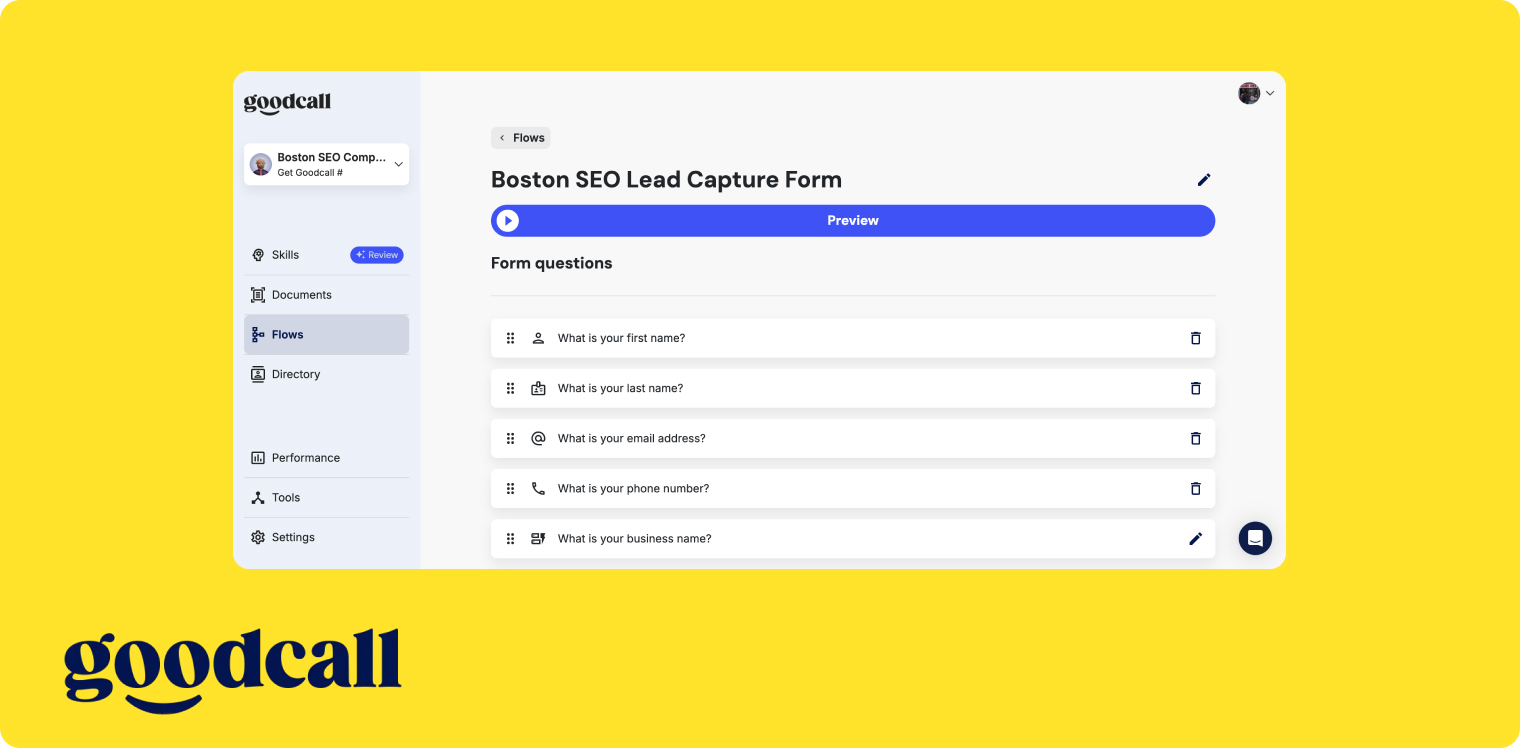
What is Goodcall?
Goodcall was started in 2021 by Bob Summers, a tech veteran and former Google employee. The platform is one of the more advanced standalone AI answering services available, built around the idea of reducing call volume entirely — not just answering calls, but resolving them so customers never need to call back.
Goodcall is a standalone service, so it doesn't come with a phone system. You'll need to keep your existing phone setup and forward calls to Goodcall when you can't answer. During those calls, the AI can collect lead information, answer trained questions, and guide callers toward booking online or leaving their details. It's designed for businesses that want fewer inbound calls, not just answered ones.
Why Goodcall is a good fit for HVAC teams
Goodcall's approach works well for HVAC businesses that want to deflect routine calls. If half your incoming calls are people asking "What's your service area?" or "Do you install heat pumps?", Goodcall can handle those without your team getting involved. You set up the questions and answers during onboarding, and the AI takes care of the rest.
The lead capture feature is worth mentioning. You can define the specific questions callers need to answer — name, address, type of issue, system brand — so when a message lands in your inbox, it's already structured and ready to act on. That's more useful than a standard voicemail transcript.
But Goodcall has some notable gaps for HVAC. The pricing is per-agent and caps the number of unique customers per month. On the Starter plan ($79/month), you get 100 unique customers, then $0.50 per additional customer. For an HVAC company with a large service area and seasonal spikes, that cap can become expensive quickly. There's no mobile app for managing the service, it only integrates via Zapier (no native CRM connections), and it doesn't support SMS.
Goodcall Pricing
All plans include unlimited minutes, but cap unique customers:
- Starter: $79/month per agent. 100 unique customers/month, then $0.50 per additional customer.
- Growth: $129/month per agent. 250 unique customers/month, then $0.50 each.
- Scale: $249/month per agent. 500 unique customers/month, then $0.50 each.
Goodcall offers a 14-day free trial. No phone system is included.
Demo Video of Goodcall
RingCentral AIR
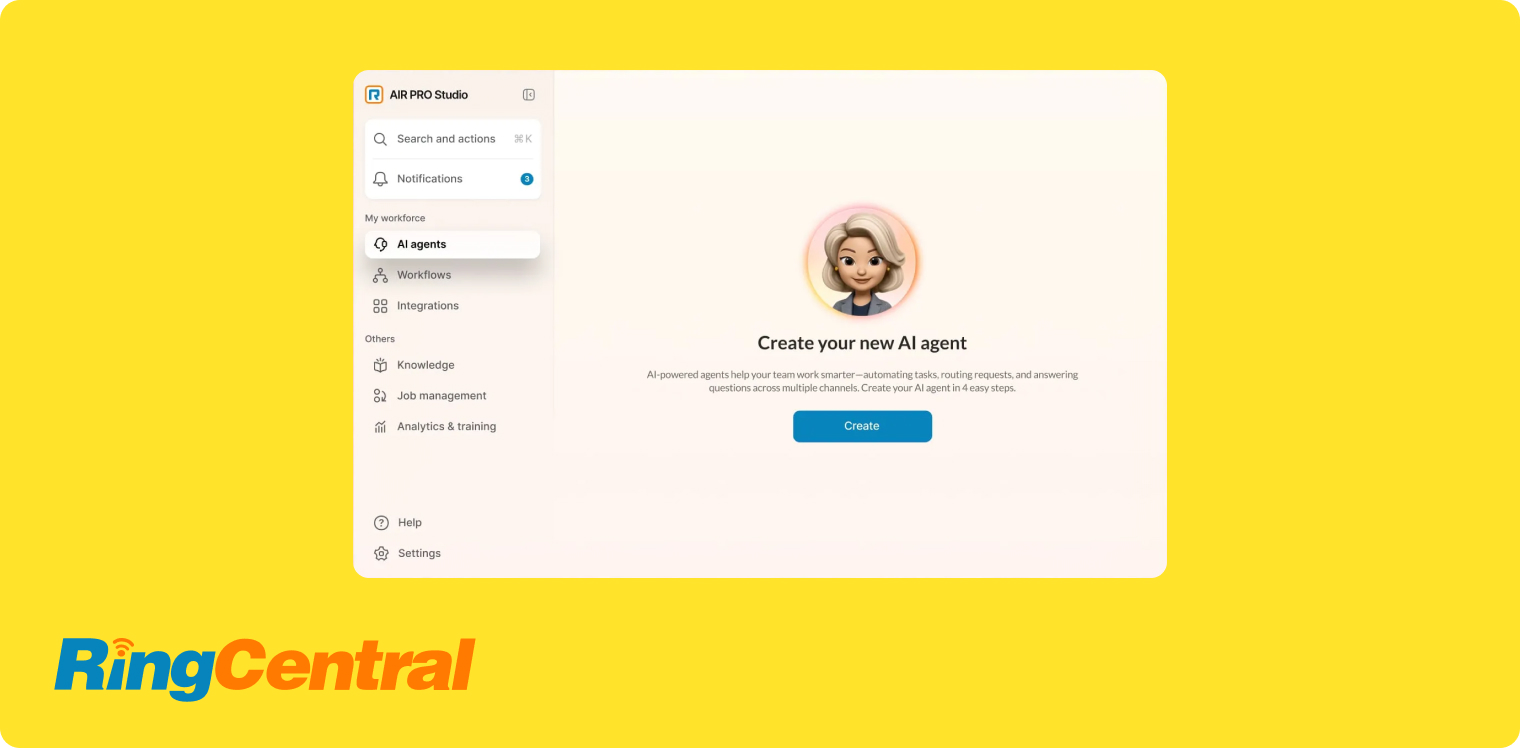
What is RingCentral AIR?
RingCentral has been a fixture in business communications since 1999. AIR, their AI Receptionist, launched in February 2025 as their answer to the growing demand for AI-powered call handling. It's built into the RingCentral phone system, so if you're already a RingCentral customer, it's an add-on rather than a new product to learn.
AIR can answer FAQs, book appointments, send SMS, and transfer calls to a human when the AI hits its limits. It also includes specific reporting metrics on call volume, knowledge gaps, and after-hours trends — useful for spotting patterns and improving your setup over time. The service supports seven languages, making it the most linguistically flexible option on this list.
Why RingCentral AIR is a good fit for HVAC teams
AIR makes the most sense for HVAC businesses that are already using RingCentral as their phone system. Adding the AI receptionist is straightforward — no new phone numbers, no call forwarding to set up, no second vendor to manage.
The appointment booking feature integrates with Google and Outlook calendars, and the AI can send SMS confirmations. For HVAC businesses that rely on scheduled appointments rather than emergency-only work, this keeps the booking process tight. The multilingual support is a bonus if your service area includes communities where English isn't the primary language.
AIR also handles call transfers well. If a customer describes an emergency the AI can't resolve, it can route the call directly to an available team member. That's essential for HVAC — you don't want your AI cheerfully scheduling a Tuesday appointment when someone's pipes are freezing right now.
The downsides? Access to AIR is still gated behind a sales call — you can't just sign up and start using it. There's no free trial. The pricing is per-minute ($39/month for 100 minutes), with $0.50/minute overages billed in 30-second increments, which can add up during peak season.
RingCentral AIR Pricing
AIR is an add-on to a RingCentral subscription:
- AI receptionist: $39/month for 100 minutes. Overages at $0.50/minute, billed in 30-second increments.
- RingCentral phone system: Subscription required (plans vary).
No free trial. You'll need to go through a sales call to activate the feature. Additional minute bundles are available for purchase.
Demo Video of RingCentral AIR
Conclusion
Picking the right AI answering service for your HVAC business comes down to three things: how much you're willing to spend, whether you want a standalone service or a full phone system, and how much control you need from your phone.
Allo is the strongest overall pick for small HVAC teams. It bundles the phone system and AI receptionist into one product, offers unlimited AI answering on every plan, and gives you full mobile control — something only Quo matches on this list. Starting at $18/user/month (billed yearly), it's also the most cost-effective option when you factor in that there's no separate phone subscription to pay for.
Rosie is the simplest and cheapest entry point if you already have a phone system and just want AI call coverage. At $49/month with unlimited minutes, it's hard to beat on price — though the base plan's limited features mean you may outgrow it quickly.
Quo Sona offers the most sophisticated call workflows and automated SMS, which is valuable if your HVAC business has a structured intake process. Just keep an eye on the per-call costs during busy months.
Nextiva Xbert and RingCentral AIR are solid options if you're already locked into those phone systems and don't want to switch. Both offer appointment scheduling and multilingual support, but neither can be managed from mobile — a real drawback for field teams.
Goodcall is the most advanced standalone AI service on this list, but its per-customer pricing and limited integrations make it a harder sell for HVAC businesses with unpredictable call volumes.
Frequently Asked Questions About AI Phone Answering Services for HVAC
What is the best AI answering service for HVAC?
There's no single answer — it depends on your team size, budget, and whether you want to keep your current phone system. For small HVAC teams that want everything in one place, Allo offers the best combination of value and features: unlimited AI answering, full mobile control, and a phone system included, all at a flat rate that won't spike during peak season. If you're a solo contractor looking for the cheapest way to stop missing calls, Rosie's $49/month plan is tough to beat. And if you're already on Quo, Nextiva, or RingCentral and don't want to switch, their respective AI add-ons let you stay put — just watch the per-call or per-minute costs, which can climb fast when summer (or winter) hits.
How much does an AI answering service cost for an HVAC company?
It depends on the type of service and your call volume. Standalone AI answering services like Rosie start at $49/month with unlimited minutes, while Goodcall begins at $79/month per agent with a cap on unique callers. If you go with a bundled phone system, Allo's plans start at $18/user/month (billed yearly) and include unlimited AI answering with no add-on fees. Quo Sona and RingCentral AIR charge per call or per minute on top of their phone subscriptions, which means your total cost varies month to month. For a typical 2–3 person HVAC team, expect to spend anywhere from $49/month (standalone, basic) to $200+/month (bundled phone system with AI add-ons) depending on the features and call volume you need.