
Key Takeaways
- Orum is best for SDR/BDR teams in tech that need maximum call volume and advanced AI coaching — its parallel dialing (up to 10 lines) and AI scorecards set it apart, though the price point makes it better suited to teams of 5+ reps with a real outbound budget.
- Allo is best for solo reps and small teams that want AI built in without add-on fees — the $45/user/month Business plan carries no seat minimum, making it the cheapest route to a power dialer in this comparison.
- Kixie is best for SMB sales teams that want deep CRM integrations alongside a multi-line power dialer — local numbers in 65+ countries and native HubSpot, Salesforce, and Pipedrive integrations make it a versatile choice for teams dialing across markets.
- Mojo is best for real estate agents and inside sales teams that prioritize raw dialing speed on a limited budget — its triple-line dialer starts at $139/user/month, runs on a copper-line infrastructure, and doesn't require an annual commitment.
Introduction
Your sales reps are spending too much time staring at a screen waiting for a call to connect. Between voicemails, wrong numbers, and calls that ring out, a good chunk of the day disappears before anyone picks up. That's the problem power dialers were built to solve.
But "power dialer" has become a catch-all term that covers very different tools. A parallel dialer calling 7 numbers at once is a fundamentally different beast from a single-line auto dialer that simply skips manual dialing. Choose the wrong one and you'll either overwhelm your reps with live calls they can't handle, or pay for a "power" feature that barely moves the needle.
We tried eight of the most widely used options — Orum, Allo, Kixie, PhoneBurner, Mojo Dialer, Aircall, CloudTalk, and JustCall — covering pricing, power dialer features, AI capabilities, CRM integrations, and geographic coverage. Whether your team lives in a CRM making 50 calls a day or you're running high-volume outbound campaigns, you'll find a clear answer here.
Before we get into the tools, here's a quick primer on what to look for — and what the different types of power dialers actually mean in practice.
What's a Power Dialer?
A power dialer is software that automates outbound calling so your reps spend more time talking and less time dialing. Instead of manually keying in numbers one by one, the dialer works through a contact list automatically — moving to the next prospect the moment a call ends or goes to voicemail.
That's the baseline. But there are meaningful differences between the types of power dialers on the market, and picking the right model matters more than picking the right brand.
Auto Dialers (Single-Line)
The simplest type. The dialer calls one number at a time, automatically. When a call goes to voicemail, the rep drops a pre-recorded message with one click and the dialer immediately dials the next contact. There's no waiting, no manual typing — just a faster version of the rep's existing workflow. PhoneBurner, Allo, and Mojo's single-line option all work this way. They're well-suited to reps who prioritize conversation quality over raw volume.
Parallel Dialers (Multi-Line)
Parallel dialers call multiple numbers simultaneously — typically between 3 and 10 at once. The moment a human answers, the call is connected to the rep. Voicemails and no-answers are handled automatically in the background.
This dramatically increases the number of live conversations per hour, but it also means reps need to be ready to pick up instantly. Orum, Kixie, Mojo (triple-line), CloudTalk, and JustCall all offer this.
Preview Dialers
A preview dialer shows the rep the contact's information before placing the call. The rep clicks to confirm before dialing begins. It's slower than the other types but works well for high-value prospects where reps need a moment to prepare — think account executives rather than high-volume SDRs.
Why use a power dialer at all?
The numbers are straightforward: most salespeople spend less than 30% of their day in actual conversations. Power dialers close that gap. They eliminate dead time between calls, handle voicemail drops automatically, and route live answers to available reps immediately.
For outbound-heavy teams, the difference in daily call volume — and the resulting pipeline impact — is hard to ignore.
How to Choose the Right Power Dialer
Every tool in this list will make your team faster. But the right one depends on your specific setup. Here are the four criteria that matter most.
Pricing
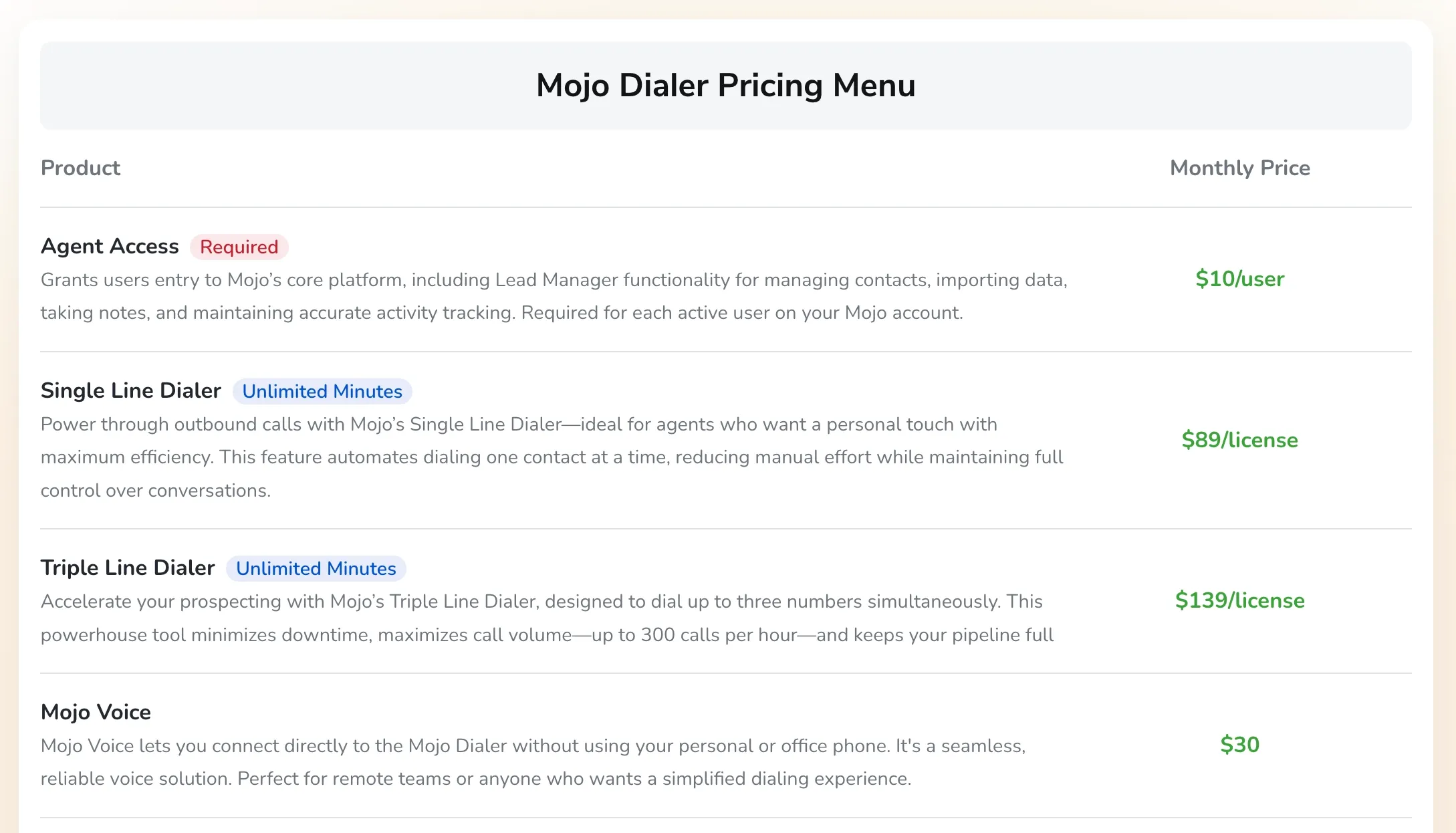
Power dialer pricing is rarely straightforward. Many vendors hide their rates or require you to upgrade to a mid-tier plan just to access the dialer feature. Mojo charges a base licence fee on top of the dialer fee. Aircall's power dialer is locked behind its $70/user Professional plan. Always check which plan actually includes the dialer — not just the cheapest entry price on the website.
CRM Integrations
The whole point of a power dialer is speed. If your reps still have to manually log calls in your CRM after each session, you've solved half the problem. Prioritize tools with native integrations for your specific CRM — not just a Zapier workaround. If you're on Salesforce, check that the integration is native and bidirectional. If you're on HubSpot, verify the marketplace ratings before committing.
AI Features
The gap between dialers is widening fast on the AI side. The best tools now offer automatic call transcription, summaries, sentiment analysis, and even real-time coaching that flags objections as they happen. If your managers spend time reviewing call recordings manually, look for a dialer that does that work for them.
Local Coverage
Answer rates drop sharply when prospects see an unfamiliar area code. If your team calls outside your home market, local presence — the ability to display a local number matching the prospect's region — is worth paying for. Coverage varies wildly: Mojo is US/Canada only, while CloudTalk covers 160+ countries. Know your target markets before you commit.
| Solution | Dialer type | Price/user/mo | Min licenses | Min monthly cost | G2 rating |
|---|---|---|---|---|---|
| Allo | Progressive dialerSingle line by design, no parallel dialing. | $45Business plan. | 1 | $45/mo$32/mo billed yearly. | 4.7 / 5209 reviews |
| Mojo | All typesSingle-line or triple-line dialing up to 3 lines. | $99Single-Line Dialer $89 + $10 access license. | 1 | $99/moMonth-to-month, no annual commitment. | 4.1 / 528 reviews |
| JustCall | All typesPower, predictive and parallel dialing up to 10 lines. | $69Pro plan. | 2 | $138/mo$98/mo billed yearly. | 4.3 / 52,385 reviews |
| PhoneBurner | Progressive dialerNo parallel dialing, one call at a time. | $165Standard plan. | 1 | $165/mo | 4.7 / 5288 reviews |
| CloudTalk | Progressive dialerParallel dialing sold as a $39/user/mo add-on. | $69Expert plan. | 3 | $207/mo$147/mo billed yearly. | 4.4 / 51,847 reviews |
| Aircall | Progressive dialerBasic power dialer, no parallel dialing. | $70Professional plan. | 3 | $210/mo$150/mo billed yearly. | 4.4 / 51,591 reviews |
| Orum | All typesPower + parallel dialing up to 10 lines. | Not publicCommunity discussions suggest $200+/user. | 3 | Not publicEst. $600+/mo for 3 seats. | 4.6 / 5863 reviews |
| Kixie | All typesSingle-line and multi-line dialing up to 10 lines. | Not publicPower dialer requires a PowerDialer plan. | Not stated | Not public | 4.8 / 5865 reviews |
Orum — Best for High-Volume SDR Teams in Tech
What is Orum?
Orum was founded in 2018 by Jason Dorfman, a sales veteran who noticed a gap in the market: most calling tools were built around monitoring salespeople, not making them faster. Backed by $51 million in funding, Orum took a different approach — building a platform that prioritizes rep productivity through speed, integrations, and AI-assisted coaching.
The result is a tool that feels built for modern outbound teams rather than adapted from a legacy phone system. It's particularly popular with tech-sector SDR and BDR teams that run structured outbound sequences at scale. That focus shows in features like Salesfloor — a live listening environment where reps can tune into colleagues' calls in real time, which is genuinely useful for remote teams trying to build culture and share winning tactics without being in the same room.
Why Orum is a strong fit for high-volume outbound teams
The core appeal is simple: Orum's parallel dialer lets reps call up to 10 numbers at once, with the platform detecting live answers and connecting them instantly. That alone changes the math on how many conversations a rep can have in a day.
What separates Orum from most parallel dialers is the AI layer on top. AI Scorecards automatically evaluate every call — scoring openers, discovery questions, objection handling, and closing — giving managers a coaching view across the whole team without listening to hours of recordings. Orum's AI also identifies objections in real time across 20+ languages, which is increasingly useful for teams with international books of business.
Where it falls short: pricing isn't published, and online discussions suggest you're looking at $200+/user/month with an annual commitment. There's also a 3-seat minimum and no mobile app — which limits its appeal for teams that work on the go. CRM support covers HubSpot, Salesforce, Outreach, and Salesloft, but if you're on anything else, you're out of luck.
Orum Pricing
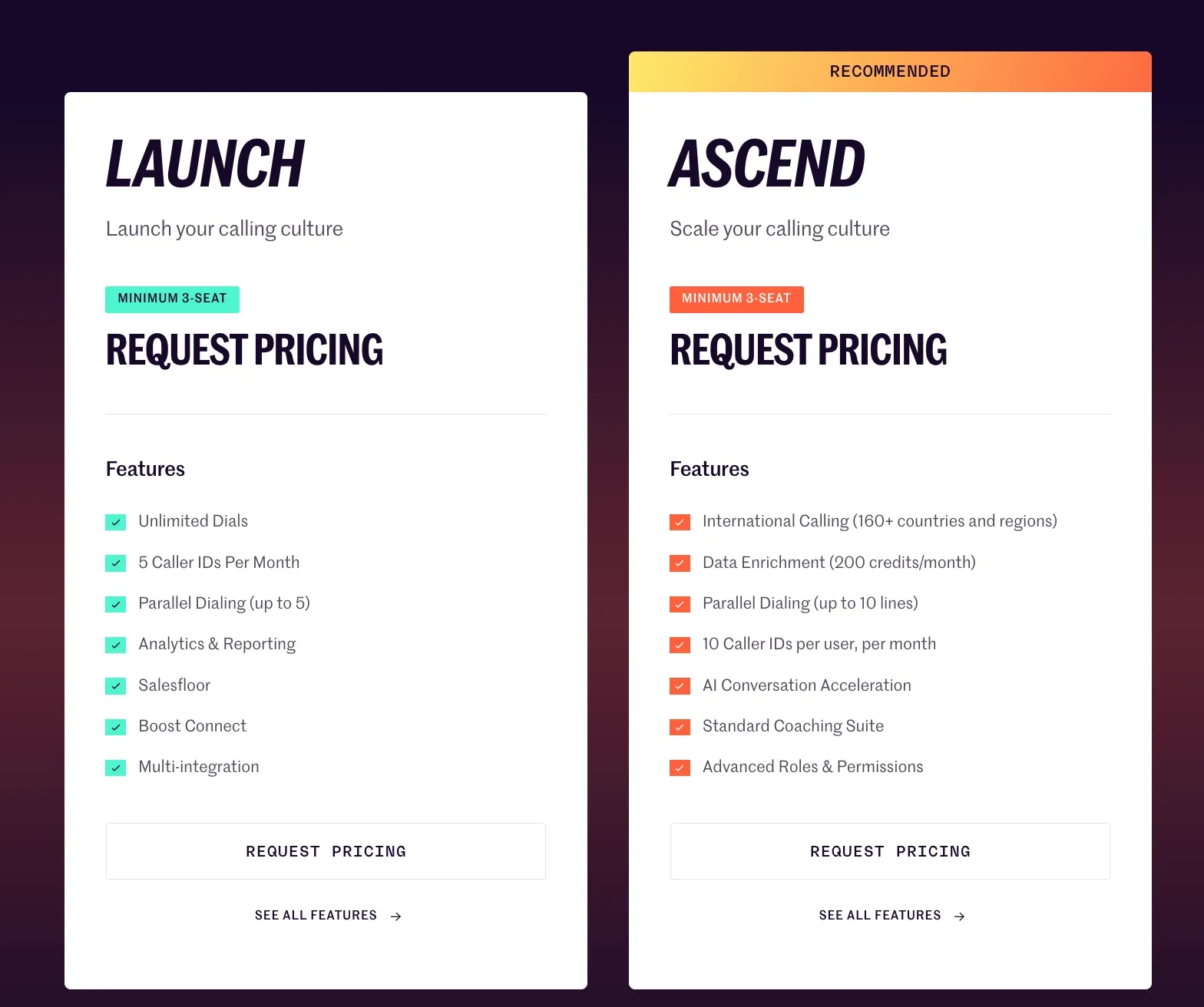
Orum offers two plans, both of which include parallel dialing. Pricing is not published publicly.
- Launch: Unlimited dials, 5 caller IDs per user/month, parallel dialing up to 5 lines, analytics and reporting
- Ascend: Adds international calling (160+ countries), data enrichment (200 credits/month), parallel dialing up to 10 lines, 10 caller IDs/user/month, coaching tools
Both plans require a minimum of 3 seats. Based on online discussions, expect to pay north of $200/user/month on an annual commitment. Request a quote directly from Orum for current pricing.
Allo — Best for Solo Reps and Small Teams That Want AI Included
What is Allo?
Allo is a business phone system launched in 2024 that treats AI as a standard feature rather than an upsell. Every plan ships with an AI receptionist, transcription in 36 languages, call summaries, drafted follow-up emails, and an assistant that can dig through your call history to answer questions. It was also built mobile-first, so a rep can run a full dialing session from a phone as comfortably as from a laptop — rare in a category where mobile apps are often an afterthought.
Where most vendors on this list grew out of call-center software, Allo is aimed squarely at small teams and solo salespeople: one number included, no seat minimums, and a setup that doesn't require an IT department.
Why Allo is a strong fit for solo reps and small teams
The economics are the obvious draw. The power dialer sits on the Business plan at $45/user/month ($32 when billed yearly) with no license minimum — so a single rep can start power dialing for $45, against entry costs of $99 to $210 elsewhere in this comparison once seat minimums are factored in.
The dialer itself is deliberately single-line. It queues contacts imported from your CRM, a CSV, the API, or through Allo's MCP connection to AI assistants like Claude, then works through them one call at a time, with the option to pause a session whenever needed. Calls, recordings, and transcriptions land in your CRM automatically — native integrations cover HubSpot, Pipedrive, Salesforce, Attio, and more, and the HubSpot app is rated 4.7/5 on the marketplace.
Know the limits before choosing it: there's no parallel dialing, so teams chasing maximum dials-per-hour will get more raw volume from Orum or Kixie. The product is young (2024), and local numbers cover 11 countries — plenty for domestic teams, thin for global outbound.
Allo Pricing
- Solo: $18/month for one user (billed yearly) — Business number, unlimited national calls, call recording, SMS, AI transcripts and summaries, unlimited AI Receptionist, core CRM integrations
- Business: $45/user/month ($32 billed yearly) — Adds the power dialer, all integrations, collaborative inbox and notes, custom AI summary templates, AI call tags, Allo MCP, analytics, and team leaderboards
Every plan comes with one local or toll-free number and pay-as-you-go international rates. A 7-day free trial is available, and cancellation takes two clicks in settings — no retention call required.
Kixie — Best for SMB Teams Needing Deep CRM Integrations
What is Kixie?
Founded in 2013 and based in Santa Monica, Kixie built its reputation on one thing: making CRM-connected calling feel effortless for SMB sales teams. Unlike tools that treat CRM integration as an afterthought, Kixie lets reps initiate calls directly from inside their CRM — no tab-switching, no copy-pasting numbers. The dialer lives where your reps already work.
What also sets Kixie apart in the SMB space is the attention to practical outbound details. Local number rotation automatically switches between numbers when the system detects you're calling the same prospect multiple times in a day — a small feature that meaningfully improves answer rates. AI spam protection runs in the background and removes flagged numbers before they hurt your deliverability.
Why Kixie is a strong fit for SMB sales teams
Kixie's multi-line power dialer goes up to 10 simultaneous calls, putting it on par with enterprise options. But what makes it stand out for SMBs is the breadth of features included alongside the dialer: voicemail drop, SMS templates, local presence in 65+ countries, live call monitoring for managers, and the ability to create follow-up tasks in your CRM directly from a call. It's a complete outbound stack rather than just a dialer.
CRM integrations are a genuine strength — native connections with HubSpot, Salesforce, Pipedrive, Zoho, and HighLevel, plus Zapier and Make for anything else. On G2, Kixie holds the highest rating in this comparison at 4.8/5.
The downsides are real though: Kixie relies on a Google Chrome extension, which means your team has to be Chrome users (not always a given). Some users report glitches and occasional outages. And the Android app has a notably low rating (2.1/5 on the Play Store), which matters if any reps are mobile-first.
Kixie Pricing
Kixie no longer publishes pricing.
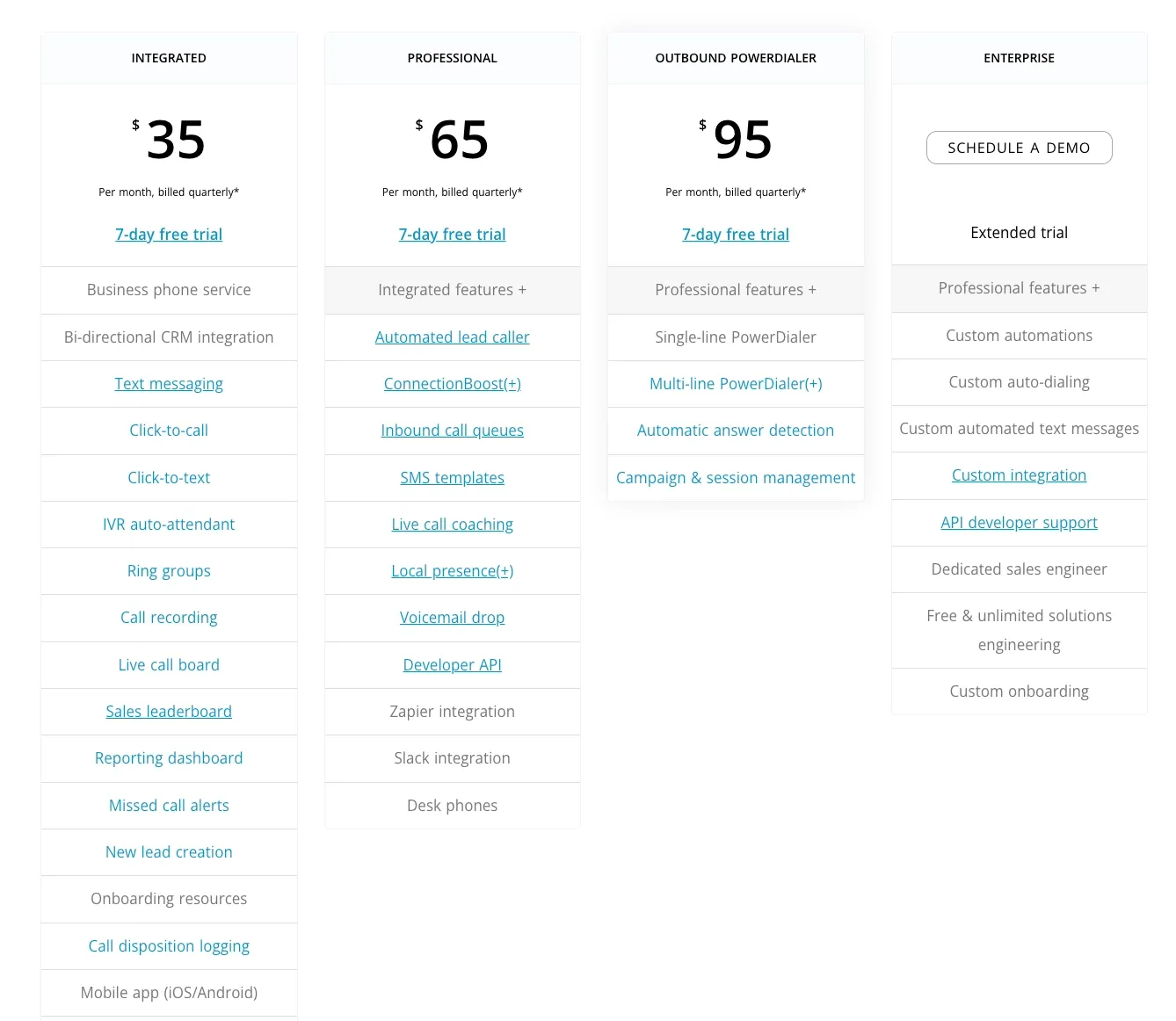
Based on their last public pricing (2023), plans ranged from approximately $35 to $95/user/month billed quarterly. A 7-day free trial is available.
- Professional: Click-to-call, SMS templates, voicemail drop, live call coaching. Unlimited US/CA minutes. CRM integrations included.
- Single-Line PowerDialer: Adds a single-line power dialer to the Professional plan.
- Multi-Line PowerDialer: Adds parallel dialing with up to 10 simultaneous lines.
Note: calls outside the US and Canada are billed on a pay-per-minute basis, even on plans that include local numbers in 65+ countries.
PhoneBurner — Best for US Teams That Prioritize Quality Over Volume
What is PhoneBurner?
PhoneBurner has been around since 2008, built by a remote US-based team. It's one of the few companies in this space to actively resist the parallel dialing trend — a deliberate choice they've leaned into with their "Responsible Communications" positioning. The idea is that calling one person at a time, with full attention, leads to better conversations and better outcomes than shotgunning five numbers at once.
That philosophy shapes the product. PhoneBurner is a single-line power dialer: it automates everything around the call (dialing, voicemail drops, local presence matching, post-call workflows) without the compliance complexity and dropped-call risk that comes with parallel dialing. It also ships with its own built-in CRM, which is a rare feature in this category.
Why PhoneBurner is a strong fit for US-based sales teams
PhoneBurner works well for teams that make a high volume of calls but want to stay out of legal grey areas. Parallel dialing has regulatory complications in some states — PhoneBurner sidesteps that entirely. The single-line approach keeps reps focused on one conversation at a time, which can lead to stronger opening lines and better discovery rather than rushing to handle a surprise connection.
Practically speaking, the tool is loaded with workflow automation: voicemail drop, local presence (matching the prospect's area code), a built-in "Armor" feature that monitors and disables numbers flagged as spam, and automated lead attribution across reps. Call transcription is available on the Premium plan.
The main limitation is geography: PhoneBurner only dials US and Canadian numbers. If your team calls internationally, it's off the table. The $165/user/month starting price is also the highest published rate in this comparison, though it includes unlimited calling and the dialer out of the box.
PhoneBurner Pricing
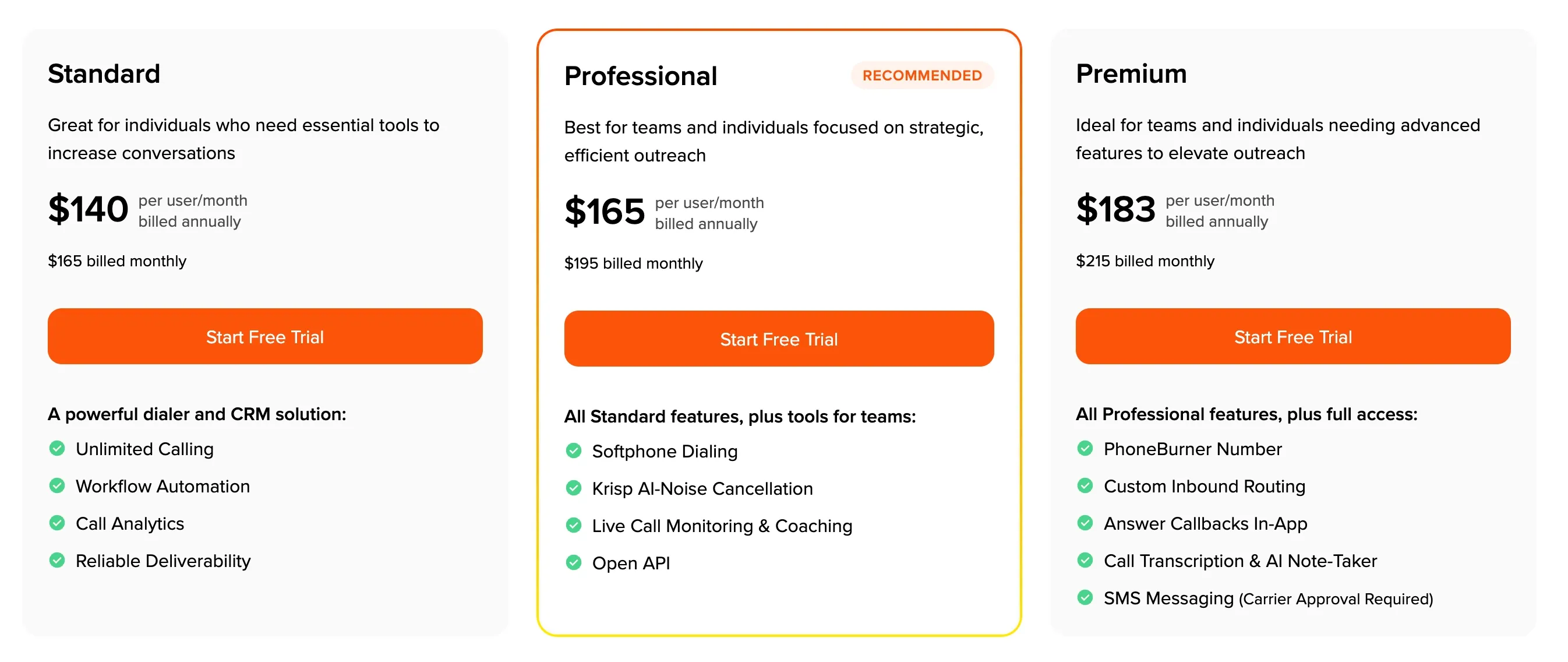
- Standard: $165/user/month (billed monthly) — Unlimited calling, call analytics, power dialer. Requires a hardware phone.
- Professional: $195/user/month — Adds live call monitoring and coaching.
- Premium: $215/user/month — Adds call transcription, text messaging, and unlimited call recording storage.
All three plans include the power dialer. No annual commitment is required for access to core features.
Mojo Dialer — Best for Real Estate Agents and Inside Sales on a Budget
What is Mojo Dialer?
Mojo started in 2007, built by a small team in New Hampshire with a clear target in mind: real estate agents who needed to make a lot of calls, fast. Over the years, the product has expanded to mortgage brokers, insurance professionals, and inside sales teams — but real estate remains the core identity.
What sets Mojo apart technically is the infrastructure choice: rather than running on VoIP, Mojo's dialer operates on a copper-line network. That means fewer dropped calls and more consistent audio quality, particularly in areas where internet connectivity is unreliable. It's an old-school decision that still earns loyalty from users who've had bad experiences with VoIP stability.
The platform also includes Leadstore, a US real estate prospecting database that lets agents pull contact data directly into their dialing sessions — a niche but genuinely useful feature for the core audience.
Why Mojo is a strong fit for real estate and domestic inside sales teams
The triple-line dialer is the headline feature: call up to three contacts at once, with automatic voicemail drop and a prospecting dashboard that shows dialing time, call count, appointments set, and more in real time. For real estate agents running cold campaigns on FSBO or expired listings, that call volume makes a measurable difference to their day.
Month-to-month pricing is another genuine advantage — no annual commitment means teams can spin up for a campaign season and dial back when activity slows. The add-on structure gives you control over what you pay for.
The shortcomings are real though. Mojo only works for US and Canadian numbers, has no local presence feature (a notable gap if you're calling across time zones), and its CRM integrations are limited to a handful of real estate-specific platforms like Follow Up Boss and BoomTown plus Zapier. There's no AI — calls can be recorded but not transcribed or scored. The interface is functional but dated.
Mojo Dialer Pricing
Mojo uses a base license fee plus dialer add-on structure, billed month-to-month.
- Mojo Access License: $10/user/month (required for every user)
- Single-Line Dialer: $89/user/month — One outbound line, unlimited US/CA calling
- Triple-Line Dialer: $139/user/month — Three simultaneous outbound lines, unlimited US/CA calling
Notable add-ons: Mojo Voice ($30/user/month), Call Recording ($25/user/month), Caller ID ($10/user/month). Pricing is month-to-month with no annual commitment required.
Aircall — Best for Mid-Market Teams That Want a Trusted Name
What is Aircall?
Aircall was founded in Paris in 2014. Today, they serve mostly mid-sized and enterprise teams. It's the kind of tool a procurement team feels comfortable signing off on — a recognized brand, a clean interface, and a list of integrations that covers almost every CRM your team might be using.
Aircall is transparent about one thing: their power dialer is intentionally limited. They've written publicly about why they believe parallel dialing conflicts with ethical outbound practices, so if you're looking for multi-line capability, you'll want to look elsewhere.
Why Aircall is a strong fit for mid-market teams
For teams that need solid geographic coverage and trusted CRM integrations more than raw dialing speed, Aircall delivers. Local numbers are available across 38 countries. Native integrations cover HubSpot, Salesforce, Pipedrive, Zoho, Attio, HighLevel, and Microsoft Dynamics. The AI feature set includes transcription, summaries, sentiment analysis, live coaching, and call scoring — though AI features are priced separately and only available in English and French.
The power dialer itself is single-line and fairly basic compared to tools like Kixie or Orum. It handles voicemail drop and automatic dialing through a contact list, but there's no parallel dialing, no local presence option, and no way to import numbers directly from your CRM into a dialing session. If your team's primary goal is maximizing call volume, Aircall isn't the right fit. If call quality, brand trust, and deep integration matter more, it's worth a look.
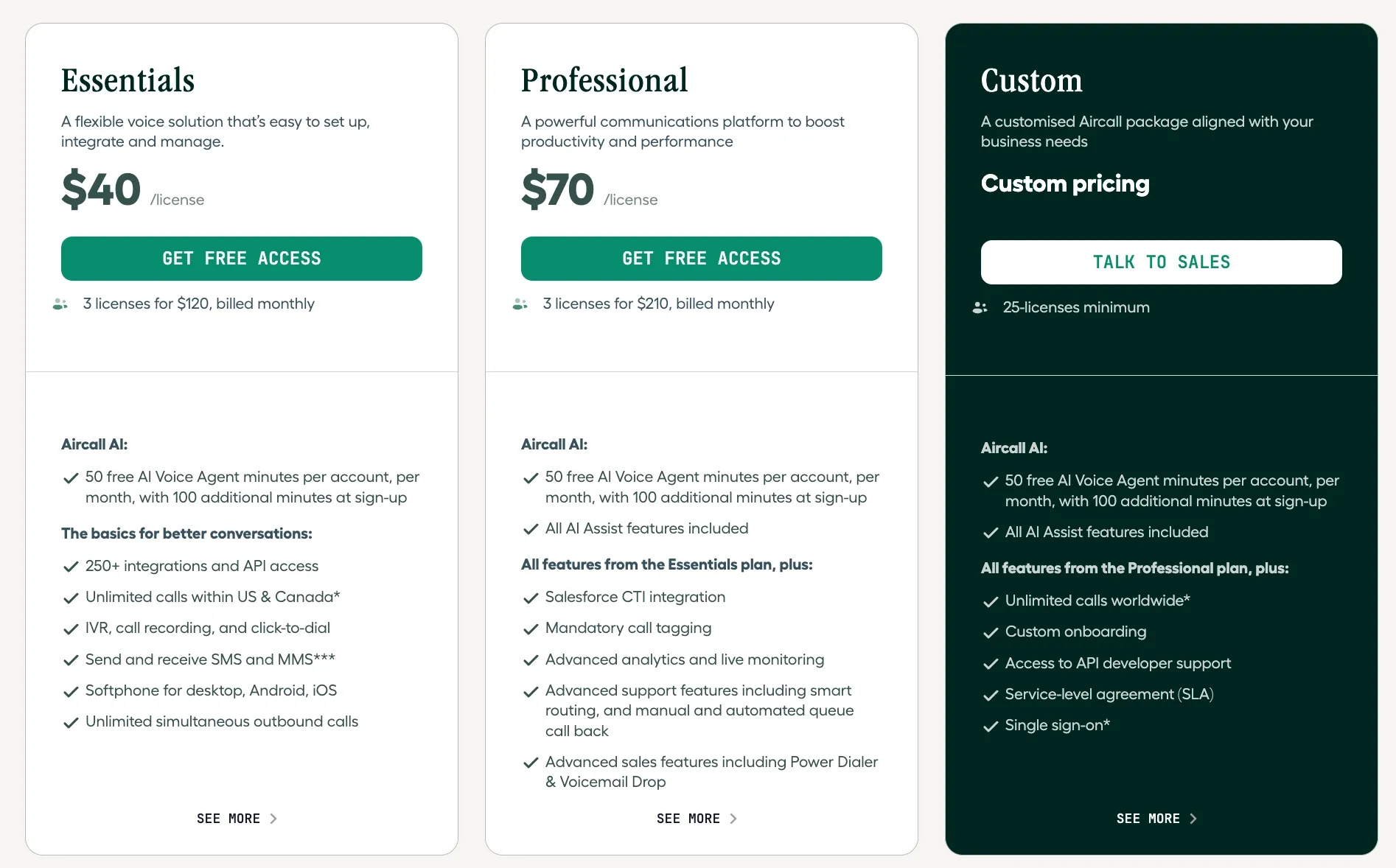
Worth noting: Aircall has a 3-licence minimum, and the power dialer is only available on the Professional plan at $70/user/month.
Aircall Pricing
- Essentials: $40/licence/month — Local number, unlimited US/CA calls, IVR, call recording, SMS/MMS
- Professional: $70/licence/month — Adds the power dialer, voicemail drop, advanced analytics, and unlimited call recordings
Minimum 3 licences required on all plans. A 7-day free trial is available.
AI features are priced separately and not included in either base plan.
CloudTalk — Best for Teams With International Operations
What is CloudTalk?
CloudTalk was founded in 2016 in Slovakia, and has grown to serve over 4,000 customers across 100 countries. That global footprint is the core of the product's identity: if your sales or support team operates across multiple countries and needs local numbers everywhere, CloudTalk's 160+ country coverage is hard to match at this price point.
CloudTalk positions itself primarily for sales teams and call centers that need both inbound and outbound capability in one place. In the past couple of years, it's added a serious AI layer on top of the calling infrastructure — including an AI Voice Agent that can handle inbound and outbound calls autonomously, which moves it into different territory from most tools in this comparison.
Why CloudTalk is a strong fit for international sales teams
The combination of local numbers in 160+ countries, a parallel dialer with up to 10 simultaneous lines, and automatic local number switching (the system rotates to a number matching the prospect's location automatically) makes CloudTalk a strong choice for teams running international outbound campaigns. G2 reviewers specifically call out international call support as a consistent highlight.
The AI feature set is comprehensive: call transcripts, summaries, topic extraction, sentiment analysis, talk-to-listen ratio, and the AI Voice Agent. That's a level of built-in AI tooling that rivals tools costing significantly more.
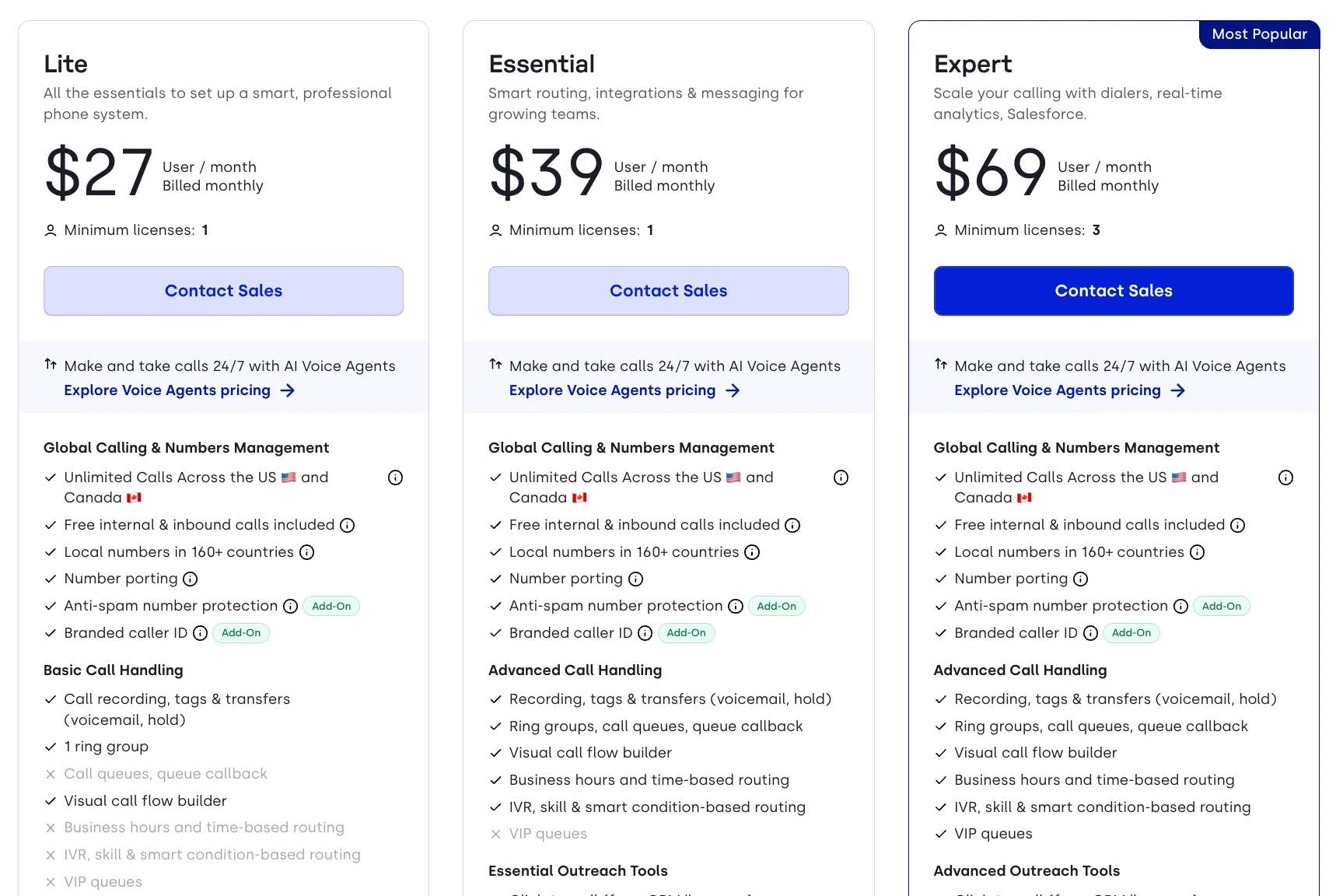
Where CloudTalk struggles: call quality is flagged as inconsistent in some Trustpilot reviews, and customer support response times have been a recurring complaint. The mobile app has a low rating on the App Store (2.4/5), which matters for reps who need to dial on the go. The power dialer is locked behind the Expert plan at $69/user/month with a 3-seat minimum.
CloudTalk Pricing
- Lite: $27/month/user — Unlimited domestic calls, local numbers in 160+ countries. No integrations, limited features.
- Essential: $39/month/user — Business hours, IVR, ring groups, CRM integrations.
- Expert: $69/month/user (min. 3 licences) — Power dialer, live monitoring, advanced reporting, WhatsApp support.
A 14-day free trial is available with no credit card required.
JustCall — Best Value Power Dialer for Growing Sales Teams
What is JustCall?
JustCall was built in 2016 by SaaS Labs, an India-based company, with a specific goal in mind: help sales teams reclaim the time they were losing to manual admin tasks. Logging calls, keeping CRMs updated, writing follow-up notes — the platform was designed from day one to automate all of it. That original focus on workflow automation is still the product's clearest selling point.
Over time, JustCall has expanded into a full outbound calling platform with AI features, a parallel dialer, and integrations across most major CRMs. It's used by both sales and support teams, including call centers, but the pricing and feature set make it particularly appealing for growing SMB sales teams that need a capable power dialer without a large upfront investment.
Why JustCall is a strong fit for budget-conscious sales teams
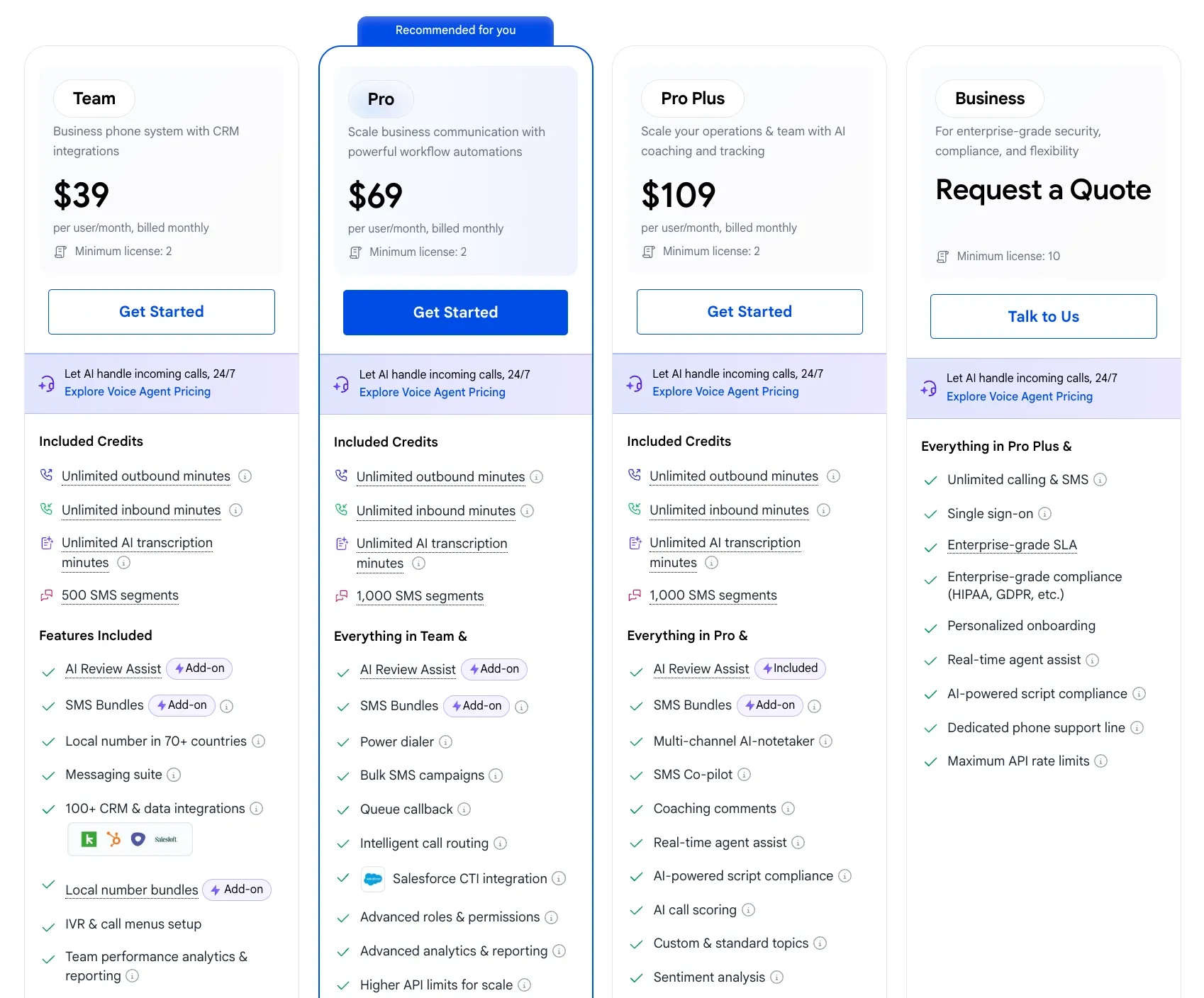
JustCall's Pro plan at $69/user/month gives you a parallel dialer with up to 10 simultaneous calls, native Salesforce integration, bulk SMS, roles and permissions, and reporting — all with just a 2-seat minimum. That's a lower barrier to entry than CloudTalk and Aircall, which both require 3 seats at the same price point.
AI transcription is included for free on all plans — a genuine differentiator. The rest of the AI features (summaries, sentiment analysis, call scoring) are available as a $9/user/month add-on called AI Review Assist, which keeps costs predictable. Local numbers are available in 70+ countries.
The downsides to know about: users report occasional platform glitches and some issues with assigned numbers being flagged as spam. AI features beyond transcription require a paid add-on rather than being baked in. And while the human support team is well-regarded in reviews, the product itself has room to grow in reliability.
JustCall Pricing
- Team: $39/user/month (min. 2 licences) — Unlimited US/CA calls, AI transcription, local number, SMS, CRM integrations
- Pro: $69/user/month (min. 2 licences) — Adds power dialer, bulk SMS, Salesforce integration, advanced reporting
- Pro Plus: $109/user/month — Adds real-time agent assist, sentiment analysis, call scoring
AI Review Assist (summaries, sentiment, topics, CRM logging): $9/user/month add-on. AI Voice Agent: $99/month with 100 minutes included. 14-day free trial available.
Our Take
There's no single best power dialer — it depends on what your team actually needs from a dialing session.
If volume is everything and budget isn't the constraint, Orum sets the ceiling for what a parallel dialer can do, with AI coaching built in. For SMB teams that want a complete outbound stack with deep CRM connections, Kixie is hard to beat. PhoneBurner is the right call for US-based teams that want simplicity and single-line reliability without parallel dialing's regulatory complexity. Mojo earns its place for real estate professionals and inside sales teams that need month-to-month flexibility and a solid triple-line dialer on a tighter budget.
At the $69/user/month tier, CloudTalk wins on international coverage and JustCall wins on overall value — especially given its lower seat minimum and free AI transcription. Aircall is the safe choice for mid-market teams that prioritize integrations and brand trust over dialing speed. Below all of them on price, Allo is the pick for solo reps and small teams: $45/user/month, no seat minimum, and AI features the rest of the market charges extra for.
Most tools offer a free trial. Start there — and make sure to test the CRM integration before you commit.
Frequently Asked Questions About Power Dialers
What is a power dialer?
A power dialer is software that automates outbound calling for sales teams. Instead of manually dialing each number, the software works through a contact list automatically — connecting reps to live answers, dropping pre-recorded voicemails, and moving to the next call without gaps. The result is significantly more conversations per hour compared to manual dialing.
What is an AI power dialer?
An AI power dialer combines automated outbound calling with artificial intelligence features like call transcription, sentiment analysis, automatic CRM logging, and real-time coaching. Instead of just making calls faster, an AI power dialer also helps reps improve over time — surfacing patterns from call recordings, flagging objections, and reducing the manual admin that follows every call. Some vendors sell these AI capabilities as paid add-ons; others, like Allo, include them in every plan.
Are power dialers legal?
Single-line power dialers are generally legal for B2B calling in the US, though you should always maintain DNC (Do Not Call) compliance and scrub your lists accordingly. Parallel dialers — which call multiple numbers simultaneously — operate in a more complex regulatory space, particularly in the US under TCPA rules. If you're dialing consumers rather than businesses, consult legal advice before using a multi-line dialer.
How much do power dialers cost?
Power dialers typically range from around $45 to $200+/user/month, depending on features and plan tier. Allo has the lowest entry point at $45/user/month with no seat minimum. Mojo starts at $99/user/month (including licence fee). PhoneBurner starts at $165/user/month. Orum doesn't publish pricing but is estimated at $200+. Most vendors require you to upgrade to a mid-tier plan to access the dialer feature — so the entry price on the website is rarely what you'll actually pay.